

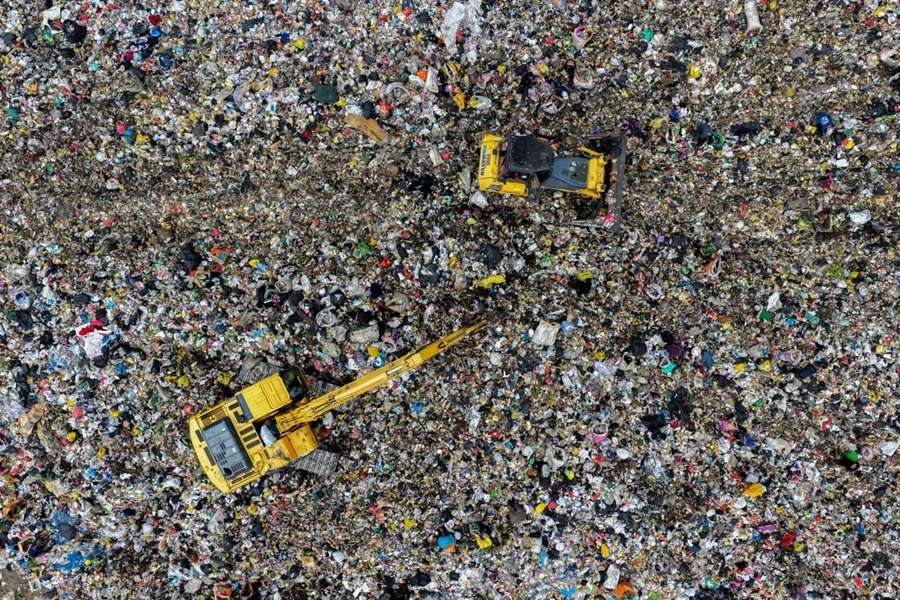
PORTALJABAR, BANDUNG CITY - The West Java Provincial Government, in collaboration with the Bandung City Government, is strengthening waste management from upstream to downstream by targeting a 20 percent reduction at the source. One of the measures being prepared is mobilizing 25,000 students to educate the public in 50 sub-districts in the Greater Bandung area.
West Java Provincial Secretary Herman Suryatman said that this effort was a follow-up to the direction of West Java Governor Dedi Mulyadi for the provincial and district/city governments to strengthen synergy in resolving strategic issues, especially waste and road space management.
This was conveyed by Herman after coordinating with the Mayor of Bandung, Muhammad Farhan, at Bandung City Hall, Thursday (15/10/2026).
According to Herman, the problems in the Greater Bandung area require structured, systemic, and comprehensive action. In addition to the waste issue, the government also faces the challenge of regulating illegal buildings, which must be balanced with risk mitigation and community empowerment measures.
"It can't be done by feeling; it has to be done by design. The heart must be present, and logic must also be present. This means that empirical and scientific approaches must be 'diadu-maniskeun' (combined)," said Herman.
He emphasized that exemplary leadership must be followed by solid bureaucratic governance down to the sub-district and village levels. This way, established policies can be translated into concrete actions on the ground.
Herman assessed that Bandung City and the Greater Bandung area face complex waste management challenges. Various innovations that have been implemented, such as Gaslah and other waste management programs, need to be strengthened by increasing community participation and waste management capacity at the regional level.
One of the concrete steps the West Java Provincial Government has prepared is to optimize the involvement of higher education institutions. Herman stated that his office has established communication with the Higher Education Service Institute (LLDIKTI) Region IV to mobilize students from around 90 universities in Greater Bandung.
The program targets the involvement of 25,000 students who will collaborate with sub-district heads, village heads, neighborhood association (RW) administrators, and other community members in 50 districts in Greater Bandung. Twenty-six of these districts are located in Bandung City, while the remaining districts are spread across the Greater Bandung area.
Students will be involved in direct community education, particularly to encourage food waste reduction, waste sorting, reuse, and recycling from the household.
Herman cited the successful waste management in Arcamanik District, Bandung City, which previously served as a pilot project for government-university collaboration. For three months, students from Bandung Islamic University (Unisba) worked directly in the field and assisted the community.
As a result, according to Herman, the volume of waste in Arcamanik has decreased by around 20 percent, while the amount of sorted waste has doubled. This experience will be replicated in other districts in Greater Bandung.
"If we replicate and strengthen the experience in Arcamanik together, God willing, we are optimistic that a 20 percent waste reduction from upstream can be achieved," he said.
Herman explained that this target has a significant impact, given that Greater Bandung generates an estimated 5,000 tons of waste per day. With a 20 percent reduction, approximately 1,000 tons of waste per day could potentially no longer enter the downstream waste management chain.
"No matter how much technology we develop downstream, our ability to reduce waste upstream must be strengthened. The best way to manage waste is to reduce it, utilize it, and recycle it, starting at home," Herman said.
On the downstream side, the West Java Provincial Government has also prepared a number of steps to maintain the operational continuity of the Sarimukti Final Processing Site (TPA).
Herman said the government had conducted consolidation and studies with several parties, including universities, to mitigate risks and optimize the capacity of these facilities.
One of the steps being prepared is waste compaction, which is planned to last until December 2026. A technical study related to this step has been conducted in collaboration with the Bandung Institute of Technology (ITB), while still taking into account the potential for methane gas and safety aspects.
In addition, the West Java Provincial Government plans to construct two gravity walls at the Sarimukti Landfill to strengthen the embankment structure and reduce the risk of landslides. The procurement process is expected to be underway so construction can begin in early 2027.
The government is also mitigating the increasing leachate problem in the new zone and exploring technical support from the Ministry of Environment. Meanwhile, the development of pyrolysis technology to convert waste into fuel oil is being explored with the Indonesian Army, while the utilization of waste into refuse-derived fuel (RDF) is also being finalized with the private sector.
Herman emphasized that these downstream efforts must go hand in hand with waste reduction at the source. Waste management cannot rely solely on facility development or technology, but requires the involvement of all elements of government, universities, the business world, and the community.
By strengthening cross-government coordination, involving universities, and changing community behavior, the West Java Provincial Government hopes that waste management in Greater Bandung can be more effective while reducing pressure on the Sarimukti Landfill.
 Share News Via
 facebook
 twitter
 whatsapp
 email