

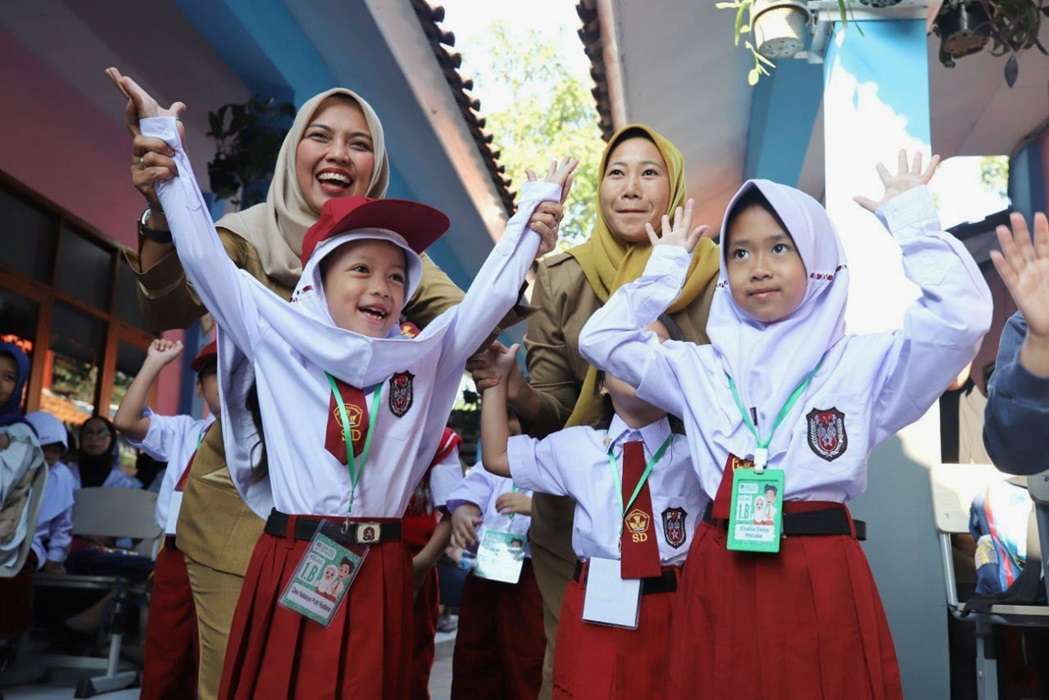
PORTALJABAR, BANDUNG CITY - Changes in the education sector in Bandung City are beginning to be felt directly by the public. The Bandung City Regional Telescope Survey by Kompas Research and Development, conducted from February 23 to March 3, 2026, recorded that 83.8 percent of residents expressed satisfaction with education services, placing it among the sectors with the highest ratings. This finding indicates that the various improvements made are no longer limited to programs but are beginning to be seen in the school environment.
These changes are most noticeable in aspects that are closely related to students' daily lives, from classroom conditions and learning methods to attention to non-academic aspects such as character education and mental health.
Over the past year, the Bandung City Government has strengthened its support for school operations through the Regional School Operational Assistance (BOSDA) program. This support is used to support basic school needs, including teaching and learning activities and daily operations, providing schools with more flexibility to improve the quality of learning.
At the same time, educational facilities are being reorganized in a more targeted manner, particularly in schools with inadequate classrooms or inadequate capacity. Throughout 2025, the Bandung City Government recorded the addition of seven new elementary school classrooms, the rehabilitation of 260 classrooms, the repair of 87 toilets, the construction of 10 drilled wells, and the construction of fortifications or boundary walls at four public elementary schools, totaling 1,330 m².
At the junior high school level, educational facilities were strengthened through the construction of one new school, the addition of 16 classrooms, the rehabilitation of 78 classrooms, the repair of 29 toilets, and the provision of two prayer rooms. These efforts have had a direct impact on improving the comfort of learning while supporting a more effective learning process in the classroom.
Changes are not only occurring in the physical aspects, but also in the learning approach. The Bandung City Education Office has begun promoting the strengthening of character education as part of the learning process, which is currently being implemented in all public junior high schools for grade 9. This program is beginning to show an impact on student discipline, social interactions, and the creation of a more conducive learning environment.
Furthermore, student attention has been extended to mental health. Over the past year, the Bandung City Education Office has begun developing an early detection system for student mental health as a preventative measure to identify potential problems early. This approach has become increasingly relevant amidst growing awareness of the importance of mental health in educational settings.
Meanwhile, access to education continues to be expanded. The educational assistance program for students from vulnerable families reaches approximately 8,379 elementary school students and 14,545 junior high school students, ensuring that no child is prevented from accessing education due to economic factors.
Despite showing a positive trend, a number of challenges remain, particularly regarding equal distribution of education quality across regions, limited school capacity in densely populated areas, and economic pressures that still have the potential to impact the sustainability of students' education.
The Bandung City Education Office stated that the changes currently occurring are beginning to be seen in the most fundamental aspects of education.
"What's starting to be felt now isn't just the program, but the changes within the school itself. From more suitable classrooms, changing learning methods, to attention to students' mental health, all of this is starting to be felt directly by students and parents," he said.
Going forward, the main focus will be on equalizing the quality of education so that its benefits can be felt more widely.
"The next challenge is ensuring this quality isn't limited to certain schools. Therefore, we are focusing on equitable quality, including strengthening schools in areas with limited capacity," he added.
Bandung Mayor Muhammad Farhan emphasized that the education sector will remain a priority in city development.
"Changes in the education sector must be felt directly by students, not just seen on paper. Therefore, we are strengthening support for schools, including through the Regional Operational Assistance Program (BOSDA), so that basic educational needs can be met and the learning process can run smoothly," said Farhan.
"We want to ensure every school has the capacity to thrive, from classroom conditions and the quality of learning to student support, including attention to mental health, which is increasingly important today," he continued.
The Bandung City Government emphasized that strengthening the education sector will continue to focus on areas that most directly impact students, particularly the quality of classroom learning, equitable school conditions, and more comprehensive support for student development, both academically and non-academically. (Bandung City Communications and Information Service/rka)
 Share News Via
 facebook
 twitter
 whatsapp
 email
email