

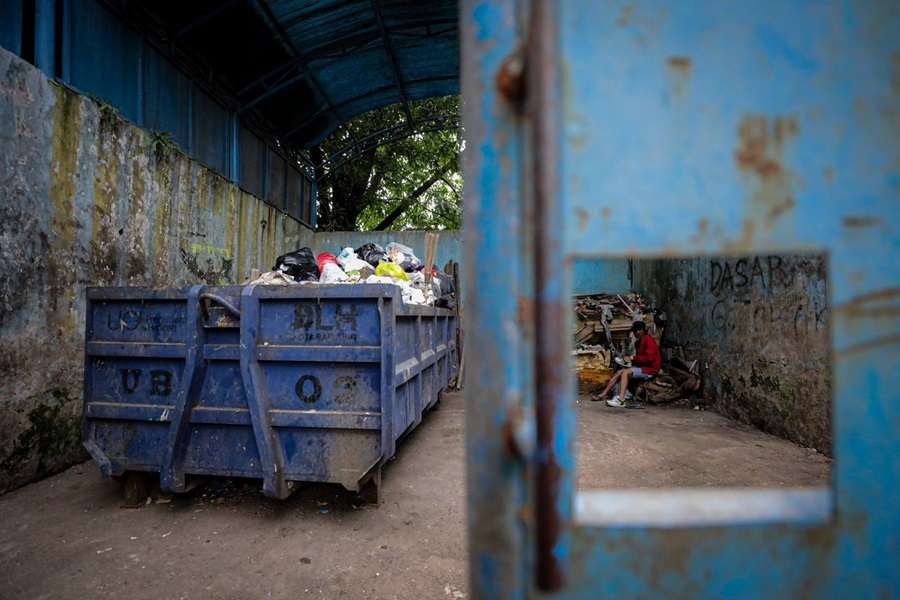
PORTALJABAR, BANDUNG CITY - The Bandung City Government (Pemkot) continues to accelerate waste management by optimizing waste management at the city level. Various strategic steps have been taken, from reactivating facilities to strengthening the community's role in waste management.
Head of the Waste and Hazardous Waste Management Division of the Bandung City Environmental Agency, Salman Faruq, explained that the main strategy being implemented is to reactivate a number of Integrated Waste Processing Sites (TPST) that were previously inoperable due to maintenance.
"The city-scale processing capacity is 100 tons per day, and we hope to complete it within a month. So, our plan is to reactivate the TPSTs that were previously under maintenance, such as those in Nyengseret, Tegallega, and Cicukang Holis," he said on Wednesday (April 29, 2026).
He revealed that a total of six TPST (landfill sites) will be re-optimized. The Environmental Agency (DLH) aims to increase waste processing capacity to 100 tons per day, up from the existing 350 tons. This brings the total waste processing target to 450 tons.
According to Salman, the TPST reactivation process cannot be done instantly because it requires administrative and technical readiness. Currently, the Environmental Agency (DLH) is completing various documents and ensuring infrastructure readiness for optimal operations.
Furthermore, collaboration with various parties is ongoing, including the Indonesian National Armed Forces (TNI). One of the processing facilities, located on TNI-owned land at Secapa, is currently undergoing coordination for its reactivation.
"We continue to communicate to activate the processing technology that has been installed there," he said.
Meanwhile, the Environmental Agency (DLH) continues to promote waste reduction at the source through public education. Organic waste processing, such as composting, maggot houses, and gas processing, is being consistently promoted at the regional level.
Meanwhile, regarding waste transportation to the Sarimukti Landfill, Salman stated that the daily quota is still limited to around 980 tons. However, due to the recent high volume of waste, this quota is expected to be exhausted ahead of schedule.
"By the end of this week, we'll have exhausted our quota. However, we're working to ensure that critical locations continue to be serviced, while other locations are implementing strict scheduling and route arrangements," he said.
Several waste accumulation areas have attracted attention, including the Gedebage Main Market area, which has now been successfully cleaned. However, other areas, such as the former Dago landfill and the Ciwasta area, still require gradual action.
"We are still working on handling the former Dago and Ciwasta landfills," he said.
The Environmental Agency (DLH) is also anticipating the potential influx of waste from outside the city, particularly in border areas. Cross-regional monitoring and coordination are continuously being strengthened to prevent further accumulation.
In the near future, the Indonesian Army will begin testing a waste processing machine. This technology is expected to accelerate waste reduction in the field.
"A commissioning test is planned for early next month. Hopefully, it will help reduce waste, especially in Ciwasta," he said.
Meanwhile, community-based organic waste processing programs like Gaslah have performed quite well. In fact, they often exceed their initial processing target of around 40 tons per day.
"The target of 25 kilograms per person per day, with a cumulative output of around 40 tons, is often exceeded. We just need to ensure optimal post-processing," he said.
The Environment Agency (DLH) is also encouraging the reactivation of organic processing facilities at the regional level, such as composters, perforated bricks, and maggot houses.
If excess capacity occurs, processing will be diverted to designated facilities, including the former Jelekong landfill, which currently serves as a compost and planting medium production site. (Bandung City Communications and Information Service/rka)
 Share News Via
 facebook
 twitter
 whatsapp
 email
email