

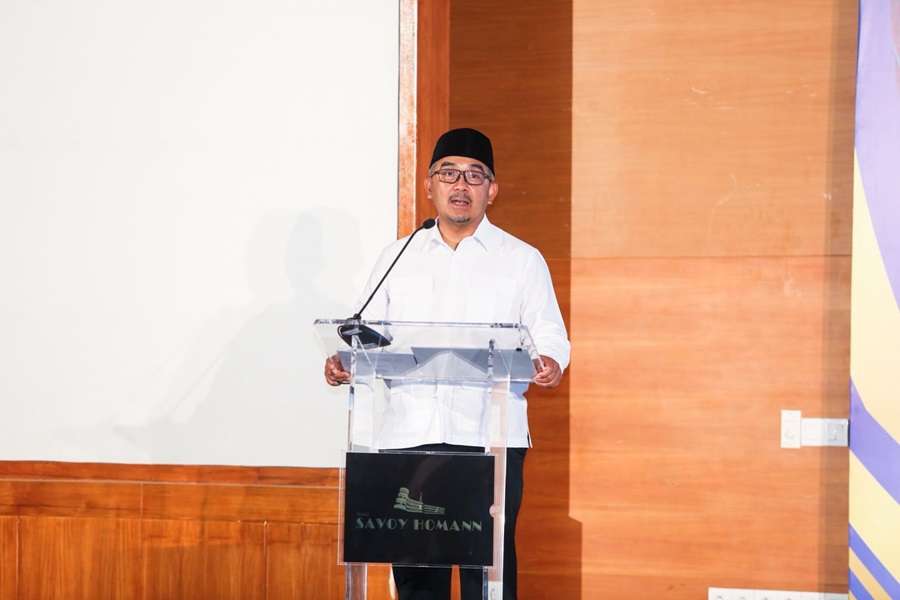
PORTALJABAR, BANDUNG CITY - The Bandung City Government (Pemkot) has begun planning the arrangement of the Alun-alun area and its surroundings into an integrated historic area through the Historic Urban Landscape (HUL) concept.
Bandung Mayor Muhammad Farhan stated that the development of historic areas has been carried out separately. The government, businesses, communities, and building owners have their own interests, so they haven't been integrated into a single area management concept.
"So far, the government has been doing its own thing, the private sector has been doing its own thing, and communities have been doing their own thing. As a result, these beautiful areas haven't been integrated as a single area," Farhan said at the Savoy Homan on Tuesday (October 6, 2026).
According to him, the HUL concept will serve as a foundation for uniting these various interests. At least four elements will be involved: academics, communities, government, and business actors.
Farhan stated that the process cannot be done instantly. The Bandung City Government is targeting the formulation of a comprehensive planning concept by 2027.
"It's impossible to complete everything in a short time. The foundation must be laid first. Without a foundation, things won't grow together, but rather individually," he said.
For the initial stage, the area that is the focus of the development stretches from Simpang Lima to Jalan Otista.
A number of roads that are part or wings of the area include Jalan Lembong, Jalan Braga, Jalan Cikapundung, Jalan Banceuy, Jalan Dalem Kaum, Jalan Otista and Jalan Alkatiri.
Farhan said that the future arrangement will not only beautify the area but also determine how historic buildings and spaces will be maintained, utilized, and developed.
"The concept is currently being formulated together. What will be retained and what will be dismantled must be clear," he said.
One of the problems mentioned by Farhan is the existence of buildings that have historical value but are located in locations that also have regulatory issues.
He cited the example of a building used as a food court on Jalan Asia Afrika, which stands above the Cikapundung River. While the building holds cultural heritage status, regulations prohibit construction on rivers.
"This needs to be debated properly," he said.
Farhan said that while the concept formulation process was ongoing, activities in the area continued.
The Bandung City Government, together with relevant parties, will ensure that road maintenance and transportation infrastructure development, including the BRT, continue without disrupting historical sites.
"The community is welcome to continue operating along this historic road. Business owners are also welcome to conduct their business activities safely in the area," said Farhan.
Meanwhile, Anton Sunarwibowo, Head of the Bandung City Development Planning Agency (Bapperida), stated that the HUL concept does not envision the town square as a standalone area. The area will be connected to several important spaces and buildings, including the Bandung Grand Mosque, the Pendopo (Pendopo), Asia Afrika Street, the Merdeka Building, the Cikapundung River, Pasar Baru, and the surrounding commercial areas.
"The town square is positioned as the center of Bandung's historical landscape, connected to the Grand Mosque, the Pendopo, Asia Afrika Street, the Merdeka Building, the Cikapundung River, Pasar Baru, and the surrounding commercial areas," said Anton. (Bandung City Communications and Information Office/rka)
 Share News Via
 facebook
 twitter
 whatsapp
 email
email