

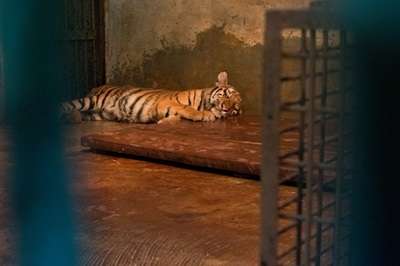
PORTALJABAR, BANDUNG CITY - The Mayor of Bandung, Muhammad Farhan, confirmed that the death of a Bengal tiger cub at Bandung Zoo was not caused by negligence in its care, but rather by a viral infection carried by its mother.
The tiger cub, Hara, reportedly died at the age of 8 months on Tuesday (March 24, 2026). The other cub, Hara, is Huru's twin. The two cubs were born on July 12, 2025, to Sahrulkan and Jelita.
Farhan explained that the mother tiger was a carrier of the virus which was then transmitted to her cubs from birth.
Of the two infected tiger cubs, one could not be saved. The other remains in intensive care.
"It's not because it wasn't cared for, but because of a virus carried by its mother. This is a virus unique to the large cat family," said Farhan at the Leuwipanjang Terminal in Bandung City on Wednesday, March 25, 2026.
He revealed that the virus that attacked was Feline Panleukopenia, a disease that commonly attacks feline family members such as tigers and cats.
This virus is known to cause a drastic decrease in white blood cells, thus making the animal's body condition very weak.
According to Farhan, all the tiger cubs were immediately separated from their mothers as an initial handling step.
While the mother is in good health because she has developed immunity to the virus, her children are still vulnerable.
The Bandung City Government, along with a team of veterinarians, is currently closely monitoring the one surviving tiger cub.
According to the latest reports, the tiger cub's condition is starting to improve.
"The diarrhea is gone, the vomiting has stopped, and he's more active than the day before. He's also started eating," he explained.
Medical treatment was carried out intensively by a team consisting of five veterinarians.
Treatment includes administration of antibiotics, antiemetics (anti-vomiting), rehydration fluids to prevent dehydration, immune supplements, and antivirals.
Farhan said the tiger cub had passed the critical phase for 72 hours, which is an important indicator in the recovery process.
"Usually, once you've passed this critical phase, the chances of continued improvement increase. However, intensive monitoring is still required," he said.
He confirmed that there was no element of neglect in this case. He said all medical personnel were on full alert from the beginning of treatment.
Looking ahead, Farhan emphasized the importance of comprehensive evaluation of animal management, particularly regarding the monitoring of infectious diseases in animals.
"This is an important lesson. This virus is one of the most important concerns in zoos with large cat populations," he said.
The government, both central, provincial, and city, continued Farhan, will ensure that similar incidents do not happen again, while also guaranteeing that the welfare of all animals in the zoo is maintained.
"I'm very concerned and saddened, but this is a serious concern so we can better anticipate future developments," he concluded. (Bandung City Communications and Information Office/rka)
 Share News Via
 facebook
 twitter
 whatsapp
 email
email