

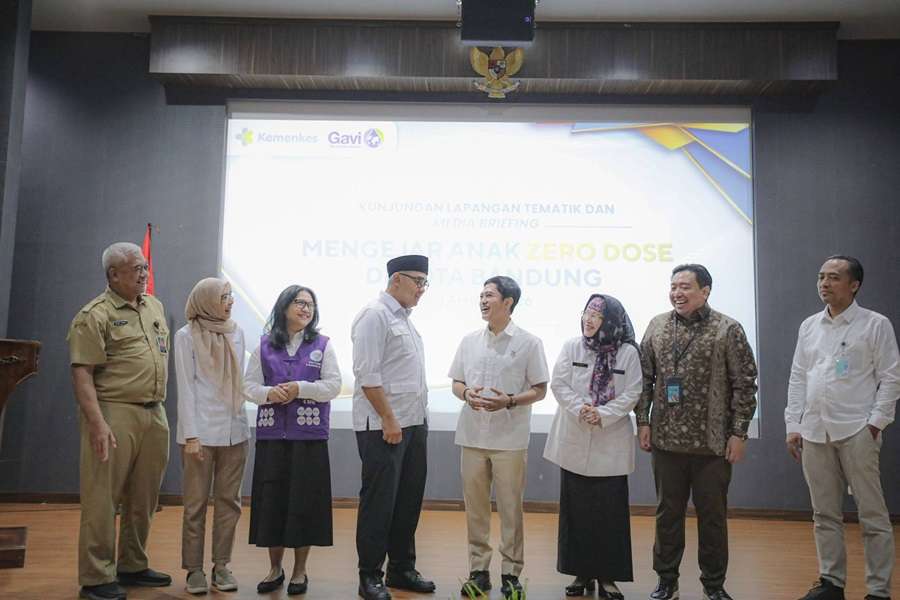
PORTALJABAR, BANDUNG CITY - Bandung Mayor Muhammad Farhan revealed various health challenges facing the city. One of them is the Zero Dose category, which refers to children who have never received a single dose of routine basic immunization vaccines, specifically the DPT-1 vaccine (diphtheria, pertussis, and tetanus) in their first year of life.
"The phenomenon of zero-dose children isn't just a statistic. Behind the term lies the future of children that we must all safeguard," said Farhan.
He made the remarks while accompanying the Deputy Minister of Health Dante Saksono Harbuwono on a working visit during the Thematic Field Visit and Media Briefing on Pursuing Zero Dose Children in the Multi Media Room of the Health Training UPTD of the West Java Provincial Health Office.
Farhan also touched on the major challenges of vaccine rejection and disinformation circulating in society.
He acknowledged that there are still groups in society who refuse immunization due to differences in views or the influence of inaccurate information.
According to him, this problem cannot be solved by the government or health workers alone.
The involvement of community leaders, religious leaders, Integrated Health Posts (Posyandu), academics, the media, and regional administrators such as RW (Neighborhood Association) is needed to build collective awareness.
"360-degree cooperation is crucial to ensure our children's right to basic immunizations is not lost," he said.
Meanwhile, the Deputy Minister of Health of the Republic of Indonesia, Dante Saksono Harbuwono, reminded that Indonesia still faces a serious threat due to the high number of children who have not been immunized.
He stated that by 2025, approximately 2.3 million children in Indonesia would fall into the zero-dose category. These children have not received measles, polio, DPT, or other basic immunizations.
"National immunization coverage is already around 80 percent, but to create herd immunity, a minimum of 90 percent is needed," Dante explained.
He assessed that the continued emergence of measles cases and a number of other infectious diseases indicated that there were still gaps in immunization protection in the community.
On that occasion, Dante appreciated the achievements of West Java Province which succeeded in reducing the number of zero dose children from around 102 thousand children to 67 thousand children in just one year.
"The reduction is almost 40,000 children. This is an extraordinary achievement," he said.
According to Dante, Bandung has a great opportunity to become a national example in zero-dose child care through innovative health services, strengthening Posyandu (Integrated Health Posts), and cross-sector collaboration.
He also called on the mass media to actively disseminate correct education about immunization so that the public does not fall prey to misinformation on social media.
"The media must be part of the solution by presenting accurate information about the importance of immunization," he said.
At the end of the activity, Dante reiterated that maintaining children's health is an important investment for the nation's future.
He hopes that collaboration between the central government, regional governments, health workers, and the community can ensure that all children receive basic health care equitably. (Bandung City Communications and Information Service/rka)
 Share News Via
 facebook
 twitter
 whatsapp
 email
email