

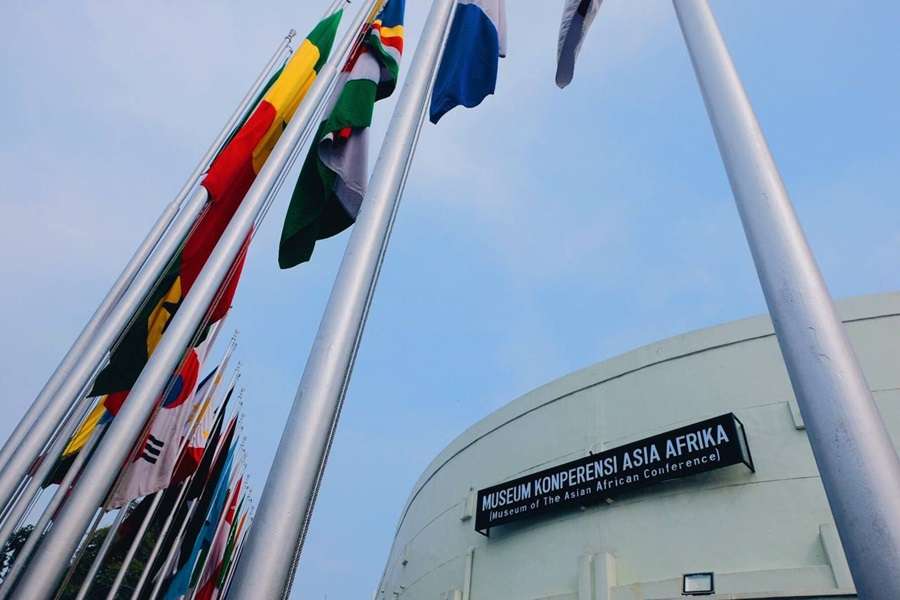
PORTALJABAR, BANDUNG CITY - Exactly 71 years ago, Bandung City recorded an important history by hosting the Asia-Africa Conference (AAC) which took place on April 18–24, 1955.
This event became a great momentum for Asian and African countries to unite to face the legacy of colonialism and reduce global tensions which were mounting at that time.
After World War II ended in 1945, the world did not immediately enter a period of peace.
A number of countries in Asia and Africa are still under colonial rule, while even independent countries are faced with various problems, ranging from internal conflicts to territorial disputes.
At the same time, the world was divided into two major powers in the Cold War era, namely the Western Bloc led by the United States and the Eastern Bloc by the Soviet Union.
This tension has triggered open conflicts in various regions as well as a nuclear arms race that is worrying the world.
In this situation, an awareness emerged among Asian countries to build solidarity.
The idea of holding a conference was born at a meeting in Colombo in 1954.
Indonesian Prime Minister Ali Sastroamidjojo proposed a broader forum involving Asian and African countries.
This proposal received strong support from President Soekarno, who had long championed the unity of the formerly colonized nations.
A significant agreement was then reached at a follow-up meeting in Bogor, which designated Indonesia as the host and Bandung as the venue.
A total of 29 countries were invited to attend the conference, representing a variety of political backgrounds, cultures and systems of government.
In the lead-up to the Asian-African Conference (AAC), intensive preparations were underway in Bandung. The Merdeka Building was prepared as the main venue for the conference.
A number of supporting facilities are also prepared, including accommodation at the Homann Hotel and the Preanger Hotel, as well as transportation and security facilities to support the smooth running of the event.
The city of Bandung is also preparing to welcome thousands of guests from all over the world.
On the morning of April 18, 1955, the atmosphere of Bandung was filled with the enthusiasm of the people who crowded along Jalan Asia Afrika.
Delegates from various countries walked to the conference site in a moment that became known as the “Historic Walk.”
Their presence was warmly welcomed by residents who wanted to witness this historic event firsthand.
The conference was officially opened by President Sukarno at the Merdeka Building. In his speech, entitled "Let a New Asia and a New Africa be Born," he emphasized that although the participating countries had diverse backgrounds, they were united by the bitter experience of colonialism and a shared desire to achieve peace and independence.
The speech received wide acclaim and became a symbol of the spirit of revival of Asian and African countries.
During the conference, various important issues were discussed, ranging from economic cooperation and culture to political and security issues.
Differences of opinion arose, especially in the Political Committee meeting, but the participants were able to resolve these differences through dialogue and deliberation.
The spirit of tolerance and mutual respect is key to ensuring the smooth running of the conference.
After going through a series of sessions for one week, the Asia Africa Conference was officially closed on April 24, 1955.
The main outcome of this conference was an agreement known as the Bandung Principles, namely ten basic principles that emphasize respect for human rights, state sovereignty, equality, and the peaceful resolution of conflicts without violence.
The Ten Principles of Bandung later became an important milestone in international relations and inspired the birth of the non-aligned movement.
Moreover, this conference shows that developing countries are able to unite and play an active role in creating world peace.
To this day, the legacy of the Asia-Africa Conference lives on in Bandung. The Asia-Africa Street area and the Merdeka Building serve as historical symbols, reminding people of the city's crucial role on the global stage.
This event is not only a source of historical pride but also a source of learning for the current generation about the importance of unity, cooperation, and a commitment to world peace. (Bandung City Communications and Information Service/rka)
 Share News Via
 facebook
 twitter
 whatsapp
 email
email