

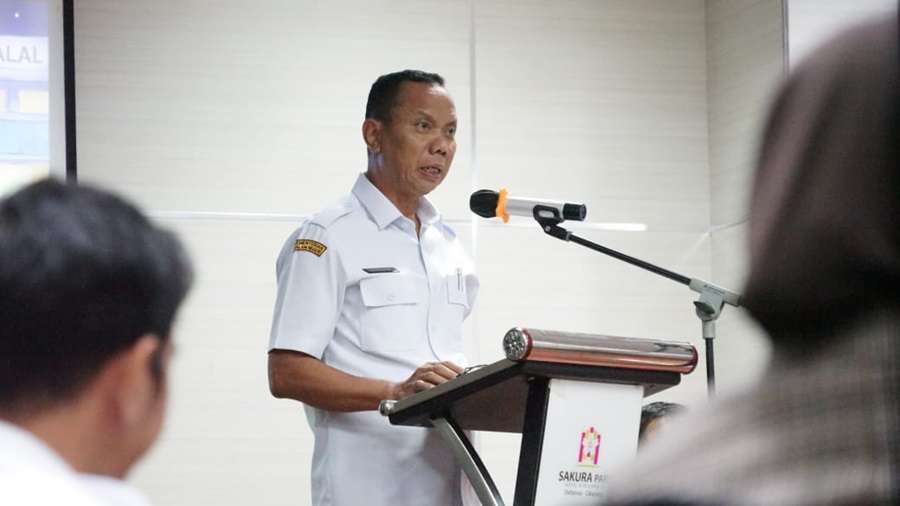
PORTALJABAR, BEKASI REGENCY - The Bekasi Regency Government, West Java, continues to promote the development of a halal ecosystem to provide protection and comfort to the public in consuming food and beverage products and using goods that meet halal requirements.
This effort was conveyed by the Regional Secretary (Sekda) of Bekasi Regency, Endin Samsudin, in a halal ecosystem development activity organized by the Technical Implementation Unit (UPT) of the Halal Product Guarantee Organizing Agency (BPJPH) which took place at the Sakura Park Hotel, Deltamas, Central Cikarang, Wednesday (14/10/2026).
Endin emphasized that the development of the halal ecosystem is not only oriented towards issuing halal certificates, but also building shared awareness among the government, business actors, producers, and the public regarding the importance of halal product assurance.
According to him, all business actors, including micro, small, and medium enterprises (MSMEs), need to be encouraged to obtain halal certification so that consumers can have certainty and protection when purchasing a product.
He explained that halal certification also provides added value for businesses. Consumers tend to trust and choose products with halal certification more than those whose halal status is unclear.
"When there are two MSMEs, one with a halal label and the other without, the public will naturally feel more comfortable choosing the product with the halal label. This means that halal certification can also increase MSME competitiveness and sales," Endin explained.
Endin also emphasized that understanding of halal requirements must be communicated comprehensively. According to him, the government does not intend to prohibit the public or businesses from selling non-halal products, but there must be clear information so consumers can understand the contents and status of the products being offered.
He cited the example of broiler chicken, a widely consumed product. He argued that the industrial-scale slaughtering process requires serious attention to ensure it fully complies with Islamic law.
"Don't just look at the product; you also need to pay attention to the process. For example, when it comes to broiler chickens consumed by the public, how are they slaughtered when thousands of chickens are slaughtered at the company? These things need to be ensured to ensure the public is guaranteed halal," he explained.
Furthermore, Endin said that the halal concept is not enough to only fulfill the halal aspects of the ingredients, but must also pay attention to the principles of halalan thayyiban, namely halal as well as good, safe, and fit for consumption.
Therefore, the existence of the Halal Product Guarantee Agency (BPJPH) is considered to have an important role in providing education, assistance, and supervision of the implementation of halal product guarantees in the community.
Endin hopes that through cross-sector coordination and collaboration, Bekasi Regency can build a halal ecosystem that involves all elements, from local governments, community organizations, halal product process facilitators, MSMEs, to companies and producers.
He also encouraged the Bekasi Regency Government to have regulations and policies that demonstrate a real commitment to supporting the implementation of halal product guarantees.
"We want to build an ecosystem. We need to understand how halal certification can reach MSMEs, producers, and companies involved in food and beverage products. Local governments must also demonstrate their commitment through regulations and policies that support public protection," he stressed.
On that occasion, Endin also explained that there are halal certification mechanisms through the regular route and the self-declaration route for MSMEs that meet the requirements.
Through the free halal certification program, MSMEs can receive assistance from Halal Product Process Assistants (P3H) to assist with the application process and certificate issuance in accordance with applicable regulations.
He believes that the presence of halal assistants needs to be maximized to reach small business owners who currently do not have certification, including food and beverage vendors in traditional markets, residential areas, and activities such as Car Free Day.
According to him, direct outreach to traders is an effective step to increase awareness and expand the scope of halal certification in Bekasi Regency.
"Halal facilitators must be actively involved in the field. Small traders need to be made aware that halal certification can be provided free of charge through government programs for MSMEs that meet the requirements. This way, more MSME products will be guaranteed halal," he said.
Through the development of this halal ecosystem, the Bekasi Regency Government hopes to increase business awareness of the importance of halal certification. In addition to providing consumer protection, this initiative is also expected to bolster public trust and strengthen the competitiveness of local MSME products.
In her presentation, Indrayani emphasized that halal certification is not merely a matter of fulfilling regulatory requirements, but rather an important part of providing certainty and protection to consumers regarding products circulating in the community.
According to him, Bekasi Regency has great potential in developing a halal ecosystem, especially supported by the existence of the micro, small, and medium enterprises (MSMEs) sector, which is one of the drivers of the regional economy.
According to the Ministry of MSMEs' Single Data Information System, the number of MSMEs in Bekasi Regency has reached 376,137. However, the number of businesses with halal certification still needs to be increased.
"Yes, this data, he said, is a shared concern, encouraging local governments and all stakeholders to further strengthen efforts to accelerate halal certification, especially for MSMEs," he said.
He believes that outreach, mentoring, and facilitation of halal certification must be continuously improved to ensure that business owners receive adequate information regarding the certification process and requirements. (Bekasi Regency Communications and Information Office/rka)
 Share News Via
 facebook
 twitter
 whatsapp
 email
email