

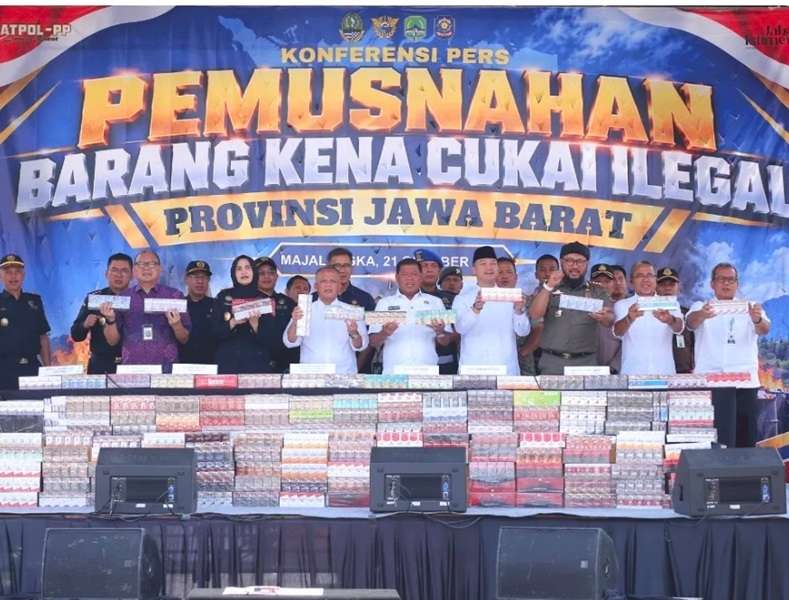
PORTALJABAR, MAJALENGKA REGENCY - The West Java Regional Office of the Directorate General of Customs and Excise (DJBC) together with the West Java Provincial Government carried out the destruction of Goods Belonging to the State (BMMN) resulting from the crackdown on the circulation of illegal cigarettes.
A total of 33.89 million illegal cigarettes were destroyed, with a total value of Rp50,582,902,320 and potential state losses of Rp25,431,617,152. This destruction was the second activity carried out by the West Java Directorate General of Customs and Excise Regional Office in 2026, in collaboration with the West Java Provincial Civil Service Police Unit (Satpol PP).
"The illegal cigarettes destroyed are the result of Customs and Excise action, both through independent activities and through synergy with the West Java Provincial Government in utilizing the Tobacco Excise Revenue Sharing Fund (DBHCHT) to support law enforcement in the excise sector," said West Java Satpol PP Head Akhmad Taufiqurrahman in Bandung, (21/10/2026).
Akhmad continued, the cigarettes destroyed were the result of actions taken between January 2026 and August 2026 and had received approval for destruction from the Minister of Finance through the Directorate General of State Assets.
"The destruction is the final stage of Customs and Excise's enforcement of illegal cigarettes. The symbolic destruction took place at the Majalengka Regency Hall," he added.
Overall, BMMN was taken to PT Mukti Mandiri Lestari (Plan Sadang), Ciwangi, Bungursari, Purwakarta Regency, West Java, to be completely destroyed by crushing, damaging, and burning until it cannot be reused.
Supervisory Performance
From January 1 to September 30, 2026, the West Java Regional Office of the Directorate General of Customs and Excise (DJBC) and the Customs and Excise Supervision and Service Office in West Java successfully conducted 3,243 actions, seizing 88,229,554 million illegal cigarettes worth an estimated Rp152.69 billion. During the same period, five investigations into criminal customs and excise violations were conducted with eight suspects, one of which has been declared complete and has been transferred to the Prosecutor's Office.
In the process of resolving cases of violations in the excise sector, Customs and Excise applies ultimum remedium (UR), namely the use of Indonesian criminal law as a last resort in law enforcement in the excise sector, where criminal sanctions will only be applied if the violation cannot be resolved with administrative sanctions in the form of fines with the aim of deterring the perpetrator and preventing the same action from repeating the same action. During the period of January 1 to September 30, 2026, the West Java DJBC Regional Office recorded 98 UR cases with a value of Rp2.75 billion. Eradicating illegal cigarettes is not only the task of the authorities, but requires the participation of the entire community.
The public is expected to refrain from buying, selling, or distributing illegal cigarettes and to immediately report any indication of excise tax violations. Prevention through raising public awareness is always a better approach than enforcement.
Violations in the Excise Sector
Based on Law Number 39 of 2007 concerning Amendments to Law Number 11 of 1995 concerning Excise, perpetrators of illegal distribution of Excisable Goods can be charged with Article 54. Any person who offers, hands over, sells, or provides for sale excisable goods that do not have excise stamps attached or other excise payment signs shall be punished with imprisonment for a minimum of 1 (one) year and a maximum of 5 (five) years and/or a fine of at least 2 (two) times the excise value and a maximum of 10 (ten) times the excise value that should be paid.
Customs and Excise continues to strive to take firm and uncompromising action against violators through optimal oversight. The open destruction, which can be witnessed in person or online, demonstrates transparency in the fight against illegal cigarettes. Furthermore, Customs and Excise expresses its appreciation to all parties involved, such as law enforcement officers (APH), ministries/agencies, regional governments, and community members who synergistically and collaboratively support the creation of a legal industry, thus supporting national economic growth.
(Rep pun/bhf)
 Share News Via
 facebook
 twitter
 whatsapp
 email