

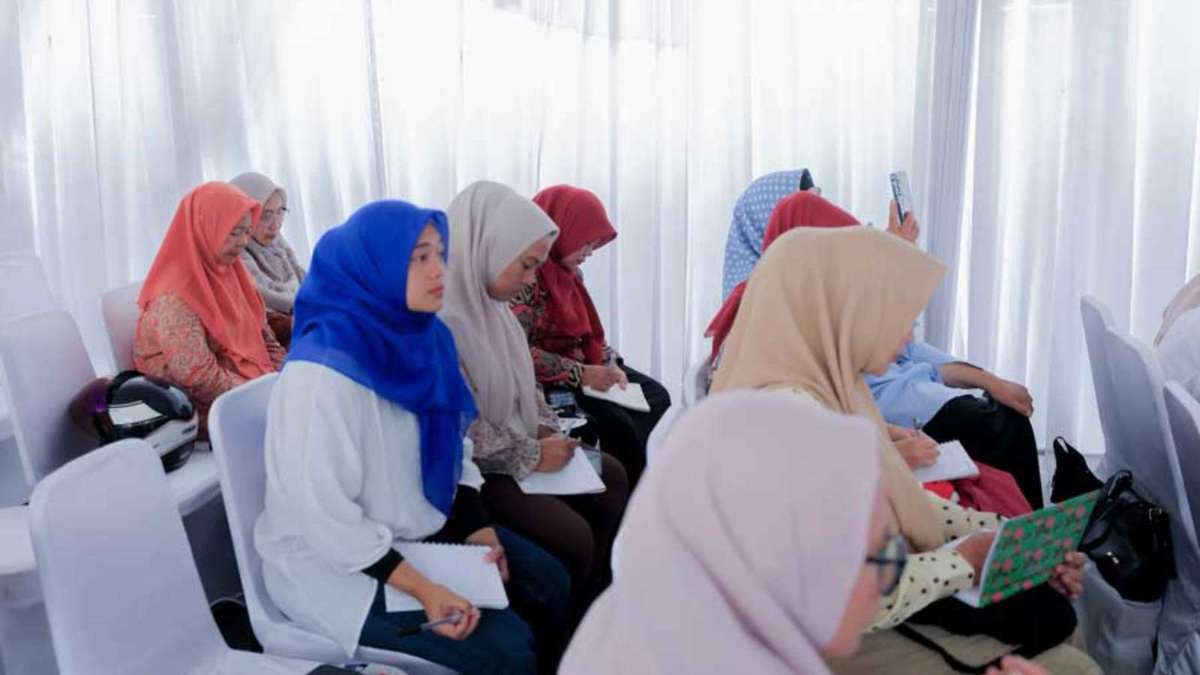
PORTALJABAR, BANDUNG CITY - The Bandung City Government (Pemkot) has officially launched the Bandung Utama Goes to Zero New Stunting program as part of its strengthening of the Stunting Prevention Movement. This is a new step by the Bandung City Government to accelerate stunting reduction through a more comprehensive approach involving all regional officials, regional governments, and the community.
The program launch took place at Yess Coffee, Bandung City, Wednesday (15/7/2026), led directly by the Mayor of Bandung Muhammad Farhan accompanied by the Head of the Bandung City Posyandu TP Aryatri Benarto Farhan.
Farhan stated that stunting can no longer be viewed solely as a matter of malnutrition. The high stunting rate is a systemic issue influenced by various factors, including sanitation and environmental quality, as well as lifestyles.
"Stunting isn't just a matter of breastfeeding or supplementation. It's a very systemic issue. If we want to reduce stunting rates, we must improve not only nutrition but also the environment, sanitation, water quality, and all the factors that influence them," said Farhan.
He revealed that, based on the Indonesian Nutritional Status Survey (SSGI), the prevalence of stunting in Bandung City is still at 22.8 percent, higher than the national target of 16 percent.
According to Farhan, this situation is an alarm for all levels of government to work more seriously and openly in dealing with existing problems.
"If we deny that we have a problem, the problem will become even further from a solution. We must have the courage to acknowledge this situation so we can find a solution together," he said.
Farhan explained that the stunting problem in Bandung is not caused by a lack of food supply. As a service and trade city, Bandung actually obtains food supplies from at least 16 provinces in Indonesia.
"When it comes to food supply, Bandung City has no problems at all. So, perhaps the problem isn't just nutrition. There are other factors we must address together," he said.
He then highlighted a number of issues that are considered to contribute to the high stunting rate, including poor air quality, inadequate sanitation conditions, and the need for continuous improvement in the quality of water sources.
Farhan said that, based on regional data, around 27 percent of houses in Bandung City do not have proper septic tanks, so there is still the potential for open defecation (BABS).
This condition has the potential to affect public health, especially children.
"Problems like this cannot be solved by the Health Department alone. They require collaborative efforts from all regional agencies because they are cross-sectoral," he said.
Therefore, Farhan asked all regional apparatus organizations (OPD), sub-district heads, and village heads to identify problems in their respective areas.
Each region, he said, has different challenges, so the solutions implemented must be adapted to local conditions.
"Regional planning is at the forefront. Some areas have flooding issues, others have sanitation issues, and others have water quality issues. All of this must be mapped to ensure targeted interventions," he said.
He also instructed the Population and Family Planning Control Agency (DPPKB) to optimize Dapur Dahshat in every sub-district as a center for processing nutritious food for pregnant women, breastfeeding mothers, and toddlers who are malnourished.
According to him, food from the Free Nutritious Meals (MBG) program needs to be reprocessed so that its nutritional content truly meets the needs of vulnerable groups.
In addition, Farhan asked the Water Resources and Highways Agency to start mapping river water quality, including conducting tests for Escherichia coli bacteria content at several points in the Cikapundung River as a basis for formulating environmental health policies.
Farhan aims for Bandung City to achieve Zero New Stunting, meaning no new cases of stunting will emerge.
However, he stated that this target is a process that must be achieved through real work, regular evaluation, and collaboration between all parties.
"Zero New Stunting is not a miracle, but a process. Every third Monday of the month, I request a progress report so I know what's working and what needs improvement," he requested.
He also requested that all stunting management programs be data-driven to ensure government assistance is distributed effectively and reaches more families in need.
Meanwhile, the Head of the Bandung City Integrated Health Post (Posyandu), Aryatri Benarto Farhan, said that stunting prevention must be carried out from the time a girl is a teenager until the child enters toddlerhood.
According to him, stunting not only impacts a child's physical growth, but also affects brain development, learning ability, and productivity as an adult.
"Therefore, prevention must start from the family and be strengthened by all elements of society," he said.
Aryatri explained that Posyandu has now transformed into a Posyandu with Six Minimum Service Standards (SPM) in accordance with the Minister of Home Affairs Regulation Number 13 of 2024.
In Bandung City, there are currently 2,004 Posyandu, with 2,003 of them active, supported by 14,797 Posyandu cadres who are the spearhead of community services.
He appreciated the launch of Bandung Utama Goes to Zero New Stunting because it was able to integrate various programs that previously ran independently into a more integrated mentoring system.
"Through collaboration between Posyandu cadres, health workers, PKK, Karang Taruna, regional governments, and all stakeholders, we are optimistic that we can produce a healthy, intelligent, resilient, and competitive generation in Bandung towards Golden Indonesia 2045," he said.
At the same location, the Head of the Bandung City Health Office, Sony Adam, added that the program will be implemented through routine data-based monitoring down to the sub-district level.
Every month, the community health center will submit data on toddlers and pregnant women at risk of stunting to the village head through a by-name-by-address system so that interventions can be carried out in a targeted manner.
In addition to providing supplementary feeding, the toddler's development will also be continuously monitored. If there is no improvement, the case will be discussed in a mini-workshop at the sub-district level to determine the next steps.
"The Health Office, along with all regional offices, will continue to conduct evaluations. With strong collaboration, we are optimistic that Bandung City can achieve Zero New Stunting," said Sony.
(Bandung City Communications and Information Service/rka)
 Share News Via
 facebook
 twitter
 whatsapp
 email
email