

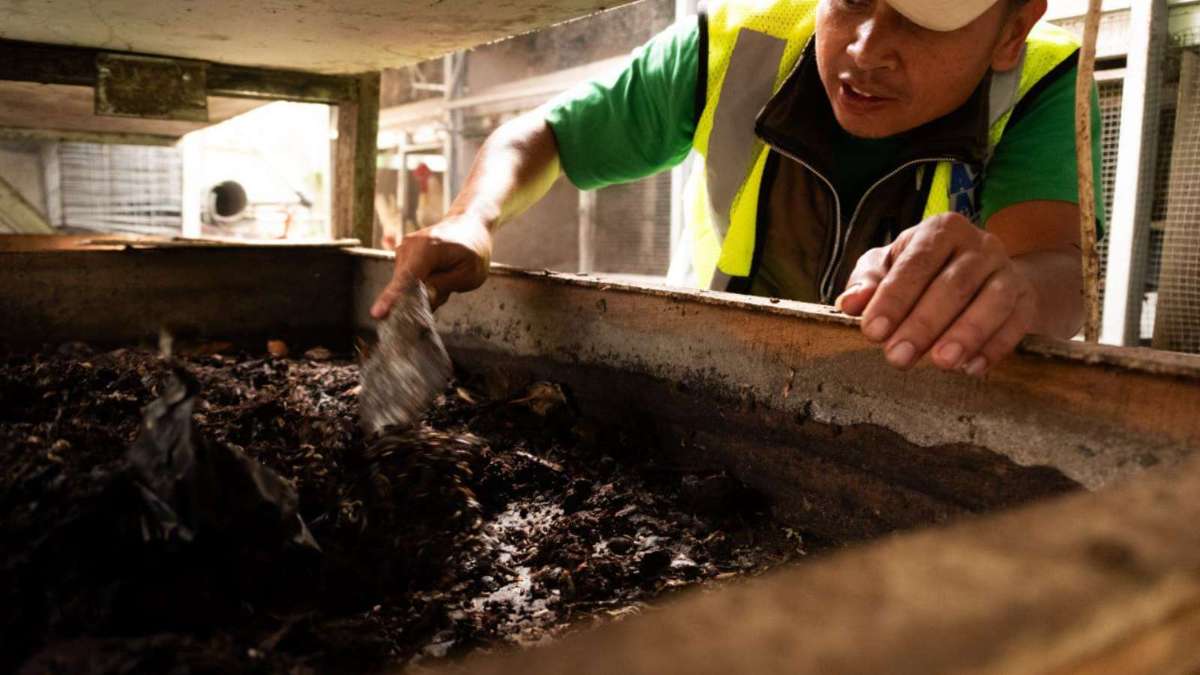
PORTALJABAR, BANDUNG CITY - The Bandung City Government supports the Bersemi Farm innovation by Bandung Institute of Technology lecturer Linus Pasasa in RW 02, Pasirlayung Village to process organic waste into nutritious food sources in the form of eggs, chicken, fish, and ducks through an integrated livestock system based on BSF maggots on 23/6/2026.
This innovation comes amidst Bandung City's recurring waste problems, which require community-based solutions and simple technology that can be applied in residential areas.
Linus Pasasa said, 'As a Bandung resident, I am concerned about the waste problem, and from there, Bersemi Farm was born from waste to nutrition' as the basis for developing this innovation.
The Bersemi Farm concept integrates household organic waste processing with Black Soldier Fly maggot cultivation, which can decompose waste in just 48 hours.
Kitchen waste in the form of vegetable scraps and fruit peels is used as maggot feed, while the maggots are reused as feed for free-range chickens, fish, and Muscovy ducks.
This system creates a circular economic cycle without waste because all processed products are reused to meet the community's food needs.
Unlike composters, which can take up to three months, this maggot system significantly accelerates the decomposition of organic waste.
The Maggot Chicken Apartment is designed vertically to accommodate limited urban land with multi-level cages and maggot cultivation at the bottom.
Chicken manure is also used as an additional source of nutrition for maggots so that the system runs sustainably.
This technology is even equipped with an automatic egg harvesting system that flows chicken eggs into a collection container so they don't break when collected.
Currently, the Bersemi Farm facility is capable of processing up to 300 kilograms of organic waste per day, while the waste production of RW 02 residents only reaches 50 to 75 kilograms per day.
This amount is still below the Bandung City Government's target of 25 kilograms of organic waste processing per RW per day.
Due to the still available capacity, Linus is opening up opportunities for other areas in Bandung City to utilize the waste processing facilities.
"We've deliberately built a large capacity so that if there are other areas that don't have organic waste processing facilities, their waste can be brought here and no longer ends up in landfills," he said.
This program not only relies on technology, but also collaboration between the Bandung Institute of Technology, the Bandung City Government, Pasirlayung Village, the Environmental Service, the Gasla Team, the Bersemi 02 Waste Bank, the PKK, and the community who are disciplined in sorting waste from home.
Organic waste is processed into maggot feed, while inorganic waste is sorted through waste banks so that the residue disposed of at the final disposal site is very minimal.
The success of Bersemi Farm has begun to attract the attention of various parties and has become a pilot model for community-based waste management in the city of Bandung.
Several areas such as Bandung Wetan, Lebak Siliwangi, Tamansari, and Cipadung have begun adopting a similar concept to reduce the burden of urban waste.
Even the Ministry of Housing and Settlements has made a visit to study the integrated livestock-based waste management model.
Linus emphasized that the main goal of this innovation is to build a new culture of waste management starting from the household level so that people do not depend on landfills.
"We hope this idea can be adopted throughout Indonesia, because organic waste should be managed environmentally and transformed into a source of food and economic resources," he said.
Rahayu Wijayanti, Head of RW 02, Pasirlayung Subdistrict, said that changes in residents' behavior began in 2023 through education on waste sorting using simple composters.
However, significant changes occurred after the Gasla Program was launched in early 2026, which strengthened community-based waste management in the region.
Residents are now accustomed to sorting organic waste into two categories, namely food scraps for chicken feed and kitchen waste for maggot feed.
"Thank God, people are starting to get used to sorting their waste. I'm even learning how to process waste so it can be useful," said Rahayu.
This innovation is expected to be a sustainable solution to reduce Bandung City's waste burden while strengthening community food security based on a circular economy.
(Bandung City Communications and Information Service/bhf)
 Share News Via
 facebook
 twitter
 whatsapp
 email
email