

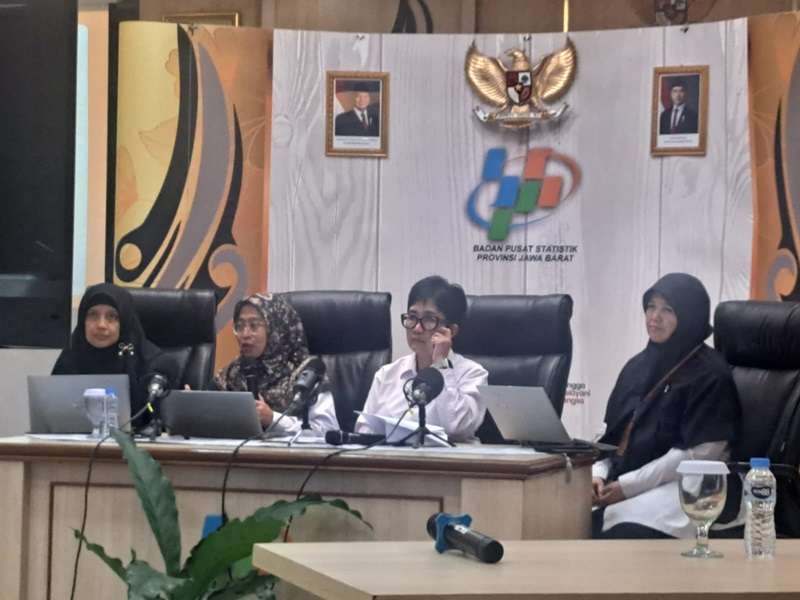
PORTALJABAR, BANDUNG CITY - The West Java (Jabar) economy grew 5.79 percent in the first quarter of 2026 compared to the first quarter of 2025 (year-on-year). On a quarter-to-quarter (q-to-q) basis, the West Java economy also grew 0.24 percent in the first quarter of 2026 compared to the fourth quarter of 2025.
Head of the West Java BPS, Margaretha Ari Anggorowati, stated that West Java's year-on-year economic growth was even higher than the national economic growth of 5.61 percent.
The highest sources of growth or contribution from the business sector were contributed by the industrial sector at 1.65 percent, transportation at 0.81 percent, infocom at 0.58 percent, accommodation and food and beverage at 0.51 percent, and trade at 0.45 percent.
The highest sources of growth or contribution from the expenditure side were contributed by household consumption at 3.27 percent, government consumption at 1.82 percent, gross fixed capital formation at 1.06 percent, and consumption by non-profit institutions serving households (LNPRT) at 0.04 percent.
"West Java's economic growth is supported by household consumption. Household consumption, combined with West Java's large population, is a driving force for current economic growth," said Margaretha at the West Java Statistics Office's Official News Release on Tuesday (May 5, 2026).
The government's policy of not increasing the price of subsidized fuel oil amidst the Iran-US-Israel war also strengthened West Java's economic growth.
"Iran's role against America and Israel is influential, but the government is struggling to grow the economy," said Margaretha.
Employment conditions are improving
Employment figures are also encouraging. In February 2026, West Java's employed population reached 25.10 million, an increase of 0.11 million from February 2025. The largest employment sector was wholesale and retail trade, with 5.47 million people, or 21.81 percent.
On the other hand, the percentage of underemployment decreased by 0.09 percent, namely from 7.57 percent in February 2025 to 7.48 percent in February 2026. Likewise, part-time workers experienced a decrease of 0.17 percent compared to February 2025.
Meanwhile, the open unemployment rate in February 2026 was 6.64 percent, down 0.10 percent compared to February 2025, which was 6.74 percent.
The three business sectors with the largest employment absorption are wholesale and retail trade, industry and agriculture, forestry and fisheries.
"The agriculture, forestry, and fisheries sectors still have the potential to boost the economy and create jobs," said Margaretha.
 Share News Via
 facebook
 twitter
 whatsapp
 email
email