

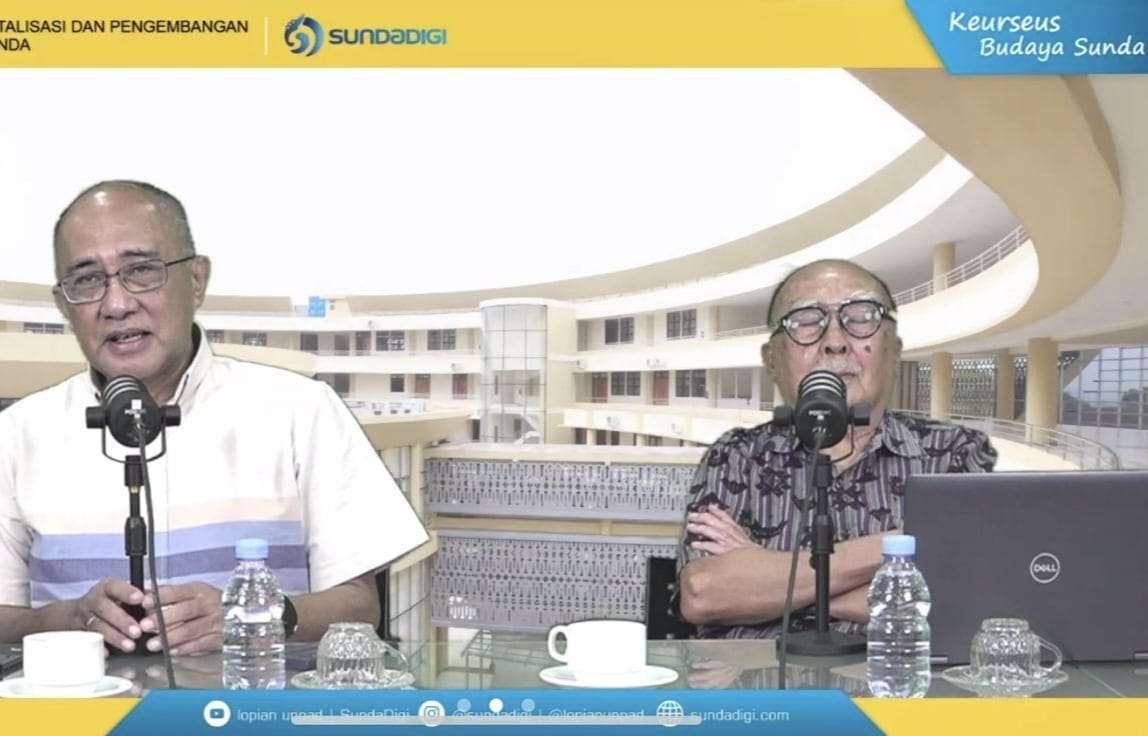
PORTALJABAR, BANDUNG CITY - Professor Emeritus of Geology, Faculty of Earth Sciences and Mineral Technology, ITB, RP Koesoemadinata, said that artifacts found in northeastern Bandung, such as obsidian fragments, polished stone tools and pottery, indicate the existence of a civilization that has existed since the Neolithic era. until about 300 years ago.
"This finding confirms that Ki Sunda's ancestors worked in the metal industry and stone tool trade," said RP Koesoemadinata in a discussion on the Prehistory of Bandung and the Origins of Ki Sunda, Wednesday (31/7/2024).
Koesoemadinata said that prehistoric artifacts were found around the Bandung basin, especially obsidian fragments found on hills more than 725 meters above sea level.
These findings indicate the existence of an ancient lake known as Lake Bandung, which also appears in the Sundanese legend "Sasakala Sangkuriang".
"According to research by Van Bemmelen (1934), this ancient lake was formed due to the damming of the Ancient Citarum River by a flow of volcanic ash from the powerful eruption of Mount Tangkuban Parahu after the collapse of Mount Sunda Purba," he said.
Koesoemadinata said that the latest research shows that the oldest lake deposits are 125 thousand years old, with the Plinian eruption occurring around 105 and 55-50 thousand years ago.
However, the results of modern geological research with radiometric dating show that it is unlikely that early settlers witnessed the damming of the lake or the birth of Mount Tangkuban Parahu.
"It makes more sense that they witnessed the second Plinian eruption around 55-50 thousand years ago," he said.
Chair of the Unpad Center for Digitalization and Development of Sundanese Culture, Prof. Dr. Ganjar Kurnia emphasized the importance of further archaeological research with radiometric dating to determine when Ki Sundanese ancestors lived around Lake Bandung.
“Many artifact-rich sites are now turning into modern residential areas, emphasizing the need for strong political support to continue research,” he said.
According to him, the history of Bandung has been inhabited since the Microlithicum or Mesolithicum era continuously until the Hindu era.
Sites north of Bandung, especially Dago Pakar, show that Ki Sunda's past culture included the metal industry.
To complete the history of Ki Sunda scientifically, it is necessary to carry out excavations and radio-isotope dating at sites that have been discovered.
Ganjar concluded that the results of geological research and radio-isotope dating have given rise to various speculations about the origins of Mount Ki Sunda and Lake Bandung.
"This speculation can be considered as a working hypothesis for further research, which is expected to reveal more about the ancient history of Ki Sunda and Bandung," he said.
 Share News Via
 facebook
 twitter
 whatsapp
 email
email