

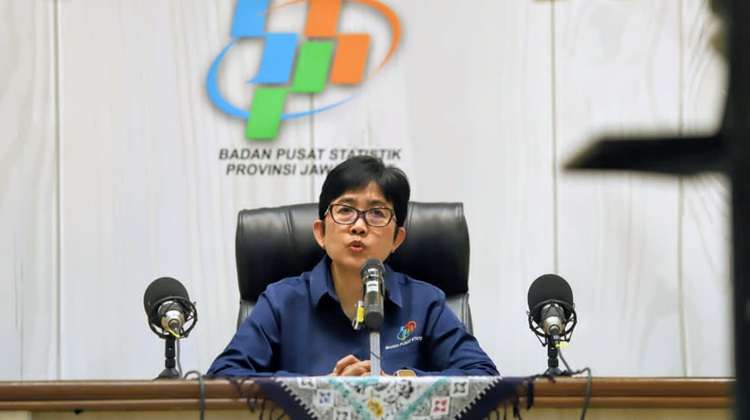
PORTALJABAR, BANDUNG CITY - The West Java Central Statistics Agency (BPS) recorded that West Java experienced monthly or month to month inflation of 0.81 percent, and annual inflation or year to date of 0.72 percent.
February marks the start of Ramadan, driving up the prices of several staple commodities in the consumer market, including bird's eye chilies, which experienced a price spike. Global gold prices also continued to show an average upward trend.
However, inflation was slightly restrained by the reduction in the price of non-subsidized fuel oil, which took effect on February 1, 2026.
Meanwhile, West Java's year-on-year inflation in February 2026 reached 4.71 percent, significantly higher than the year-on-year inflation in February 2025, which actually experienced deflation of 0.27 percent.
The Head of the Statistics Indonesia (BPS) of West Java Province, Margaretha Ari Anggorowati, stated that the high year-on-year inflation in February 2026 was due to the low base effect of electricity tariff discounts last year. The February 2025 electricity tariff discounts applied to both prepaid and postpaid customers.
"However, if the impact of electricity is excluded from the calculation, year-on-year inflation in February 2026 was only 2.65 percent," he said in a statistical release at his office on Monday (2/3/2026).
According to BPS monitoring in West Java Province, all 10 regencies/cities experienced monthly inflation. Tasikmalaya City experienced the highest inflation at 0.97 percent, while Bandung and Depok City experienced the lowest inflation at 0.65 percent each.
"Based on commodities contributing to inflation, gold jewelry contributed the highest inflation in February 2026, at 0.21 percent. Furthermore, cayenne pepper, broiler chicken, rice, and shallots also contributed the most," Ari explained.
NTP Also Increases
The increase in the prices of some horticultural commodities had an impact on the increase in the Farmer Exchange Rate (NTP) in February 2026. The NTP was recorded at 117.29, an increase of 1.40 percent compared to January 2026, which was 115.67.
The increase in the NTP was due to the price index received by farmers (IT) increasing by 2.27 percent, higher than the increase in the price index paid by farmers (IB) which was 0.85 percent.
"The commodities that predominantly influenced the price increase (IT) were cayenne pepper, red chili, and unhusked rice. Meanwhile, the commodities that influenced the price increase (IB) were broiler chicken, cayenne pepper, and shallots," explained Ari.
In line with the NTP, the Farmer's Business Exchange Rate (NTUP) also increased. The NTUP in February 2026 was recorded at 121.87, a 2.08 percent increase compared to January 2026. This was due to a 2.27 percent increase in the index received by farmers, while the production cost index and additional capital goods index experienced a slight increase of 0.18 percent.
"Commodities influencing the increase in the production cost index and the addition of capital goods are the increase in the price of broiler chicks (DOC), threshing wages, and harvesting wages," said Ari. (guh)
 Share News Via
 facebook
 twitter
 whatsapp
 email
email