

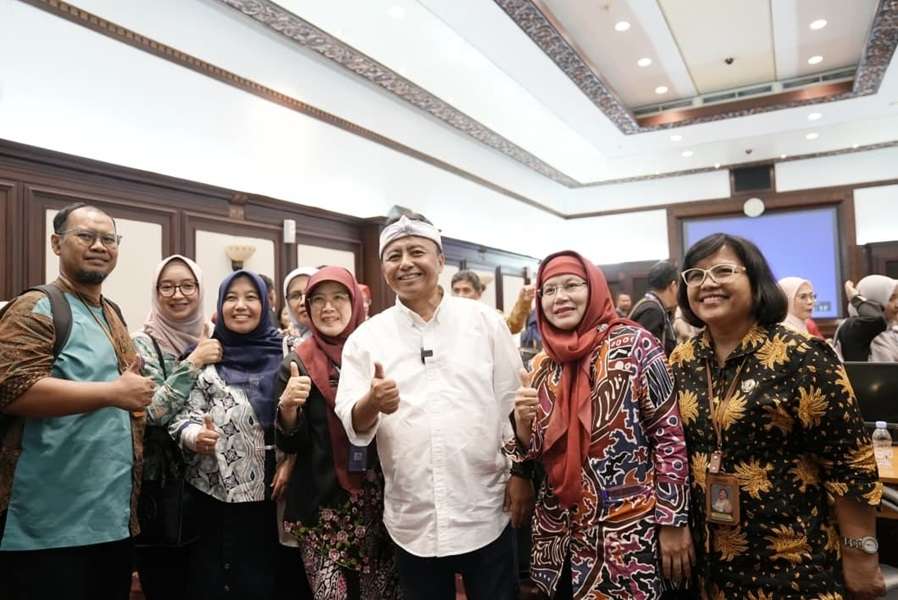
PORTALJABAR, BANDUNG CITY - The Regional Secretary (Sekda) of West Java Province (Jabar) is strengthening an integrated movement to accelerate the handling of tuberculosis (TB), pregnant women with chronic energy deficiency (KEK), and malnourished toddlers.
According to Herman, these three health issues are priorities that must be addressed concretely, without waiting for new programs or projects.
This was stated by Herman Suryatman when leading a consolidation with 27 heads of district/city health services in the Health Services Monitoring and Evaluation activity, in the Papandayan Meeting Room, Gedung Sate, Bandung, Thursday (15/10/2026).
Herman said that his party wants West Java to be free of tuberculosis, pregnant women with special economic zones (KE), and malnourished toddlers by 2029. He emphasized that these achievements must be pursued through collaborative efforts from all elements of government and society.
"Don't delay when it comes to health matters. Don't wait for programs, don't wait for projects. Whatever we can do, do it," said Herman Suryatman.
Regarding TB management, Herman stated that West Java has identified approximately 226,000 cases, out of the Ministry of Health's projected target of 230,000 cases. This achievement is a crucial step in identifying patients and breaking the chain of transmission in the community.
According to Herman, the large number of identified cases should not be viewed as a failure. Instead, open case finding is a crucial foundation for TB management, as undetected cases have the potential to continue transmitting the disease.
The next step is to ensure that all identified patients receive consistent treatment for six months according to the prescribed regimen by healthcare professionals. Herman emphasized that medication is readily available at the community health center, so the next challenge is ensuring patients complete their treatment.
"The formula is: find, treat. If treatment is consistent, God willing, recovery will occur. The most important thing is to ensure that residents suffering from TB take their medication regularly," he said.
In addition to tuberculosis, the West Java Provincial Government is prioritizing the treatment of pregnant women with chronic energy deficiency (CED) and malnourished toddlers. Herman stated that of the approximately 900,000 pregnant women in West Java, an estimated 90,000, or around 10 percent, experience CED. Meanwhile, approximately 76,000 toddlers have been identified as malnourished.
Herman emphasized the importance of meeting animal protein needs for pregnant women and toddlers, including through the consumption of eggs, fish, meat, and milk. For pregnant women living in special economic zones (KE), he cited the example of supporting daily egg consumption as a nutritional intervention that can be tailored to the needs and circumstances of the beneficiaries.
For well-off families, education and awareness-raising are key steps to ensuring they can independently meet their nutritional needs. Meanwhile, less well-off families need assistance through various available resources, including the regional budget (APBD), government programs, and support from the National Zakat Agency (Baznas) and the community.
"If you can't afford it, report it to the village head. We'll work together to help. Don't let financial constraints prevent pregnant women and toddlers from getting the nutrition they need," Herman said.
He explained that managing pregnant women with special needs (KE) and undernourished toddlers is also a fundamental step in preventing new cases of stunting. Nutritional support from pregnancy through early childhood needs to be strengthened to prevent the problem from developing into a long-term health issue.
Herman stated that the stunting prevalence rate in West Java had decreased significantly from 21.7 percent in 2023 to 15.9 percent in 2024, demonstrating the effectiveness of various programs to accelerate stunting reduction in the region.
He also stated that this achievement is the result of collaborative efforts between the provincial and district/city governments. The West Java Provincial Government hopes to reduce the stunting prevalence to below 10 percent this year.
To accelerate interventions, the West Java Provincial Government will optimize the West Java One Data (SADA Jabar) platform as a tool to identify targets, verify data, and connect community needs with available support.
Data from the National Single Social and Economic Data (DTSEN) will be combined with health department data and information from district/city, sub-district, and village and urban village governments. Herman cautioned that the data needs to be verified in the field, as differences in update times can lead to discrepancies in beneficiary status.
Therefore, the health department is being asked to mobilize community health centers and midwives, while regional officials, from sub-district heads to village heads, are being encouraged to conduct direct verification. If targets are confirmed to be appropriate, interventions must be implemented immediately. If discrepancies are found, data needs to be updated.
The West Java Provincial Government is also encouraging the formation of an integrated team to actively seek out and assist residents in need, including pregnant women in special economic zones (KE), malnourished toddlers, and out-of-school children. This initiative relies not only on government funding but also leverages mutual cooperation, community resources, the business sector, and support from various institutions.
Within the West Java Provincial Government, support is also being prepared through the involvement of civil servants (ASN) in assisting targeted families. Beneficiary mapping and mentoring are underway to ensure that the support provided aligns with needs on the ground.
Herman emphasized that the success of a health program cannot be measured solely by budget size or the number of activities implemented. The key measure is tangible changes felt by the community, from TB patients completing treatment, pregnant women receiving adequate nutrition, to toddlers growing healthily.
"Government is for the people. We must work together to ensure that no pregnant women suffer from chronic energy deficiency, no toddlers suffer from malnutrition, and that West Java can be free of tuberculosis. The sooner the better," said Herman.
 Share News Via
 facebook
 twitter
 whatsapp
 email