

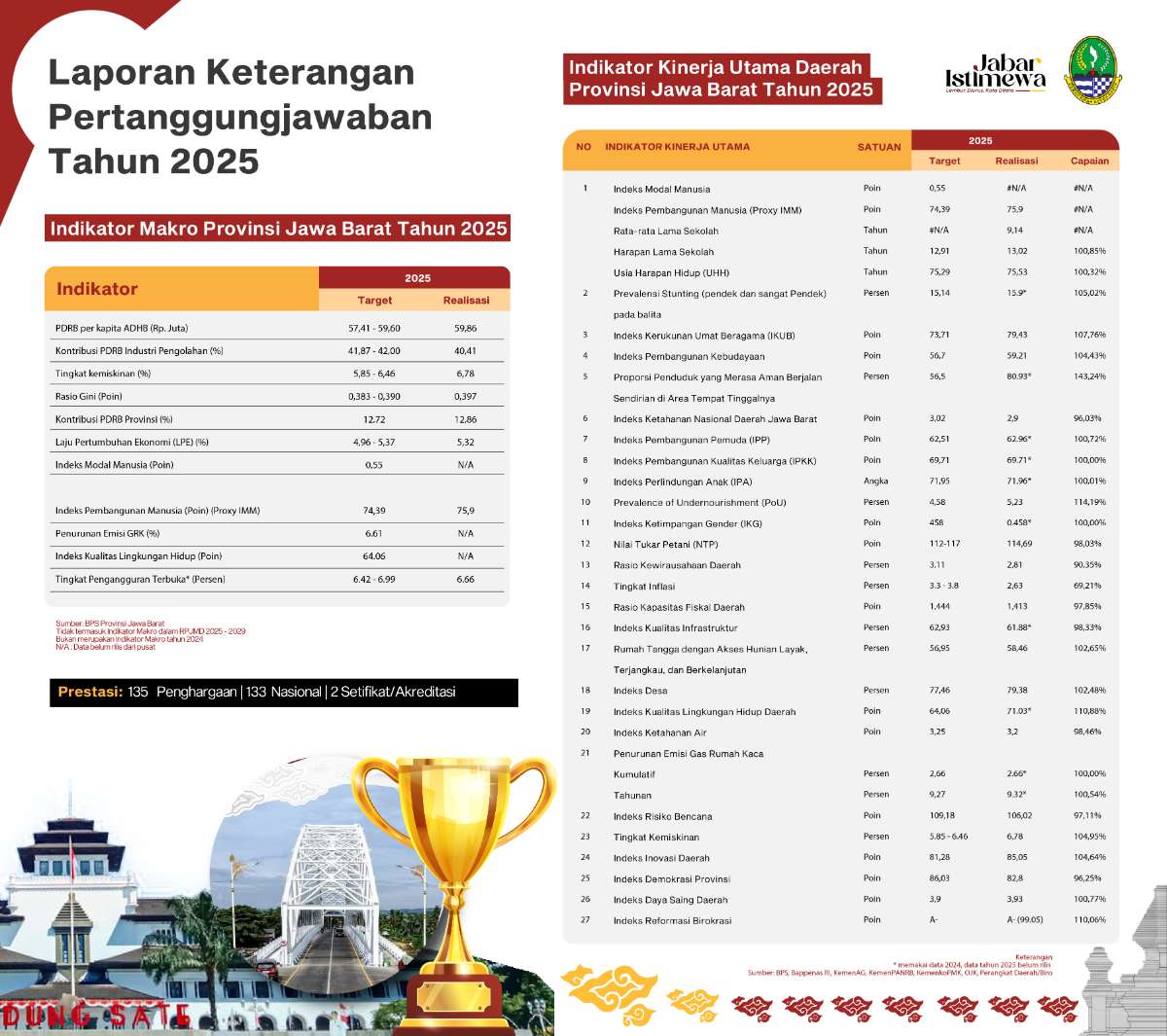
PORTALJABAR, BANDUNG CITY - West Java's Human Development Index (HDI) will increase to 75.9 points in 2025, up from 74.92 points the previous year. This achievement also exceeds the established target of 74.39 points.
The Head of the West Java Regional Development Planning Agency (Bappeda), Dedi Mulyadi, stated that the increase in the 2025 HDI is supported by improvements in all of its constituent dimensions, namely health, education, and a decent standard of living.
In the health sector, the West Java Provincial Government has successfully reduced the infant mortality rate to 6.67 per 1,000 live births. Furthermore, life expectancy has increased to 75.53 years, indicating improvements in the quality of health services and overall public well-being.
In the education dimension, expected years of schooling increased to 13.02 years. Average years of schooling also showed a positive trend, reaching 9.46 years in 2025, exceeding the target of 9.35 years and increasing by 0.22 years compared to the 2024 figure of 9.24 years.
To strengthen these achievements, the West Java Provincial Government is implementing various strategic interventions at the secondary and special education levels. Through the Regional Education Operational Assistance (BOPD), financial support is provided to 578,196 high school students, 367,040 vocational high school students, and 9,376 special education students.
In addition, the Universal Secondary Education Assistance (BPMU), which is under the authority of the West Java Provincial Education Office, was distributed to 261,488 high school students, 667,298 vocational school students, and 19,975 special needs students as an affirmative instrument to maintain sustainable access to education and reduce the potential for school dropouts.
Additional interventions were carried out through the Pancawaluya Personal Scholarship, which reached 3,503 high school students, 5,662 vocational school students, and 235 special needs students to support students from underprivileged families.
Operational support for educational units was also strengthened through the Educational Unit Operational Assistance (BOSP) which reached 1,715 high schools, 2,884 vocational schools, and 391 special schools in West Java.
In terms of infrastructure provision, the local government has completed the construction of 11 New School Units (USB) and 722 new classrooms and student practice rooms to increase capacity and improve the quality of learning. Furthermore, furniture has been provided to 397 schools, 224 classrooms have been renovated to ensure adequate learning facilities, and 290 toilets have been built to support school sanitation and environmental health standards.
Overall, strengthening interventions in the health and education sectors contributes directly to improving the quality of human resources in West Java. Synergy between education financing policies, expanding access to services, and developing school infrastructure are crucial factors in driving increases in average years of schooling and expected years of schooling, key components of the 2025 Human Development Index (HDI).
Future efforts
The West Java Provincial Government will continue to strive to improve the Human Development Index (HDI) by increasing the distribution of educational facilities and infrastructure through the addition of new school units, classroom improvements, and character-based education.
Digitalization of learning will also be implemented to reduce the gap in education quality between cities and districts through standardized digital learning platforms.
In the health sector, improving health facilities and human resources will be the focus of the West Java Provincial Government in the future.
In addition, improving primary services and implementing clean and healthy living behaviors (PHBS) as preventive efforts to improve public health.
"We also continue to strive to increase per capita spending by increasing public consumption and increasing income," said Dedi.
 Share News Via
 facebook
 twitter
 whatsapp
 email
email