

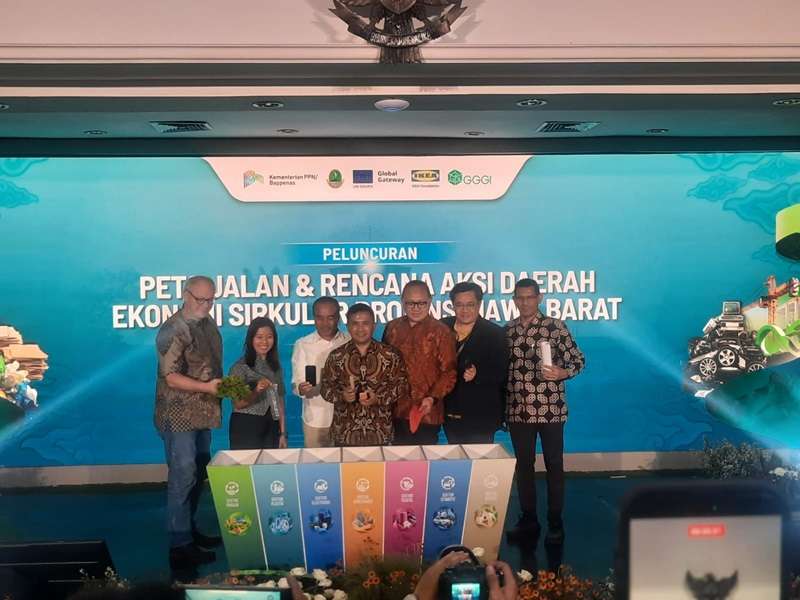
PORTALJABAR, BANDUNG CITY - The West Java Provincial Government together with the Ministry of National Development Planning (PPN)/Bappenas and the Global Green Growth Institute (GGGI) launched the Regional Action Plan (RAD) for the Circular Economy and the Food Loss and Waste Reduction (FLOWER) Program 2025 - 2045. The program was launched to reduce food loss and waste (FLW).
Teguh Sambodo, Deputy for Food, Natural Resources, and the Environment at the Ministry of National Development Planning/Bappenas, said that through this program, the community is encouraged to have awareness, responsibility, and innovation that allows them to manage waste from production to consumption responsibly.
This program is part of a regional program funded by the IKEA Foundation with areas of India, Mexico and Uganda, which adopts a foodshed approach, with the aim of addressing the entire value chain in a specific geographic focus, from food production, through distribution and processing, to the end of food consumption.
West Java was chosen as a pilot project for the FLOWER program because it has both challenges and great potential in food loss and waste.
According to a Bappenas study in 2024, food losses in West Java reached 47.79% of the FLW at the provincial level.
The Greater Bandung area contributes to 1.5 million tons of food waste annually as it is the third largest metropolitan area in Indonesia and is estimated to be home to around 9.3 million residents by 2025 while hosting 7.7 million tourists (by 2023).
In Indonesia, it is estimated that FLW, between 2000 and 2019, ranged from 1.44–31.8% of total food produced in various food commodity groups (e.g., horticulture, fisheries, livestock, and others).
Teguh said the Ministry of National Development Planning/Bappenas has launched the 2025-2045 National Circular Economy Roadmap and Action Plan (RAN-ES), which can be an approach to reducing waste generation and utilizing resources more sustainably.
RAN-ES focuses on five priority sectors: food, construction, electronics, textiles, and retail (plastic packaging). These five priority sectors represent nearly one-third of Indonesia's GDP and provided jobs to more than 43 million people in 2019.
West Java then added two leading sectors: paper and automotive. Both sectors are considered to make significant contributions to the regional economy.
"We appreciate West Java Province for being willing to be a pilot and a lighthouse for other provinces in developing and implementing a circular economy," Teguh said after the launch at the West Java Regional Development Planning Agency (Bappeda) Office in Bandung on Tuesday (September 29, 2026).
Climate change
Food loss and waste (FLW) is a major contributor to climate change, accounting for 8–10% of global greenhouse gas (GHG) emissions. In addition to emissions, FLW depletes resources and threatens food security, wasting nearly 30% of global agricultural land and freshwater.
Food losses during various stages of production and transportation (food losses) and food wasted during the distribution and consumption stages (food waste)
contribute significantly to economic losses and environmental impacts.
The Regional Assistant for Economic Affairs and Development of the West Java Regional Secretariat, Sumasna, said that food waste is one of the serious challenges facing West Java.
"In downstream matters, it turns out that 45 to 50 percent of the waste that goes to the landfill is food waste, food scraps," said Sumasna.
Given the current waste management system in the area, especially with the Sarimukti Final Processing Site (TPA) nearing maximum capacity, intervention in the upstream segment to reduce FLW is necessary to maintain environmental sustainability.
The FLOWER program will be organized by the Ministry of National Development Planning/Bappenas and implemented by GGGI. The Regional Development Planning Agency (Bappeda) of West Java Province is proposed as the primary stakeholder and beneficiary of this program, given its role as a multi-sectoral authority in the province.
The program will coordinate with various stakeholders from the government and private sectors, as well as academia, to ensure synergy and avoid overlap with other initiatives.
The Ministry of National Development Planning/Bappenas, in collaboration with the West Java Provincial Development Planning Agency (Bappeda), will provide general direction regarding the Program's implementation. A Project Steering Committee (PSC) is planned to be established to guide the implementation process and produce contextual and appropriate solutions.
The committee will also be operationalized through coordination with the cross-ministerial Circular Economy Steering Group (CESG) to be formed and led by Bappenas, specifically the Food Sector Working Group under it.
 Share News Via
 facebook
 twitter
 whatsapp
 email
email