

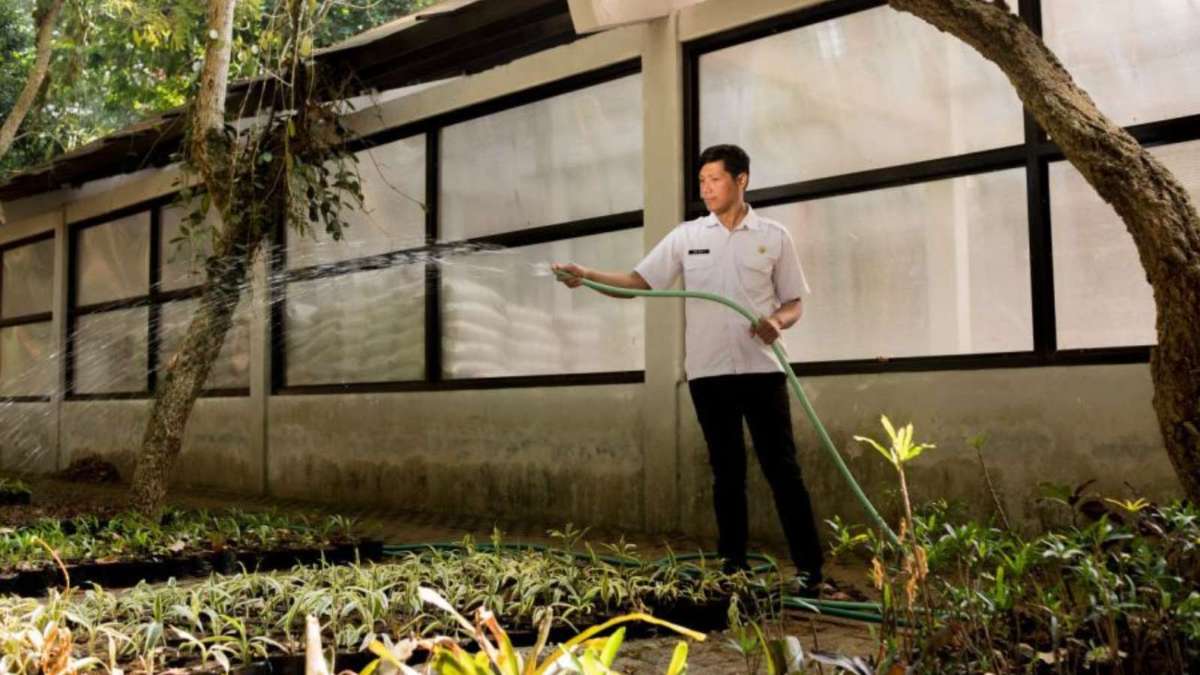
PORTALJABAR, BANDUNG CITY - The Bandung City Government (Pemkot) continues to maintain the existence of green open spaces and beautify the city environment through independent production of ornamental plant seeds.
This effort was carried out by the Plant Nursery Technical Implementation Unit (UPT) under the Bandung City Housing and Settlement Agency (DPKP). This UPT is tasked with increasing ornamental plant seedlings to meet the needs of city parks, road medians, and requests from various regional agencies.
Acting Head of the Bandung City Plant Nursery Unit, Dian Garnadi, said that seedling production is one of the efforts to ensure the availability of ornamental plants in various public spaces.
"This Nursery Unit is tasked with cultivating ornamental plant seedlings. These will be planted along road medians, sidewalks, and in parks, and some will also be distributed to applicants in areas such as sub-districts and districts," said Dian at the Bandung City Plant Nursery Unit on Wednesday (August 12, 2026).
According to him, the needs of Bandung City Government-owned parks are a priority. Meanwhile, individuals or institutions wishing to obtain plants can submit applications following established procedures and based on stock availability.
"Primarily, we serve the landscaping sector, improving our gardens first. If there's a request, we'll provide it based on the plants available here," he said.
The plants provided to applicants are also free of charge. However, this service is currently primarily intended for regional-level institutions, such as sub-districts, districts, and other regional institutions.
Each application must be accompanied by an official letter. The release of the plants is then recorded in a handover report as part of the administration and stock control process.
Interestingly, the nursery process at the UPT uses an independent plant propagation system. When plant stocks begin to dwindle, staff don't immediately purchase new seedlings but instead take portions of existing plants in several city parks and propagate them further.
Dian explained that one of the methods used is cuttings. Plants that are already tall enough in city parks or on roadsides are selected to take parts that can be developed into new seedlings.
"For production and reproduction, we take cuttings. We take the seeds from city parks, such as Maluku Park, Pramuka Park, roadsides, or sidewalks. Once the plants have grown taller, we take cuttings and then propagate them here," he explained.
This pattern allows the crop production cycle to continue. The resulting seedlings are then nurtured until they are ready to be planted or distributed.
However, Dian acknowledged that weather conditions can impact plant availability. During the prolonged dry season several years ago, for example, officials had to source plants outside the region because some crops in Bandung City were experiencing drought.
"During the long dry season two or three years ago, we even went as far as Ciwidey and Subang to search because of the extreme drought," he said.
The seeding process starts from preparing the planting media, such as soil, compost and manure. After that, the seedlings from the cuttings are planted in polybags and undergo a maintenance process.
If pests are present, the plants will first be treated to ensure healthy growth. Once roots have begun to develop and the plants are deemed strong enough, the seedlings can be distributed to the applicant.
"We start from scratch. We take cuttings from available seedlings, then prepare polybags and planting media. Once the roots have emerged and the plants are healthy, they can be distributed," he said.
Ideally, seedlings take about three weeks to germinate before being distributed to applicants. However, in practice, plants are often picked up after about a week when they are deemed ready.
This means that the Nursery UPT service not only plays a role in providing plants for the internal needs of the Bandung City Government, but also supports reforestation at the regional level.
In addition to ornamental plants commonly used to beautify gardens, the Nursery UPT also provides a number of types of plants that are considered suitable for the character of the Bandung City landscape.
Some of them are used as decorations for roads and public areas, including plants that are synonymous with the city of Bandung, such as patrakomala.
"The type of plant is usually adapted to the street name or concept. There's Soka, and then there's Bandung's signature plant, Patrakomala," Dian explained.
For regional institutions wishing to acquire plants, the procedure is relatively simple, provided the administrative requirements are met. Applicants can submit applications online or in person, and plants will be provided based on availability.
Dian said that this service is part of the government's service to the public and is free of charge.
"It's free, because it's government-run. The employees are also paid by the government," he said.
(Bandung City Communications and Information Service/rka)
 Share News Via
 facebook
 twitter
 whatsapp
 email
email