

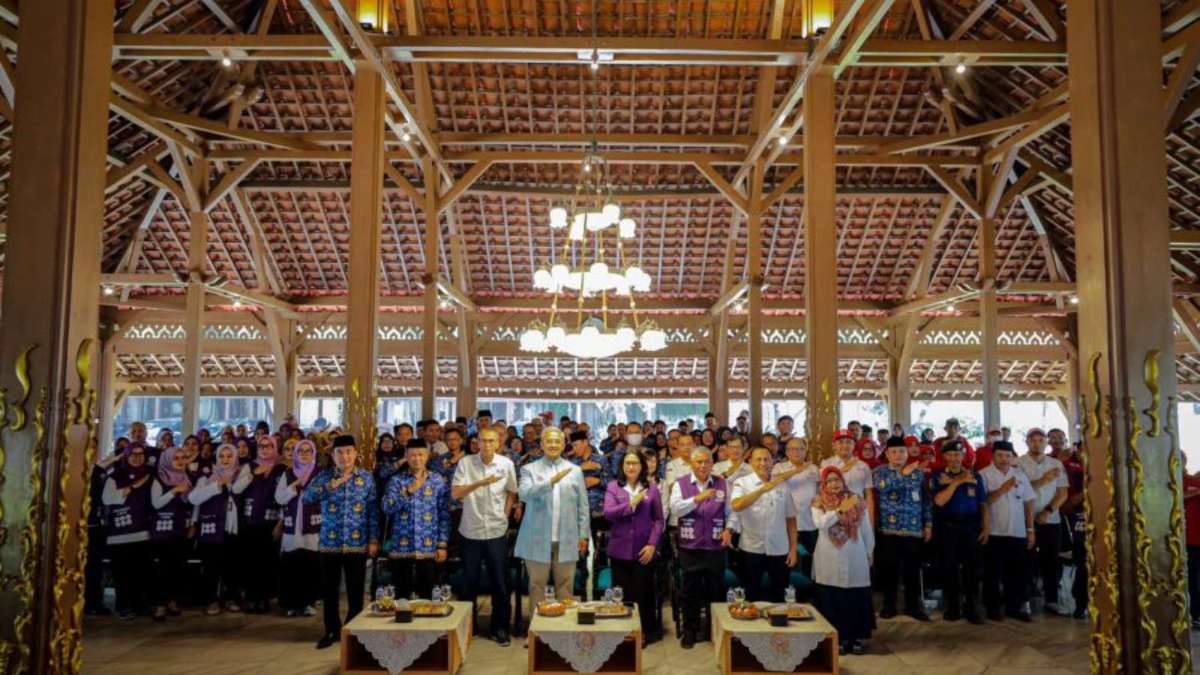
PORTALJABAR, BANDUNG CITY - The Bandung City Government (Pemkot) is encouraging the strengthening of collaboration between the Indonesian Red Cross (PMI) and the Bandung City Integrated Health Post (Posyandu) Advisory Team through the launch of the Posyandu Volunteer Unit (Keswandu).
The launch of Keswandu was also marked by the signing of a memorandum of understanding between the Indonesian Red Cross (PMI) of Bandung City and the Bandung City Integrated Health Post (Posyandu) Advisory Team. The program aims to strengthen the role of Posyandu volunteers and cadres in providing services to the community, particularly in health, social, and emergency response.
Bandung Mayor Muhammad Farhan said the collaboration was a concrete effort to build a disaster-resilient community.
According to him, a disaster-resilient community is not only measured by its ability to cope with major disasters like earthquakes, floods, or landslides. Resilience is also evident in how quickly a community responds to various disruptions in daily life, including traffic accidents and fires.
"A community's resilience to disasters is determined by how we respond to various disruptions to daily life. Even traffic accidents can be categorized as a disaster," said Farhan at the Bandung City Hall on Thursday (September 17, 2026).
He cited the example of handling a traffic accident involving many people. He argued that the involvement of the police, TNI (Indonesian National Armed Forces), volunteers, health workers, and other stakeholders demonstrated the importance of coordination in responding to emergencies.
Farhan stated that the emergency response system in Bandung City is currently capable of responding in less than 15 minutes. In some situations, response times have reportedly reached around eight minutes.
"This means our capacity to become a disaster-resilient society is already strong. We can only hope to God Almighty that a major disaster will not occur in Bandung. However, that doesn't mean we shouldn't be vigilant," he said.
Farhan believes that the existence of Keswandu is important because it brings together the strengths of PMI and Posyandu, which already have networks of volunteers and cadres down to the regional level.
He hopes that this collaboration will not stop at ceremonial activities but will produce concrete and measurable programs.
"Specifically for Posyandu, I ask that they truly focus on learning to utilize the knowledge, expertise, and experience of the Indonesian Red Cross in providing knowledge and expertise transfer on health care," he said.
He believes the Indonesian Red Cross (PMI) has experience and capacity in humanitarian care, while Posyandu (Integrated Health Posts) has direct contact with the community. Collaboration between the two is believed to strengthen services from the city level down to the community level.
Farhan also highlighted the important role of Posyandu in supporting the fulfillment of six Minimum Service Standards (SPM) ranging from health, education, public works, public housing, public order and security to social.
One of the issues of concern is environmental sanitation. Farhan stated that sanitation issues are not just about cleanliness, but also relate to changes in behavior, infrastructure, settlement systems, and social conditions.
Therefore, he said, these various problems require collaboration between many parties.
"No single actor, including the mayor, can do everything. I'm not Superman. Collaboration is key to how Bandung can address its various problems," he said.
Meanwhile, the Secretary of the Bandung City Integrated Health Post (Posyandu) TP, Momon Ahmad Imron Sutisna, said that PMI and TP Posyandu are both government partner institutions that have volunteer and cadre networks at the regional level.
According to him, there is a overlap in the duties of PMI volunteers and Posyandu cadres, particularly in health and social services. Therefore, synergy between the two is expected to optimize public services.
"The presence of PMI volunteers at Posyandu will assist Posyandu, particularly in the health and social sectors, in providing blood donor data for pregnant women at risk of giving birth, recruiting potential blood donors, and promoting family care, as well as improving the skills of Posyandu cadres in providing first aid," said Momon.
He explained that the implementation of Keswandu would involve various elements at the regional level, starting from sub-districts, urban villages, community health centers, TPPKB field officers, TP PKK, TP Posyandu, sub-district PMI, RW and RT heads to Posyandu cadres.
In addition, PMI volunteers such as Siaga, Voluntary Corps (KSR), Junior Red Cross (PMR) and blood donor families are also expected to be involved.
Because Keswandu is a relatively new innovation in Bandung City, Momon said that outreach needs to be carried out in a sustainable and tiered manner.
"Hopefully, this collaboration will further accelerate everyone's understanding of Keswandu and improve the technical capabilities of PMI volunteers and Posyandu cadres in supporting Keswandu activities in the field," he said.
Meanwhile, the Head of the PMI Bandung City, Ade Koesjanto, said that the collaboration was not just a document signing but a commitment to expand humanitarian services to the community.
"Posyandu (Integrated Health Posts) have a very strategic position because they are close to families and communities. This is where we can implement prevention, education, support, and community health services from within the immediate environment," said Ade.
He explained that the PMI wants to expand its role beyond being present during disasters or emergencies. Through Keswandu (Community Empowerment and Disaster Management), the PMI hopes to participate in preventative measures and increase community preparedness before emergencies occur.
"We hope that Keswandu can be part of a joint movement to build a healthier, more resilient, and more caring community in Bandung City," he said.
Ade emphasized that the program's success requires the involvement of many parties. The government, the Indonesian Red Cross (PMI), Posyandu (Integrated Health Post) cadres, volunteers, and the community must work together to ensure faster and more widespread health and humanitarian services.
"After the launch, there must be a concrete program, stronger cadres, closer service delivery, and a community that increasingly feels the benefits," he said.
He hopes that Keswandu will be the beginning of sustainable humanitarian collaboration from the city, sub-district, village, neighborhood association (RW) to the family level.
"A drop of blood, a million hopes for others. One act of caring, a million benefits for society," said Ade.
(Bandung City Communications and Information Service/rka)
 Share News Via
 facebook
 twitter
 whatsapp
 email
email