

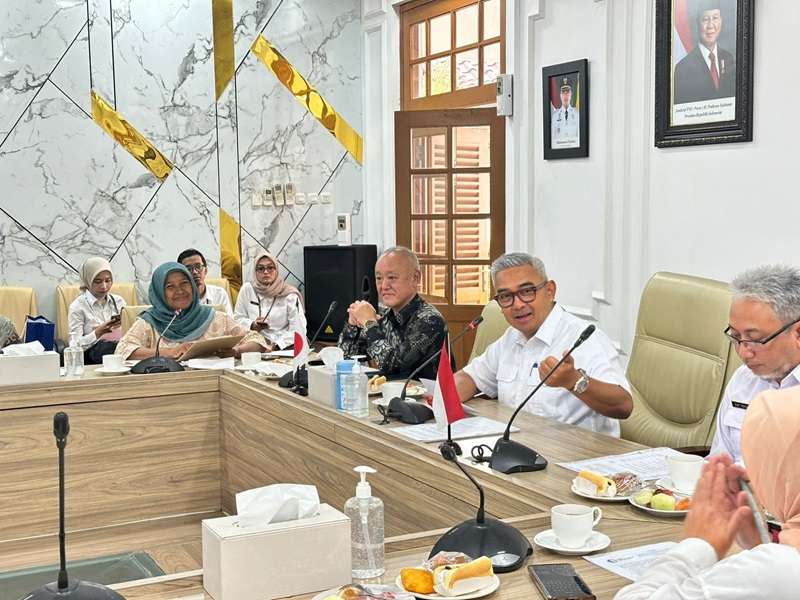
PORTALJABAR, BANDUNG CITY - The collaboration between the cities of Bandung and Kawasaki, Japan, to improve the water environment continues to show positive results. This was conveyed by Misu Yukihiko, Manager of the International Project Promotion Unit, in a presentation on the progress and achievements of the technical cooperation project known as the BKG (Bandung City and Kawasaki City Gesuido Project).
In his presentation, Misu highlighted the main challenges facing domestic wastewater management in Bandung. Currently, more than 80 percent of Bandung still relies on wastewater piping and septic tanks.
However, problems are still found, such as pipe connections that are not properly connected so that household waste flows directly into the river, and septic tanks that are not pumped regularly and have the potential to leak.
"Therefore, we believe that increasing public awareness is an important point that must be included in this project," said Micu at the Bandung City Hall on Wednesday (January 21, 2026).
The BKG project involves several regional agencies in Bandung City, including the DSDABM (District Water Resources Management Agency), the DPKP (Regional Water Resources Development Agency), the Environmental Agency (DLH), and Perumda Tirtawening. The main goal is to increase the knowledge and capacity of city government staff, regional companies, and the community regarding water environmental improvement, while also disseminating these best practices to the wider community.
During the three years of implementation, 13 activities were conducted in Bandung City, involving 54 staff from the Kawasaki City Government. Conversely, Bandung City staff also participated in five training sessions in Kawasaki, with a total of 25 participants. In total, approximately 50 meetings were held, both in Bandung and Kawasaki.
Various outputs were achieved. For the first output, the project team developed educational materials for staff and the community, including videos and visuals with specific characters to ensure easy-to-understand messages.
The second output was capacity building for wastewater management stakeholders, with two staff training sessions attended by 172 people. As a result, 84 percent of participants experienced increased understanding.
The third output focused on increasing public awareness. Two seminars were held, involving 338 fourth-grade elementary school students and their parents. Survey results showed that 89 percent of participants reported increased understanding after the seminars, and three months later, 80 percent had begun implementing behavioral changes in their daily lives.
Regarding sustainability, Misu emphasized the importance of a chain mechanism for disseminating knowledge. Trained counterparties are expected to train other staff, who will then pass on the education to the wider community.
Going forward, there are three main focuses that are expected to continue: ongoing training for staff, capacity building at the district level, and the provision of educational materials for learning in elementary schools.
"We hope this mechanism will take root in the Bandung community and eventually spread to wider areas across Indonesia," said Misu. (Bandung City Communications and Information Office/rka)
 Share News Via
 facebook
 twitter
 whatsapp
 email