

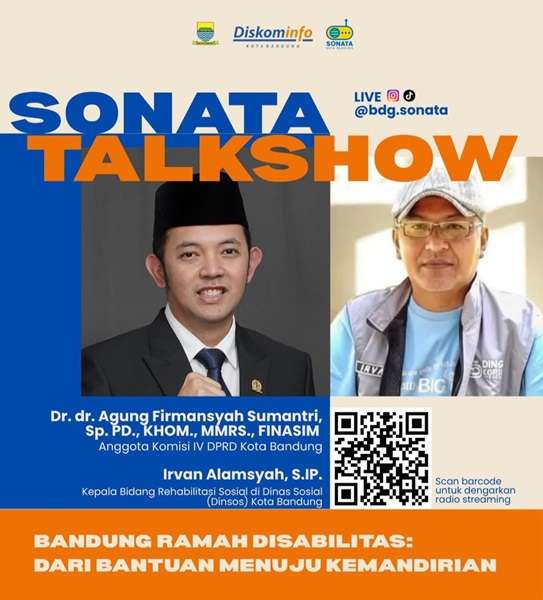
PORTALJABAR, BANDUNG CITY - Bandung continues to promote a friendly and inclusive environment for people with disabilities. These efforts are not only carried out through social assistance but also aimed at fulfilling rights, providing opportunities, and strengthening independence.
This was discussed in the Sonata Talkshow, Wednesday (7/10/2026), by presenting Member of Commission IV of the Bandung City DPRD, Dr. dr. Agung Firmansyah Sumantri, Sp. PD., KHOM., MMRS., FINASIM, and Head of the Social Rehabilitation Division of the Bandung City Social Service, Irvan Alamsyah, S.IP.
Irvan stated that the Bandung City Government has shown concern for fulfilling the rights of people with disabilities. He noted that since he joined the Social Services Agency in 2023, these efforts have continued, including through existing regulations in the city.
"We have a 2019 Regional Regulation to fulfill and respect the rights of people with disabilities. This regulation and its derivatives are already in place and are ongoing," Irvan explained.
In its implementation, Irvan explained, the Social Services Department mitigates the various needs of people with disabilities, including those of working age.
According to him, one of the challenges still faced is that not all companies understand how to provide suitable workspace.
"One of the problems is that companies don't really understand where they want to place people with disabilities and what kind of work they'll do," he said.
Irvan added that job opportunities for people with disabilities are also beginning to be realized within government agencies. At the Bandung City Social Services Agency, two blind people currently work as PPPK (Community Empowerment Personnel), one as a social worker and one as a social counselor.
"This means the Bandung City Government has made a commitment. Even during recruitment, we've provided opportunities for people with disabilities," he said.
Beyond employment issues, Irvan highlighted the importance of registering people with disabilities. He stated that, based on the Social Services Department's DTSN data, there are currently around 30,000 registered people with disabilities.
However, according to him, this number does not necessarily reflect the entire situation on the ground because there are still people who are not open about the condition of their family members.
"In our opinion, these figures still don't reflect the full situation. One reason is that the stigma in society remains very strong," he said.
Therefore, Irvan stated that education is one of the ongoing steps. "In the past two years, we have begun educating and opening up the public to the idea that people with disabilities have the same rights as us," Irvan said. He noted that this process has led to growing public awareness, including the increasing number of proposals for assistive devices and regional food aid through recess and development planning meetings (musrenbang).
Irvan emphasized that support for people with disabilities extends beyond aid. The Social Services Department also provides social guidance for people with disabilities, children with special needs, and families of people with disabilities.
"We're doing more sharing. The resource persons can be medical personnel, psychologists, community organizations, or parents who can share their experiences and best practices," he explained.
According to Irvan, this sharing space can help families and caregivers so they don't feel like they are facing challenges alone.
This effort later evolved into the idea of providing daycare for children with disabilities. Irvan explained that the idea was discussed during a discussion with the Bandung City RBM regarding infrastructure and non-infrastructure needs for people with disabilities.
In this process, the Mayor of Bandung and his wife as Chair of the Bandung City RBM also paid attention to the needs of people with disabilities and their families.
"We were invited by the Mayor and the Mayor, who are the Chairpersons of the Bandung City RBM. From that discussion, the idea emerged to utilize the existing space for services to support the needs of people with disabilities," explained Irvan.
From discussions with the Bandung City RBM and various parties, this need then developed into the provision of daycare for children with disabilities.
Irvan said the service could finally be realized in 2026 after being proposed in 2025. The daycare, located at the Bandung City Social Services Office, is provided free of charge for children with disabilities, with a capacity of 10 children.
"We hope that the daycare at the Social Services Department can become a prototype or pilot project that can then be adopted in other areas," said Irvan.
Meanwhile, Agung emphasized that the independence of people with disabilities must be built through opportunities to obtain education and employment.
"If we want people with disabilities to be independent, they must have access to education and employment," Agung stressed.
According to him, inclusive education needs to be built with a system that is able to adapt to the needs of students.
"It's not the children who are always forced to conform to the system. It's the education system that must be able to adapt to the needs of the students," he said.
Regarding the world of work, Agung reminded that empowerment should not stop at training. He emphasized that training must be accompanied by competency development, certification, access to jobs and businesses, and market access.
“Training without access to jobs or markets will not be enough,” he said.
Therefore, the business world needs to be involved and the government can act as a facilitator through job matching, MSME development, market access, and entrepreneurship so that people with disabilities can earn an income.
Agung also highlighted the importance of inclusive healthcare access. He argued that the mere existence of healthcare facilities is insufficient if people with disabilities still struggle to access them.
"Access to health should not just stop at the availability of hospitals or community health centers," he said.
He explained that people with disabilities must be able to reach health facilities, enter the facilities, communicate with health workers, receive examinations and medication, receive rehabilitation, and get referrals if necessary.
Furthermore, Agung said that social assistance remains important as a form of protection, but assistance should not be the end goal.
"We need to shift the paradigm. Aid is still important, but it's not the end goal," he explained.
According to Agung, people with disabilities need a series of ongoing supports, starting from social protection, rehabilitation, empowerment, increasing productivity, until finally achieving independence.
In line with this, Irvan believes that various programs implemented by the government must continue to be directed towards opening up opportunities.
According to him, supporting people with disabilities is not enough by just providing assistance, but it is necessary to ensure they have space to develop through education, employment, social services, and family support.
"When we talk about independence, everything has to start with opportunity," he said.
Realizing a disability-friendly Bandung ultimately requires collaboration between the government, business, education, families, communities, and society.
Assistance remains part of social protection, but it needs to be followed up with rehabilitation and empowerment so that people with disabilities have the opportunity to study, work, do business, obtain health services, and develop their potential.
With increased access and reduced stigma, Bandung is expected to become a city that provides equal opportunities for people with disabilities to grow, be productive, and be independent. (Bandung City Communications and Information Service/rka)
 Share News Via
 facebook
 twitter
 whatsapp
 email
email