

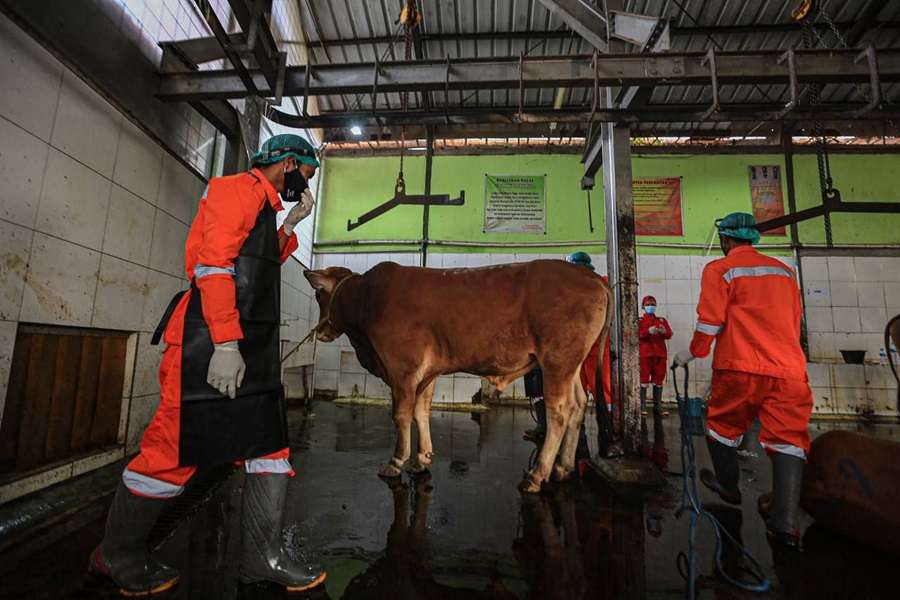
PORTALJABAR, BANDUNG CITY - Ahead of Eid al-Adha 1447 Hijriah, the Head of the Bandung City Food Security and Agriculture Service (DKPP), Gin Gin Ginanjar, ensured that strict supervision of the health of sacrificial animals was carried out from before to after slaughter.
This was conveyed in the Sonata Talkshow themed "Safe and Healthy Qurban: What Needs to Be Prepared?" on Thursday (May 21, 2026).
Gin Gin explained that the inspection of sacrificial animals is carried out in two stages: antemortem and post-mortem. The antemortem inspection is conducted while the animal is still alive to ensure its health before slaughter. After slaughter, the DKPP team conducts a more detailed examination of the animal's internal organs.
"Post-mortem examinations are usually more detailed than antemortem examinations. We examine the head, flesh, and internal organs like the lungs, spleen, and heart to ensure there are no diseases that could potentially be transmitted to humans," said Gin Gin.
He added that if animal parts are found to be showing signs of health problems or certain diseases, these parts will be separated and not recommended for consumption or distribution.
The Bandung City Office of the Public Order Agency (DKPP) also deployed monitoring teams to various sacrificial animal slaughterhouses during Eid al-Adha. According to Gin Gin, post-mortem examinations are one of the most challenging tasks, as they are conducted simultaneously at multiple slaughterhouses.
"Our colleagues in the field have been working quite hard. They've been on duty since two weeks before the big day and continued until a few days after Eid al-Adha," he said.
On that occasion, Gin Gin also answered public questions regarding the characteristics of a suitable sacrificial animal. One of the questions concerned the condition of the teeth of sheep or goats.
He explained that the age of a sacrificial animal can generally be determined by the condition of its teeth. However, a toothless animal is also considered less suitable because it indicates a defect that should be avoided.
Furthermore, the DKPP recommends that sacrificial animals be rested before slaughter. It is recommended that animals be deprived of food for several hours before slaughter to improve their condition.
"Animals should be rested at least 12 to 24 hours before slaughter. Vaccinations should also not be administered before slaughter, as this could affect the animal's condition," he explained.
Regarding animal diseases, Gin Gin emphasized the importance of vigilance against zoonotic diseases, which are diseases that can be transmitted from animals to humans, such as anthrax and foot-and-mouth disease (FMD). However, he confirmed that Bandung remains safe from these infectious diseases.
"Bandung City is indeed on alert due to high animal traffic, but thank God, so far no worrying zoonotic cases have been found," he said.
To mark animals that have passed a health inspection, the DKPP provides a special collar to healthy and suitable sacrificial animals. The public can also scan the barcode on the collar to verify the animal's health status.
In addition to animal supervision, the DKPP also provides halal slaughter training to Qurban committees and DKM (Islamic Community Empowerment Agency) members in various areas of Bandung City. This training covers slaughtering techniques, meat management, and hygienic and sharia-compliant distribution.
Gin Gin also urged the public and qurban committees to reduce the use of plastic bags when distributing sacrificial meat. He encouraged the use of environmentally friendly containers such as bamboo baskets (besek), leaves, or reusable containers.
"We hope that the implementation of the sacrifice will be orderly, hygienic, safe, halal, and will not produce excessive waste," he said.
Furthermore, the Bandung City Office of Public Order (DKPP) regulates locations for sacrificial animal slaughter to avoid disturbing public order. In a circular issued, it is recommended that sacrificial animal sales locations be located at least 200 meters from residential areas.
"If violations are found, enforcement will be carried out jointly with the regional government and the Public Order Agency (Satpol PP)," Gin Gin emphasized.
The Bandung City Office of Communication and Information (DKPP) ensures that this year's sacrificial animal supply will be sufficient for the needs of the Bandung community. Under these conditions, the public is expected to choose healthy, safe, and suitable animals for sacrifice. (Bandung City Communication and Information Office/rka)
 Share News Via
 facebook
 twitter
 whatsapp
 email
email