

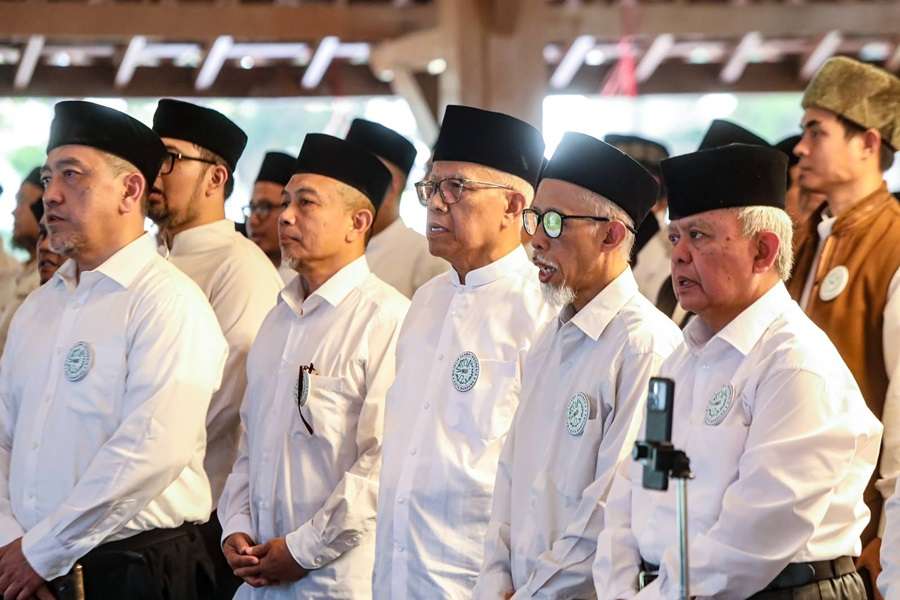
PORTALJABAR, BANDUNG CITY - Bandung Mayor Muhammad Farhan has entrusted five strategic agendas to the newly inaugurated Indonesian Ulema Council (MUI) Bandung City board. These include addressing social issues and strengthening the community's economy, as well as disaster education and waste management.
Farhan hopes that clerics will become important partners for the government in addressing various urban challenges.
He delivered this message at the inauguration of the Advisory Council and Daily Management of the Bandung City MUI for the 2026-2031 service period at the Bandung City Hall, Saturday (10/10/2026).
Farhan stated that the role of religious scholars cannot be separated from social and national life. In addition to guiding the community, religious scholars are also expected to provide insights and solutions to social problems faced by the community.
"The Bandung City Government needs a partnership with religious scholars. Social problems cannot be solved with just two initiatives," said Farhan.
According to him, collaboration between the government and religious scholars is necessary so that various problems can be resolved through the right approach, prioritizing guidance and still paying attention to humanitarian values.
Farhan revealed that the city of Bandung faces complex social problems, ranging from drug abuse, illegal prostitution, distribution of alcoholic beverages to online gambling.
He believes that addressing this issue through discipline and enforcement alone is not sufficient. The government also needs the support of religious scholars to strengthen education and community development.
"I, along with the Forkopimda (Regional Leadership Communication Forum) elements in Bandung City, really hope for guidance from religious scholars so that we can work together to resolve this problem in the most humane way," he said.
Farhan stated that handling social problems must be done through an institutional and regional approach to avoid triggering vigilante action or persecution.
He also highlighted the impact of online gambling on families. Farhan recounted his experience meeting a resident who lost access to social assistance after his family's National Identification Number (NIK) was suspected of being used for online gambling activities.
According to him, this condition creates humanitarian problems because the affected families still have to meet their daily needs, while the addiction recovery process takes time.
"It's not easy to bring back someone who's addicted to gambling. It's not easy at all," he said.
Therefore, Farhan hopes that the MUI can help strengthen education and provide input on approaches that can prevent the problem from spreading further.
Farhan's second priority is strengthening the community's economy through halal certification education. He hopes the Indonesian Ulema Council (MUI) will expand its outreach on halal certification, including through interfaith communication.
Farhan believes that halal certification is not only related to the beliefs of Muslims but also has economic potential that can support the competitiveness of local products.
"I really hope that clerics, with their extraordinary networks with other religious leaders, will also provide education about halal certification," he said.
He explained that understanding halal certification needs to be conveyed inclusively to avoid misunderstandings in society.
According to Farhan, halal certification can add value to local products, expanding the market, increasing consumer confidence, and strengthening business competitiveness.
Farhan also stated that Bandung City's economic growth is showing a positive trend. Economic growth is recorded at 4.99 percent at the end of 2024, increasing to 5.29 percent at the end of 2025, and reaching around 5.8 percent in the first half of 2026.
He hopes that this momentum can be maintained through collaboration between the government, religious leaders, and business actors.
Farhan further encouraged the MUI to collaborate with the Bandung City National Zakat Collection Agency (Baznas) to optimize the collection of zakat, infaq and alms.
According to him, the potential for community funds in Bandung City is still large, so it needs to be developed through modern, transparent collection methods that can reach more people.
"I really hope the Indonesian Ulema Council (MUI) can work together with Baznas to explore various possibilities and communication methods for raising funds for the community," said Farhan.
He believes that increasing community participation in distributing community funds can expand the benefits of social programs, especially for residents who need assistance.
Farhan gave an example, saying that gradually increasing community contributions can have a significant impact if done broadly and sustainably.
Therefore, he hopes that the MUI and Baznas can formulate appropriate strategies to increase public trust and participation in Islamic philanthropic activities.
Climate change and disaster risk were also of concern to Farhan. He warned that changes in seasonal patterns and rainfall intensity have the potential to increase the threat of disasters in urban areas.
For this reason, he invited the Indonesian Ulema Council (MUI) to compile a religious study that could strengthen public awareness of the importance of disaster preparedness.
"I really hope the Ulema Council will conduct a study on the evidence that strengthens the ability of Bandung City residents to become disaster-resilient," he requested.
Farhan proposed collaboration between the Indonesian Ulema Council (MUI), the Bandung City Government, and the Regional Disaster Management Agency (BPBD). One approach deemed effective is utilizing the mosque network to provide disaster education to the public.
"Because one of the most effective methods of educating communities about disaster resilience, I believe, is through mosque loudspeakers," he said.
In addition to disaster education, Farhan also highlighted the importance of providing clean water facilities. He requested the support of religious scholars in collecting data on mosques with waqf status as a means of supporting the planning of clean water facilities for the community.
Farhan stated that piped water network coverage in Bandung City is still around 38 percent. Therefore, providing alternative clean water facilities is a necessity that requires collective attention.
Farhan's final recommendation to the MUI management was waste management. He stated that the Bandung City Government continues to develop waste management methods, but these efforts must be accompanied by changes in public behavior.
According to him, sorting waste from home is an important step to reduce the volume of waste that must be transported to the final processing site.
"I really hope that the Ulema Council, along with the kiai (Islamic scholars), along with the ustaz (Islamic teachers) and ustazah (Islamic teachers) will provide education on waste sorting," he stressed.
Farhan explained that the Bandung City Government plans to develop organic waste processing through composting at the regional level. This program is expected to gradually reduce household waste generation.
He hopes that mosques and religious leaders can become part of the environmental education movement, so that awareness of waste sorting can become a habit in the community. (Bandung City Communications and Information Office/rka)
 Share News Via
 facebook
 twitter
 whatsapp
 email
email