

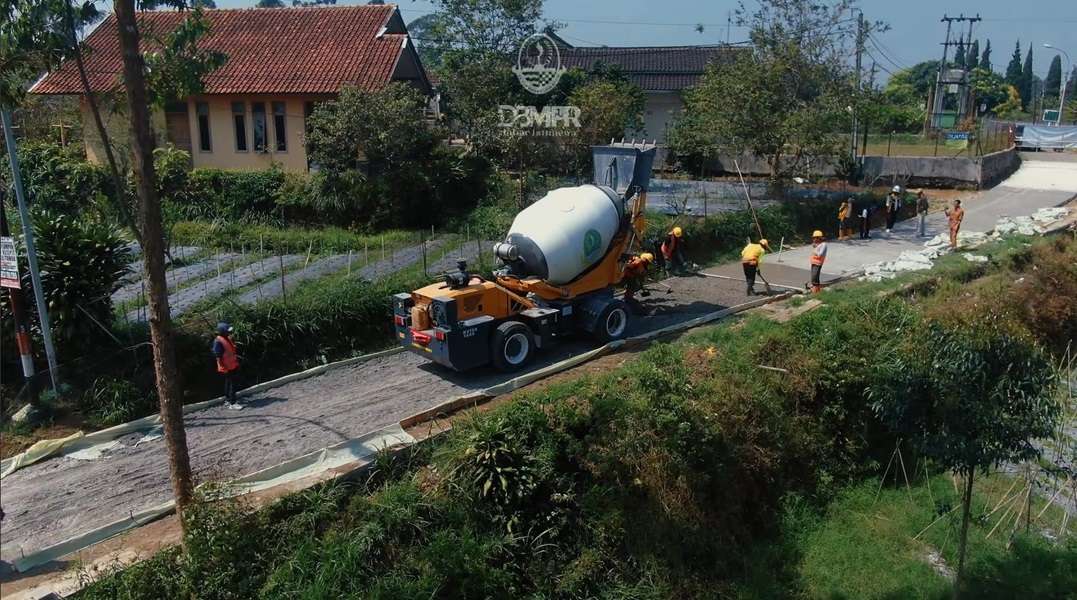
PORTALJABAR, BANDUNG CITY - Building village roads in remote or hard-to-reach areas in West Java is no longer a problem. The West Java Provincial Government has provided 18 self-loading concrete mixers, also known as mobile batching plants, vehicles capable of producing concrete on-site.
With this equipment, road work is no longer hampered by distance or access to the site. Roads can still be built and repaired even if the location is far from the concrete plant.
Agung Wahyudi, Head of the West Java Public Works and Spatial Planning Agency, stated that a mobile batching plant is a multifunctional piece of heavy equipment that combines the functions of loading, weighing, mixing (mixing) concrete materials, and transporting the concrete in a single vehicle. This equipment is designed to produce high-quality fresh concrete directly on-site, automatically and independently.
Mobile batching plants offer several advantages over manual methods or conventional mixer trucks. One such advantage is labor efficiency. The equipment is designed to be operated by a single operator. The entire loading and unloading process is controlled directly from the cab.
Furthermore, this tool offers high mobility and flexibility. "With its compact design and robust wheel drive system, it is highly reliable for projects in difficult terrain, narrow roads, or remote locations inaccessible to large cement mixer trucks," Agung said on Monday (12/10/2026).
With the help of a large shovel on the front, this machine can scoop concrete-making materials like sand, gravel, and cement directly from the pile without the need for an external wheel loader. The materials are then weighed using a sensor-based digital weighing system to ensure the material dosage meets the desired concrete quality formula.
Thanks to the integrated digital weighing sensor, the risk of measurement errors due to human error can be minimized so that the quality of the concrete produced is maintained.
The mobile batching plant will then mix all the materials together with water (from the integrated water tank) in the mixer drum until it becomes a homogeneous concrete mixture.
"The material mixing process can be carried out on the road while the unit is moving to the casting location. This reduces the waiting time for concrete deliveries from external batching plants," Agung said.
The final step, the machine transports fresh concrete directly to the casting point in the project area and pours it precisely.
West Java Governor Dedi Mulyadi, or KDM, stated that the use of the fleet is part of his administration's efforts to accelerate the fulfillment of basic community needs. "These vehicles are intended for paving concrete roads, eliminating the need for concrete pouring at the factory," KDM said.
He confirmed that the funds for the mobile batching plant procurement did not come from his personal pocket, but from government tax revenues. "This is one way the government returns tax money to the public through the provision of public facilities," he said.
Mobile batching plants have been used for road construction in several locations, such as Margamulya Village, Pangalengan District, Bandung Regency; Pamoyanan Village, Cianjur District, Cianjur Regency; and Dukuh Village, Bandung Regency.
 Share News Via
 facebook
 twitter
 whatsapp
 email
email