

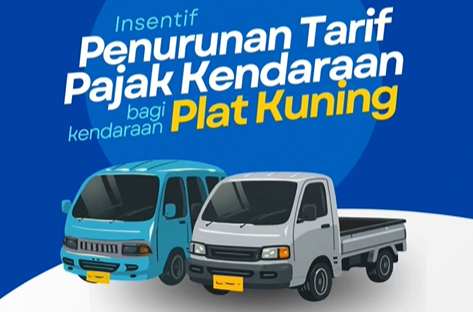
PORTALJABAR, BANDUNG CITY - The West Java Provincial Government is providing tax incentives for yellow-plated vehicles starting January 1, 2026. Through this policy, the imposition of Motor Vehicle Tax (PKB) and Motor Vehicle Ownership Transfer Fee (BBNKB) for public transportation of people and goods is reduced with certain conditions.
The Head of the West Java Regional Revenue Agency, Asep Supriatna, explained that the PKB levy for public transportation vehicles, which was originally 60 percent, has now become 30 percent of the PKB levy base.
Meanwhile, for public goods transport vehicles, the PKB levy, which was previously 100 percent, has now been reduced to 70 percent of the PKB levy base.
This incentive also applies to BBNKB I (new vehicles). BBNKB I for public passenger transportation is now subject to 30 percent of the BBNKB tax base. Meanwhile, BBNKB I for public goods transportation is subject to 60 percent of the BBNKB tax base.
"Thus, both PKB and BBNKB I will receive a reduction in their outstanding tax bills in accordance with the provisions in effect since early 2026," said Asep, Friday (27/2/2026).
Operators must meet several requirements to receive PKB and BBNKB incentives for public passenger and freight transportation. These requirements include the requirement to be an Indonesian legal entity, such as a Limited Liability Company (PT) or Cooperative.
"Yellow-plated vehicles in the name of CVs, firms, or individuals do not receive incentives according to applicable regulations," said Asep.
Operators must also have a permit to operate public passenger or freight transportation. For passenger transportation, a route permit or a permit for non-route passenger transportation is required.
This policy is expected to ease the burden on public transportation business operators who comply with regulations while encouraging administrative compliance and legality of public transportation businesses in West Java.
Meanwhile, black and white plate vehicles did not experience an increase in the amount of tax that must be paid due to the implementation of the PKB option.
 Share News Via
 facebook
 twitter
 whatsapp
 email
email