

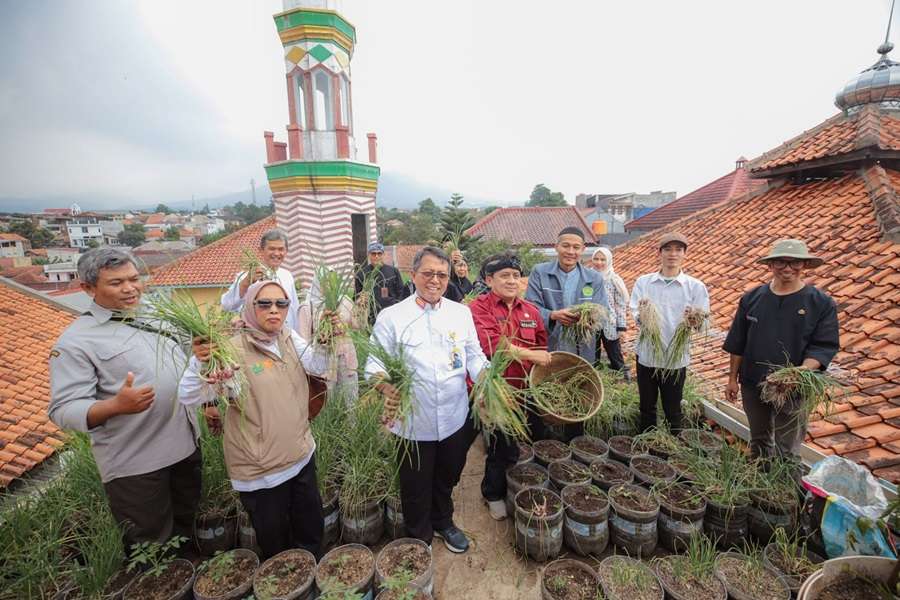
PORTALJABAR, BANDUNG CITY - The Green Waqf Program developed by the Bandung City Land Office at the Al-Hidayah Mosque RW 03, Pasirbiru Village, Cibiru District, has succeeded in increasing the productivity of the waqf land through onion harvesting and crispy mushroom processing to support the congregation's economy and residents' food security.
Head of the Bandung City Land Office, Yayat Ahadiat Awaludin, said the program is a continuation of agrarian reform through the optimization of certified waqf land.
"This is a continuation of the agrarian reform program that began with the certification of the mosque's waqf land. Coincidentally, this mosque has land that can be used for urban farming," said Yayat (May 21, 2026).
According to Yayat, the urban farming concept was implemented because Bandung City has limited land with a high population density so that narrow land can still be used productively.
"With limited land, we encourage effective cultivation. One kilogram of onion seeds can produce up to six kilograms of marketable onions. This has great potential to improve community well-being," he said.
The Green Waqf Program has been running for one year in five areas of Bandung City with ongoing assistance to further develop waqf land management.
Yayat explained that cross-sector support was also provided through collaboration with the Bandung City Food Security and Agriculture Service, the Micro, Small and Medium Enterprises Service, and the West Java Provincial Forestry Service.
"We're working together from upstream to downstream, from seeding and technical assistance to marketing. We hope to increase production and see wider community benefits," he said.
The Chairman of the Al-Hidayah Mosque Prosperity Council, Ridwan, said that this onion harvest was the fourth, with yields continuing to increase compared to the start of the program.
"Thank God, this is our fourth harvest. Initially, we only harvested 2 kilograms, but now almost the entire plot is filled with onions. The yield is quite good and profitable," said Ridwan.
In addition to cultivating onions, the mosque management also develops catfish, vegetable, chicken and mushroom businesses as part of the congregation's economic empowerment.
Ridwan said that onions are the most promising commodity because they offer more stable profits than other businesses.
"Catfish is still a viable business, vegetables are less profitable, but onions are the most promising. The profits can go to the mosque and congregation," he said.
Mushroom cultivation has also developed through processed crispy mushroom products with cheese, original, barbecue, and spicy flavors to increase the economic value of the harvest.
Ridwan hopes that the program will be able to make the mosque a center for social and economic activities in the community.
"Our hope is that mosques will not only be places of worship, but also centers of economic activity. This will attract people to come, not only to seek knowledge but also to reap economic benefits," he said.
The Buruan Sae Extension Coordinator of the Bandung City Food Security and Agriculture Service, Ucu Nurhasanah, said that his office continues to assist urban farming groups to strengthen family food security in the community.
"We've seen quite successful results with this onion. It's excellent and has the potential to be developed further," said Ucu.
The Bandung City DKPP will also strengthen assistance in facilities, infrastructure, and coaching so that the Green Waqf group becomes more independent and sustainable.
(Bandung City Communications and Information Service/bhf)
 Share News Via
 facebook
 twitter
 whatsapp
 email
email