

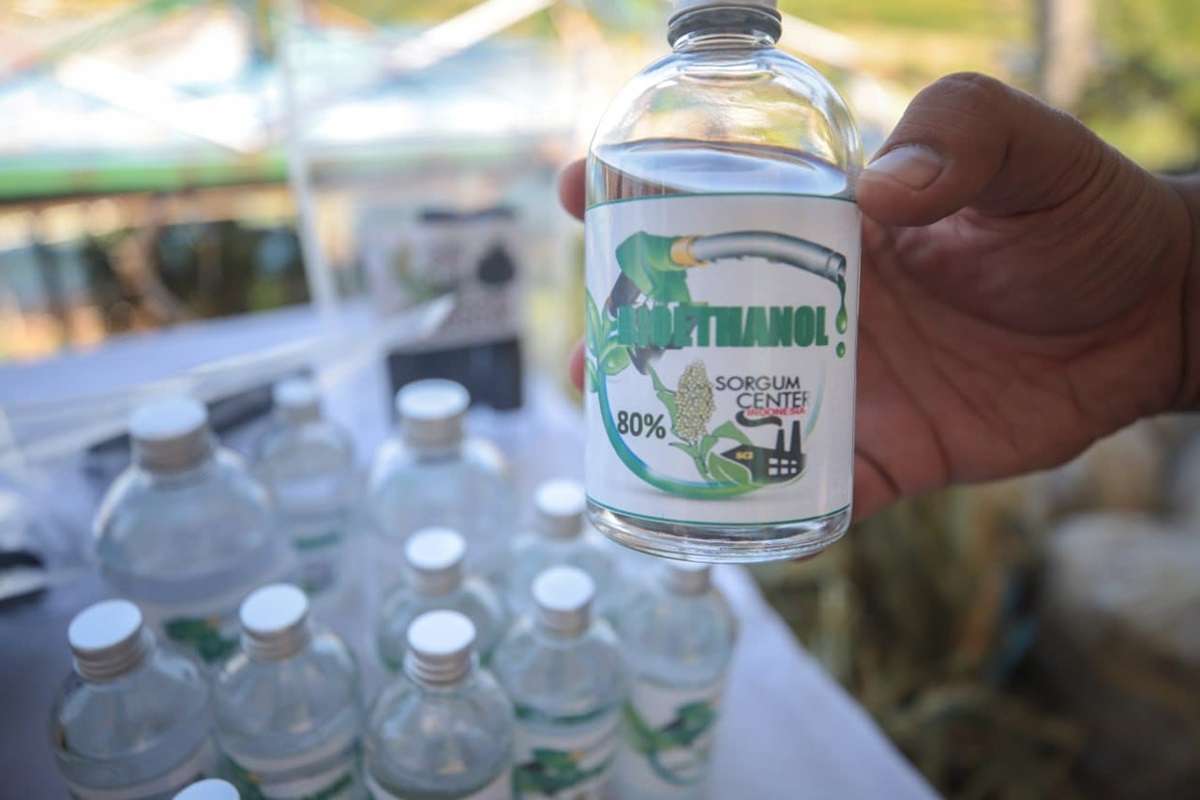
PORTALJABAR, BANDUNG CITY - The Bandung City Government is developing a new renewable energy source processed from Sorghum as the basic material into bioethanol. The development is a collaboration between the Bandung City Government through the Bandung City DKPP together with Pasundan University, BRIN, Bank BRI, and several other parties.
Head of the Bandung City Food Security and Agriculture Service (DKPP), Gin Gin Ginanjar, said that the Bandung City Government continues to develop Sorghum as an effort to achieve food and energy security in the city of Bandung.
"In the city of Bandung, almost 97 percent of the food present in the city of Bandung is imported from outside the city of Bandung. One of the efforts is to develop independence or food security with limited land, one of which is by utilizing local food such as Sorghum," he said at the Urban Plantation Agricultural Reserve event as a Form of Food and Energy Security at Seinfarm, Wednesday, (18/9/2024)
The use of sorghum into Bioethanol, according to him, is one of the solutions to Bandung City's energy security. For that reason, in its development, the Bandung City Government invites various stakeholders.
In addition, sorghum has also been processed into various food ingredients ranging from sorghum rice, flour, sugar, to briquettes as a substitute for coal.
Furthermore, the sorghum raw material is processed into food products made by MSMEs. Currently, the sorghum garden in the Seinfarm area has reached 1.5 hectares.
Gin Gin hopes that with the support from various parties ranging from the central government, provinces, business circles to academics, the development of the concept of food and energy security in Bandung City will be even better.
"Today we are planning how Seinfarm can become a center for sorghum and a center for developing food security while being independent in the food sector. Including having independence or innovation related to energy," he said.
Meanwhile, Chairman of Sorgum Center Seinfarm Wisnu Cahyadi said, Bioethanol is processed using sorghum tape. Currently, the production of bioethanol is still in a small stage of 100 kg per day. The target is to reach 1,000 kg per day. He hopes that Sorghum can become a mainstay staple food for the city of Bandung.
"In the future, we will develop it to approximately 10 hectares and this will be assisted by the West Java Provincial Government through the Food Crops and Horticulture Service," he said.
Responding to this, Assistant for Economy and Development Eric Mohamad Atthauriq said that urban plantation agricultural reserves have a very important role. This concept not only aims to increase local food production but also to create a greener and more sustainable urban ecosystem.
"Let's all support and develop this Urban Plantation Agricultural Reserve together. We make Bandung City a pioneer in innovative and sustainable match management for the sake of creating a healthy, independent and competitive city," he said while reading the written remarks of the Acting Mayor of Bandung, Bambang Tirtoyuliono.
For information, at this event, the signing of the commitment of urban plantation agricultural reserves based on sorghum as a form of food security and renewable energy was also carried out by the Bandung City Government, Bandung City DPRD, West Java Provincial Government, Ministry of SOEs, Ministry of Cooperatives and SMEs, Pasundan University, ID Food, National Food Agency, BPOM West Java, BRIN and Sorgum Center Seinfarm. (Bandung City Communication and Information Service/Revo)
 Share News Via
 facebook
 twitter
 whatsapp
 email
email