

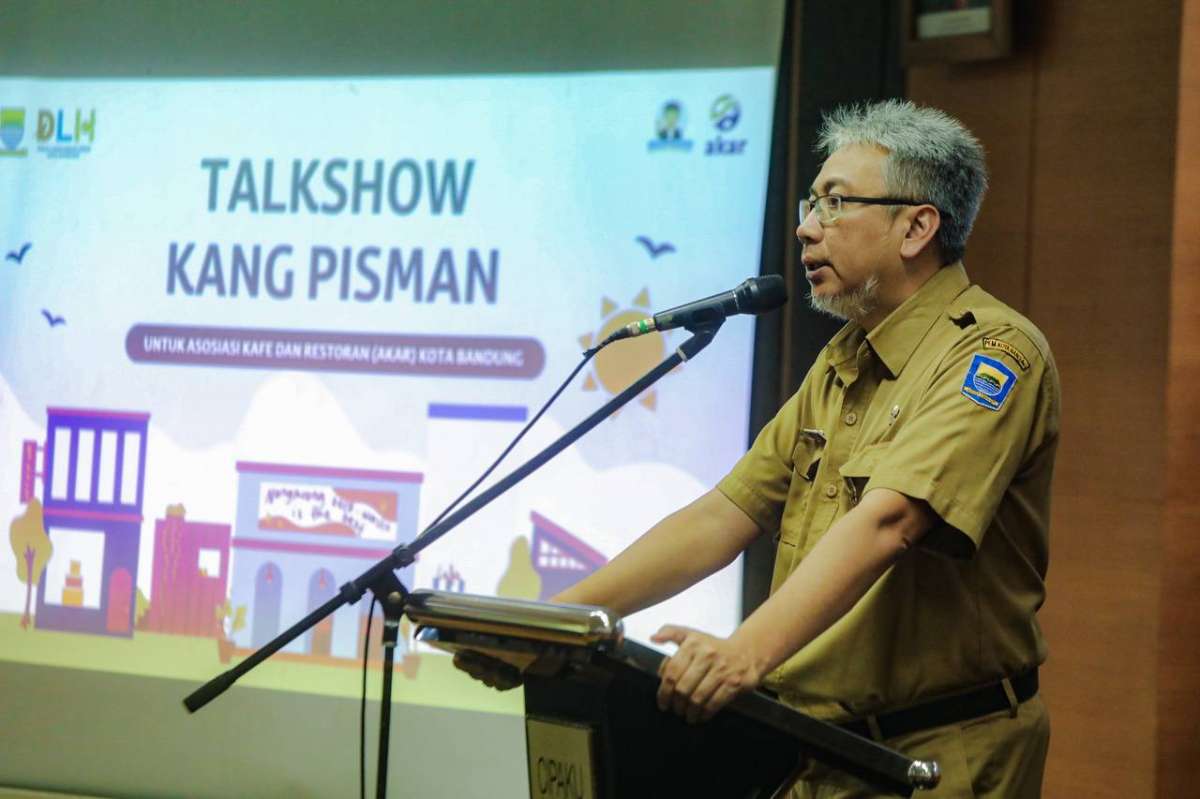
PORTALJABAR, BANDUNG CITY - The Bandung City Regional Government is encouraging cafe and restaurant entrepreneurs to be able to process waste from the source. This is an effort to reduce waste generation in the city of Bandung, where currently there are still restrictions on disposal to the Sarimukti TPA.
Head of the Environmental Service, Dudy Prayudi, said that the composition of waste in cafes and restaurants is dominated by organic waste and the rest still has sales value for processing.
"That the composition of waste in cafes and restaurants is 50-60 percent organic and 40 percent high value, such as drink bottles which have high value," he said.
Dudy stated at the Waste Management Socialization activity for Cafe and Restaurant Managers in Bandung City, at the Cipaku Hotel (23/1/2024).
According to him, the residual waste produced by culinary establishments is very minimal. The estimate is only around 10 percent.
"The residual waste is small from restaurants or cafes. Even the waste that is sent to the TPS is very small, maybe only 10 percent," said Dudy.
Due to this, Dudy invited entrepreneurs to be able to process waste starting from the source. Even cafes and restaurants strive for zero waste.
"If you look at the field or at the TPS, the waste is still mixed. So we urge entrepreneurs who are members of the Bandung City Cafe and Resto Association (Akar) to work together to resolve the waste at the source," said Dudy.
He hopes that entrepreneurs in Bandung City will be able to replicate various success stories that have been carried out by other entrepreneurs. So that it can be implemented optimally as an effort to reduce waste.
"For example, Sindang Reret Restaurant is able to process waste. It's just a matter of our commitment to resolve waste at the source independently. There have been many success stories in the city of Bandung, so business actors must be able to replicate this by friends so that it can be implemented in their workplaces ," said Dudy.
Meanwhile, Head of the Solid Waste and B3 Waste Management Division of DLH Bandung City, Salman Faruq, revealed that Bandung City residents' awareness of managing waste has begun to increase significantly.
Currently there is a decline in waste production from both residential and non-residential areas. Initially it was 0.63 kg per person and per day, now it is only 0.54 kg per person and per day.
"This indicates that everyone's awareness is growing to be wise in managing waste," he explained.
Nevertheless, there is a need for socialization and real action in managing waste. The reason is that currently, there are still restrictions on sending waste to the Sarimukti TPA.
"In the city of Bandung, currently 1,300 tons per day, 60 percent of which is household waste and 40 percent non-household waste. In January 2024, there will be restrictions to the Sarimukti TPA, namely 50 percent of waste deliveries or 628 tons per day, only residual waste is permitted," he stressed.
"Currently 58 hotels and 3 restaurants have processed waste independently. So far, progress has been significant, we hope that other entrepreneurs will be able to duplicate this movement," he said.
 Share News Via
 facebook
 twitter
 whatsapp
 email
email