

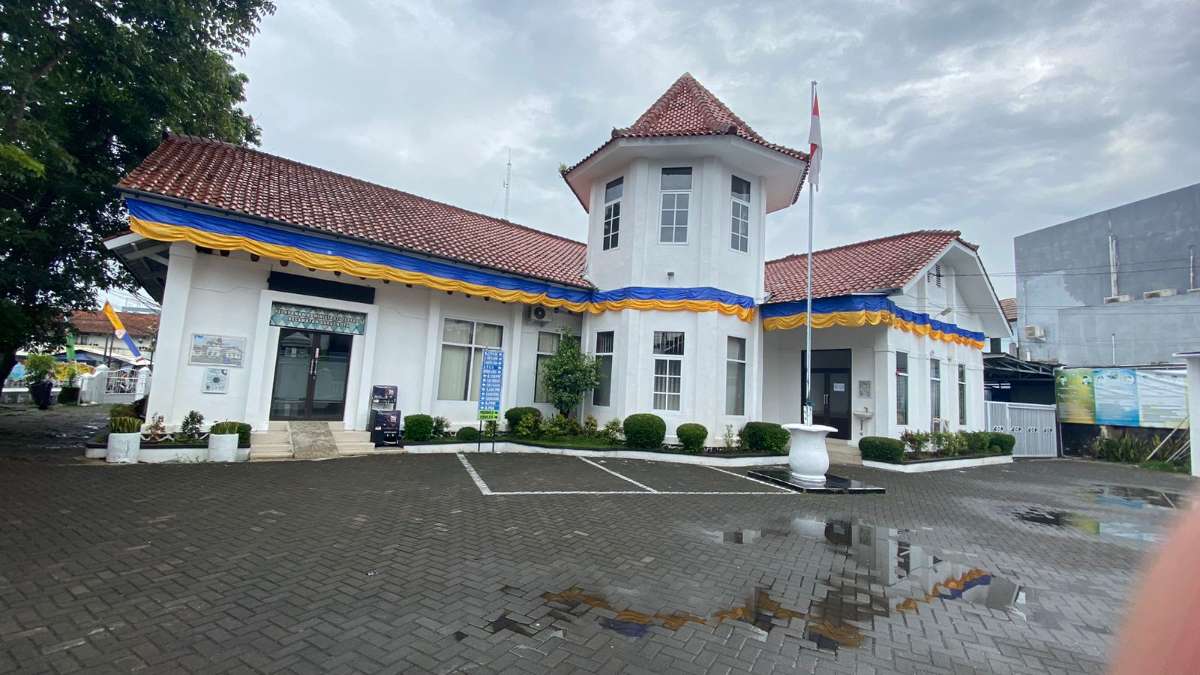
PORTALJABAR, DISTRICT. GARUT - Garut Regency, known as Switzerland Van Java, maintains its charm as a tourism destination thanks to its natural beauty and colonial heritage.
Garut historian and cultural observer, Warjita, said that the beauty of Garut with its unique characteristics has attracted the attention of Europeans since colonial times by helping to promote its beauty.
Before Bandung reached the peak of popularity, Garut was considered the heart of Priangan by Dutch explorers thanks to its geographical beauty and attractive Dutch plantations which became a magnet for visitors from abroad.
"Also with many Dutch companies, tea plantations, rubber, quinine, all kinds," he said.
Warjita highlighted the unique collaboration between European and traditional Sundanese (Indic) building styles that still stand strong today, such as Pamengkang and the Disparbud Office Building, Garut Post Office, and the BPKAD Building on Jalan Kian Santang.
"Just look at the buildings, they definitely have a height, then there is a temperature (roof), that's a collaboration with Sundanese buildings," he added, Friday (9/2/2024).
Not only that, Warjita also highlighted the role of Garut Square which is the center of city life and government. This square, which existed before the colonial period, is a silent witness to the transfer of the traditional center of government from the Sultanate of Mataram to the Dutch colonial period.
"That is the great concept of Garut, so the colonial legacy is still left, in the true sense that the square is not a colonial legacy, it already exists, but the colonial period was not removed so it was collaborated," he said.
Heritage buildings, one of which is the Alun-Alun and Pendopo complex area, were previously built on February 16 1813 during the reign of Governor General Raffles. Then construction was completed in 1821, and the regional pavilion began to be used during the time of the first Regent of Garut or Regent of Limbangan, namely RAA Adiwijaya.
However, not all of Garut's colonial heritage is lucky. The Tall Building, owned by Garut's first dodol entrepreneur, H. Umar, a Garut dodol pioneer, collapsed due to a major earthquake in 1979-1980. Despite this, preservation efforts continue, with many historic buildings designated as cultural heritage.
Currently, many of Garut's heritage buildings have been designated as cultural heritage. Warjita, together with the Garut Regency Tourism and Culture Office, is currently working on turning several historical buildings in Garut Regency into cultural heritage.
In commemorating the 211th anniversary of Garut Regency, Warjita conveyed the importance of community involvement in preserving historical heritage.
An observer of Garut history, Darpan Winangun, who is also the Chair of the Board of Trustees of FK MGMP Sundanese Language SMA West Java Province, and Chair of the Supervisory Board of the Indonesian Regional Language Educators Association (PPBDI), regrets the condition of several historic buildings which are increasingly fading. Darpan highlighted the existence of historical buildings which should be silent witnesses to the city's journey, but unfortunately many have been eroded by time and modernization.
"What is still around the square is the Regent and Babancong buildings, the buildings are relatively well-preserved," he said.
However, he appreciated the efforts to maintain several buildings, such as Garut Station, which remains intact and is part of the historical heritage guarded by PT. KAI. On the other hand, Garut Chinatown is experiencing rapid changes, thus losing its distinctive characteristics.
"Chinatown is now changing very quickly, if I look at the 80s, the typical Chinese buildings behind the temple still have a Chinese atmosphere, but now especially at the front it has changed a lot," he said.
He also told the story of the failed attempt to maintain the PTG (Garut Textile Factory) chimney, as a landmark, which has now been destroyed without leaving a trace, following his efforts without the support of the owner and collective awareness.
"We took the initiative so that the chimney would not be torn down, but because the ownership has also been transferred to private ownership, it is difficult for us to maintain it, depending on the owner," he said.
Darpan formulated two important hopes. First, the formation of a community that is able to preserve Garut's cultural heritage. Second, there is a need for this heritage to be included in cultural heritage data collection, which is supported by clear regulations.
For him, heritage is not just about buildings, but historical stories that mark Garut's past glory.
“This cultural heritage or heritage building has important historical value. "The hope is that this legacy can be a sign that Garut was once glorious, superior in the past," he said.
Responding to this, the Head of the Garut Regency Tourism and Culture Service (Disparbud), Luna Aviantrini, Monday (12/2/2024), stated that the government had taken several steps in an effort to preserve Cultural Heritage buildings in Garut, namely:
1. Data Collection and Inventory
The first step is to collect data or inventory of Cultural Heritage buildings to support cultural preservation efforts. Collaboration is needed to map cultural heritage that has not been recorded, is lost, still exists, and is almost extinct.
2. Determination of Cultural Heritage
After a recommendation from the Cultural Heritage Expert Team, the government will propose the designation of Cultural Heritage both to the Provincial Government and through the relevant Ministries.
3. Maintenance and Caretaker
Carry out maintenance by appointing a Custodian (Jupel) at each Cultural Heritage. Jupel is responsible for caring for, maintaining and maintaining the security of cultural heritage in accordance with the duties and functions regulated in Law No. 11 of 2010 concerning Cultural Heritage.
However, Luna also revealed several obstacles faced in efforts to preserve Cultural Heritage in Garut, namely:
1. Lack of Experts
There is a scarcity of experts or employees who have competence in the field of culture, especially related to history and archeology in Garut.
2. Lack of Socialization
There has not been optimal socialization of the Law/Perda or Perbup on Cultural Heritage Buildings or other regulations related to the preservation of cultural heritage to the community, so that public awareness of the importance of the existence of Cultural Heritage is lacking.
3. Cooperation needs to be improved
Collaboration with cultural preservation institutions and local communities still needs to be improved, including collaboration with historians, archaeologists and anthropologists.
4. Lack of Socialization Activities
Lack of socialization of the importance of preserving Cultural Heritage through activities such as seminars, dialogues, symposiums, workshops, etc. to the younger generation.
5. Rapid City Development
Rapid urban development is changing the function and meaning of existing Cultural Heritage, causing a number of Cultural Heritage to become cultures in danger of being lost, even extinct. Example: (PTG, Gedong Jangkung, Padang Boelan, Lasminingrat Residential House) is an example of a cultural heritage that has changed function.
6. Planning that needs to be improved
Planning for the preservation of historic buildings in an integrated and sustainable manner between policy makers still needs to be improved.
In this regard, Luna emphasized the importance of overcoming these obstacles so that efforts to preserve Cultural Heritage in Garut can run optimally. (rdp*)
 Share News Via
 facebook
 twitter
 whatsapp
 email
email