

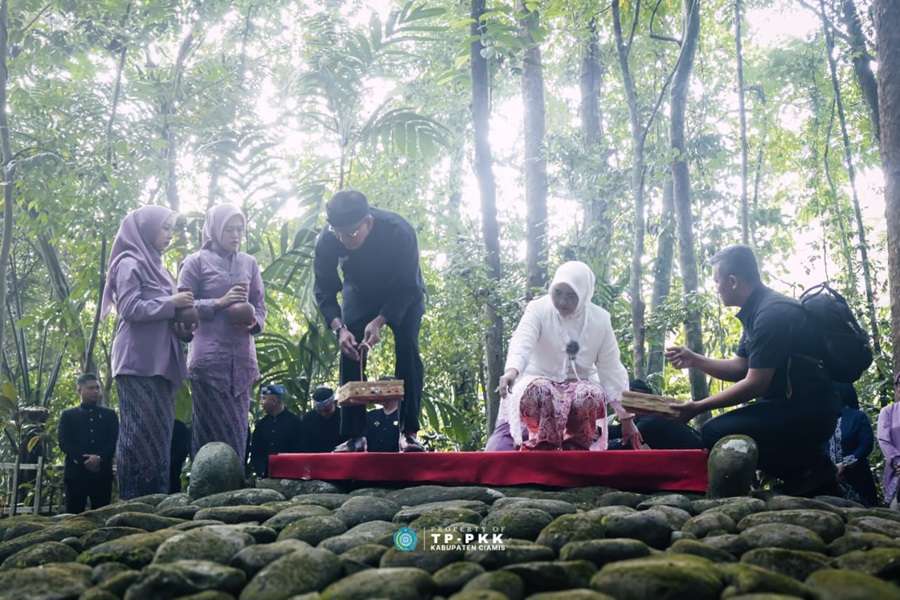
PORTALJABAR, CIAMIS REGENCY - To celebrate the historic 384th anniversary of Ciamis Regency, the Ciamis Regency Government once again held a sacred pilgrimage to the graves of the Tatar Galuh ancestors on Wednesday (10/6/2026).
This activity has become an annual routine agenda as a form of high respect and a medium for reflection on the services of previous leaders who formed the foundation of Ciamis to this day.
The Regent of Ciamis, Herdiat Sunarya, led the main group directly from the Pendopo since morning, the Sundanese cultural atmosphere was very thick because all the men in the group were seen wearing traditional pangsi clothes, while the women in the group were elegantly wearing Sundanese kebaya.
This series of retracing the steps is divided into six historical graves spread across the Ciamis and Kawali areas:
The pilgrimage begins with a visit to the tomb of Raden Adipati Arya Panji Jayanegara, the first Regent of Galuh Imbanagara (1642–1678). It is located in Ciwahangan, Imbanagara.
The pilgrimage continues to the tomb of Raden Tumenggung Wiradikusumah, the 14th Regent (1814–1819), located in Cigadung, Imbanagara, Ciamis.
The third pilgrimage took place at the tomb of Rd. Adipati Adikusumah, located on Mount Galuh, Sindangrasa, Ciamis. Rd. Adipati Adikusumah was the 15th Regent (1819-1839).
The fourth pilgrimage was to the tomb of Raden Adipati Kusumahdiningrat, the 16th Regent (1839 – 1886). Raden Adipati Kusumahdiningrat's tomb is located in Jambansari, Selagangga, Ciamis.
The fifth pilgrimage to the tomb of Raden Adipati Arya Kusumah Subrata, the 17th Regent (1886 – 1914). Located at Sukasirna's tomb in Ciamis.
The series of pilgrimages ends at the ancestral tomb of Astana Gede Kawali, which contains the tomb of Adipati Singacala as the king of Kawali (1663-1718), located at the foot of Mount Sawal, precisely to the north of the city of Ciamis, namely in Indrayasa Hamlet, Kawali District, Ciamis Regency.
At each location, the pilgrimage procession proceeded solemnly. The event began with a brief biography of each ancestral figure, followed by a communal prayer, and concluded with a wreath-laying ceremony at the graves by Regent Herdiat and his staff.
This tradition is not merely an annual ceremonial routine, but rather a reminder to the current generation that Ciamis's progress today is inseparable from the sweat and great struggles of those who came before it. (Ciamis Regency Communications and Information Service/rka)
 Share News Via
 facebook
 twitter
 whatsapp
 email
email