

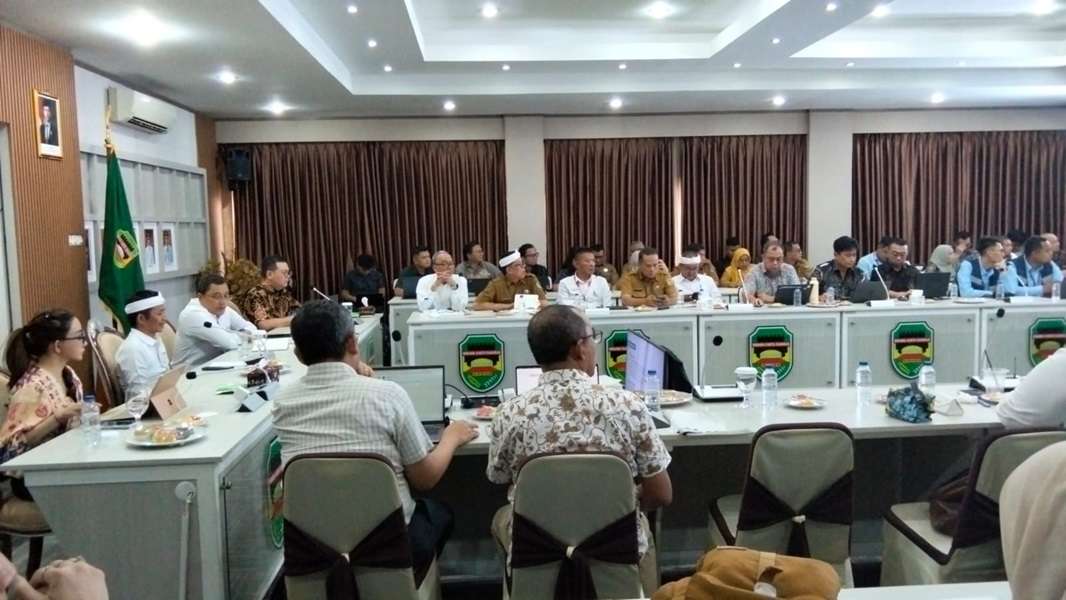
PORTALJABAR, PURWAKARTA REGENCY - The Purwakarta Regency Government held a meeting with several elements to discuss plans for the construction and operation of an artificial intelligence (AI) data center located in the Jatiluhur area, Purwakarta Regency, West Java, Monday (5/10/2026).
The meeting took place in the Janaka Hall of the Regional Secretariat of the Regency
The Purwakarta meeting was led directly by the Regent of Purwakarta, Saepul Bahri Binzein, and attended by academics from the University of Indonesia and researchers from the National Research and Innovation Agency (BRIN).
A number of matters discussed were related to AMDAL (Environmental Impact Analysis) and PBG (Building Construction Approval) documents, as well as highlights regarding the use of water for cooling systems.
Zein, Saepul Bahri Binzein's nickname, emphasized that the construction and operation of the AI Data Center would not disrupt the water supply for community needs, including agriculture. This is because the water supply from the Gapura Tirta Rahayu (GTR) Purwakarta Regional Drinking Water Company (Perumda Air Minum) is still underutilized.
"The current water withdrawal permit of 120 liters per second has only been used, leaving 50 liters per second remaining. If BDx supplies 27 liters per second of water, there will still be 23 liters per second remaining. This means there will be no disruption to the supply to the community or agriculture," he added.
However, according to Zein, this theory needs to be tested first. The Purwakarta Regency Government, along with various parties, will discuss plans for the construction and operation of an AI data center over the next 10 days.
Meanwhile, Dini Fronitasari, an AI researcher from BRIN, emphasized the need for Indonesia to have AI computing. However, several factors must be taken into account to ensure the presence of an AI data center doesn't disrupt other sectors, including water and electricity consumption.
He also proposed the use of a closed cooling system in AI data center operations.
"The closed cooling system reduces water requirements by up to 80 percent," said Dini.
 Share News Via
 facebook
 twitter
 whatsapp
 email
email