

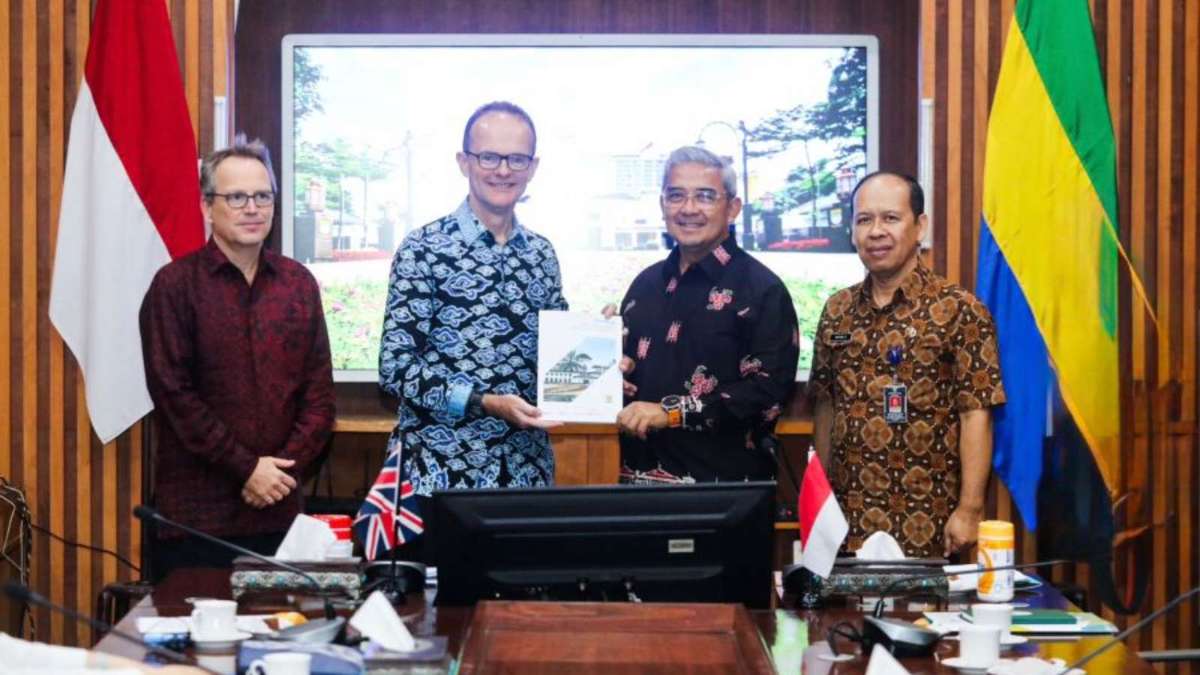
PORTALJABAR, BANDUNG CITY - The Bandung City Government (Pemkot) is opening up global green investment opportunities by developing various strategic sectors within the framework of climate investment. This step is part of the effort to create a greener, more resilient, and more sustainable Bandung.
This was conveyed by the Mayor of Bandung, Muhammad Farhan, during the official handover of the Climate Investment Opportunities Diagnostic report compiled by the International Finance Corporation (IFC) through the APEX Green Cities program, in the Central Room of Bandung City Hall, Friday (28/8/2026).
Bandung Mayor Muhammad Farhan stated that the Bandung City Government's collaboration with various international partners is growing and diversifying. Investment opportunities in the climate sector can strengthen Bandung's position as a world-class investment destination.
"Our cooperation has now grown and become more diverse. Certainly, in terms of investment opportunities within the climate investment framework, this increases Bandung's chances of becoming a world-class investment destination," said Farhan.
Farhan mentioned several sectors that have the potential to be developed through green investment, including waste management and the development of green and blue open space index concepts.
He believes environmental management is becoming increasingly important as Bandung City grows and its population grows. One challenge that requires attention is air quality.
"We also face challenges with the increasing population density in Bandung. At the same time, we are experiencing problems with air quality in Bandung, which is now considered one of the worst in Indonesia," he said.
Farhan believes that air quality issues cannot be solely attributed to the presence of large-scale industries. Bandung currently has no large-scale industries, which are often blamed for poor air quality in the region.
In addition to air quality, the Bandung City Government also offers investment opportunities to improve the quality of raw water and groundwater.
Farhan stated that Bandung City's clean water needs currently depend on raw water supplies from outside the region. Meanwhile, the quality of raw water in several rivers in Bandung still faces contamination issues.
"We're also inviting climate investment to address raw water quality in Bandung. Currently, we still have to purchase raw water from outside Bandung to distribute clean water," he said.
He hopes that investment in this sector will help improve the quality of raw and groundwater in Bandung. In the long term, this will support the goal of providing safe drinking tap water in at least five-star hotels in the city.
"If there is an opportunity for climate investment to improve the quality of raw water and groundwater in Bandung City, then our goal of producing drinkable tap water, at least in star-rated hotels in Bandung City, would provide extraordinary added value," he explained.
The British Government also supports Bandung City's efforts to strengthen green investment. British Ambassador to Indonesia, Dominic Jermey, expressed his appreciation for the collaboration between the Bandung City Government, the British Government, and the International Finance Corporation (IFC).
The collaboration resulted in the Bandung Climate Investment Opportunities Diagnostic Report, a data-driven study that maps climate resilience priorities and green investment opportunities in the city of Bandung.
Jermey said the British Government, through the Department for Energy Security and Net Zero, was proud to support the preparation of the study.
According to him, the more important thing after the report is compiled is how the recommendations in it can be followed up into real programs and investments.
"This report is part of our transformation efforts for the future. It presents a data-driven analysis of Bandung City's climate resilience priorities and identifies various green investment opportunities in the city," said Jermey.
He assessed that this collaboration is one of the tangible results of the strategic partnership between Indonesia and the UK, particularly in promoting economic growth, sustainable investment, accelerating the transition to net zero, and climate action.
Jermey also highlighted a number of challenges facing Bandung, ranging from pollution and air quality, water management, tourism development and investment to the transformation of waste management into energy.
He stated that the UK has experience facing similar challenges in cities such as London, Oxford, and Glasgow. Therefore, the UK government is ready to support Bandung in implementing the recommendations it has developed.
"We are very pleased to be able to support the City of Bandung's journey at this stage. We also look forward to continuing our partnership with the Bandung City Government in implementing the findings of this report," he said.
Meanwhile, IFC Country Manager, Euan Marshall, explained the results of the Climate Investment Opportunities Diagnostic (CIOD) compiled within the framework of the Apex Green Cities Program.
He stated that Bandung is one of 30 cities worldwide participating in the program's network. Through this program, cities are encouraged to identify and develop investments in climate action with the greatest impact.
"Specifically, the Climate Investment Opportunities Diagnostic identifies 28 high-impact measures or policies. If all these measures are implemented appropriately, Bandung City's greenhouse gas emissions are estimated to be reduced by up to 22 percent by 2035," Euan said.
According to him, this target is an opportunity for Bandung to demonstrate leadership in climate action not only in Indonesia but also in the Asian region.
Of the 28 steps identified, there are about eight main steps that contribute to about 90 percent of the potential emission reductions.
Some of these sectors include the construction and development of green buildings, energy efficiency, utilization of renewable energy, waste management, public transportation and water management.
Euan believes that waste management through proper sorting, collection, and processing is one of the high-impact steps in reducing greenhouse gas emissions.
IFC also sees financing opportunities through private sector engagement, including public-private partnership (PPP) schemes, to support urban services while reducing the public financing burden.
Several opportunities that can be developed further include strengthening the Bus Rapid Transit (BRT) system, waste-to-energy programs, park-and-ride facilities, and the implementation of low-emission zones in core cultural heritage areas.
In addition, the development of green and resilient public buildings is also an investment opportunity that can be developed together.
Euan said that IFC is open to continuing to support the Bandung City Government and its partners from both the public and private sectors in realizing these various opportunities.
With the 2035 target fast approaching, he encouraged the City of Bandung to start taking big steps now.
"2035 is closer than we think, so the target is indeed very ambitious. However, we must also dare to think big so we can start taking steps that will have a big impact," he said.
(Bandung City Communications and Information Service/rka)
 Share News Via
 facebook
 twitter
 whatsapp
 email
email