

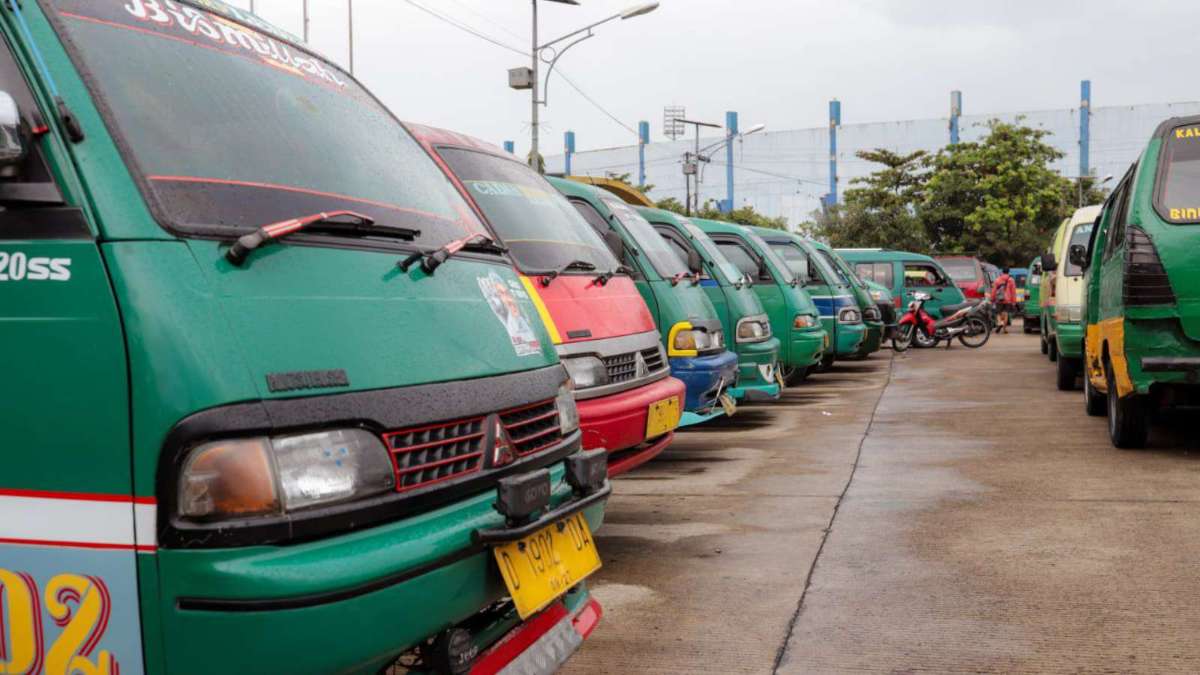
PORTALJABAR, BANDUNG CITY - The Bandung City Government (Pemkot) confirmed that the smart public transportation program has shown encouraging results after running for one year.
From an operational perspective, the service is considered to be running well. However, the biggest challenge remains fleet procurement, which requires significantly higher costs than conventional public transportation.
Bandung Mayor Muhammad Farhan revealed that evaluations over the past year have shown that the operational performance of the smart public transportation (angkot pintar) has met expectations. However, the price of the electric vehicles remains a major obstacle to expanding the program's implementation.
"The evaluation results show that the smart public transportation (angkot) is operationally very good. However, the challenge lies in procurement costs. The price of an electric public transportation (angkot) can be up to twice that of a conventional public transportation (angkot)," said Farhan at the Bandung City Hall on Monday (June 29, 2026).
To address this issue, the Bandung City Government, together with the West Java Provincial Transportation Agency, the Bandung City Transportation Agency, and the Ministry of Transportation, are currently developing a financing scheme so that fleet procurement can be carried out sustainably.
According to him, the fleet will be operated by city transportation cooperatives, such as Kobutri, Kopamas, and Kobanter, which have long been the backbone of public transportation in Bandung. Government support is expected to ease the investment burden on operators, accelerating the transformation to environmentally friendly transportation.
In addition to fleet procurement, the Bandung City Government is also continuing to review plans for convergence, or consolidation, of public transportation ownership. This process is considered to require careful consideration, as it involves numerous vehicle owners with differing interests.
"Convergence is still being calculated. Uniting several public transportation owners into one business entity is no easy feat. Therefore, we are currently developing the right business model," he said.
Farhan explained that successful convergence can only be achieved with the support of a clear and sustainable subsidy scheme. The Bandung City Government, the West Java Provincial Government, and the Central Government are expected to share roles in providing funding support to ensure a modern public transportation system remains economically viable for operators.
"There must be a fixed business model where the Bandung City Government, the Central Government, and the Provincial Government all provide subsidies. Because subsidies must be provided, it's impossible not to," he said.
(Bandung City Communications and Information Service/rka)
 Share News Via
 facebook
 twitter
 whatsapp
 email
email