

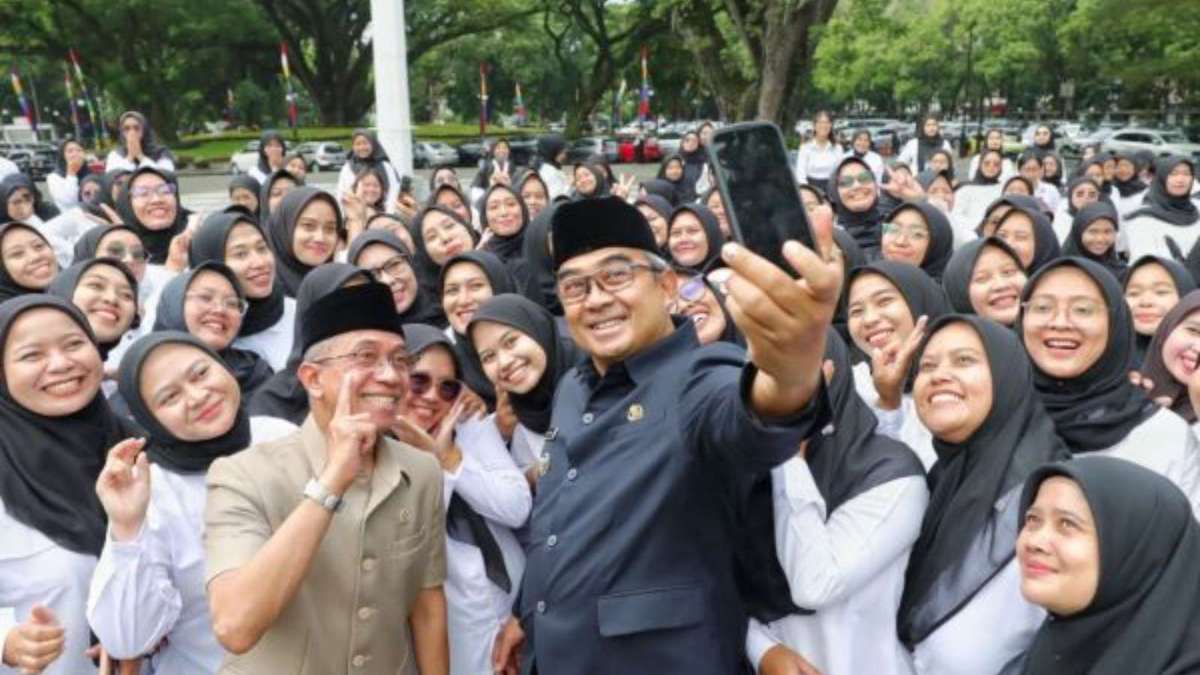
PORTALJABAR, BANDUNG CITY - The Bandung City Government (Pemkot) has confirmed that the contract period for part-time Government Employees with Work Agreements (PPPK) will be extended after the contract period ends in October 2026.
Bandung Mayor Muhammad Farhan stated that the extension was made because the Bandung City Government did not yet have the fiscal capacity to upgrade the status of Part-Time PPPK to full-time employees.
"Their contracts expire in October. They will be extended," said Farhan at Bandung City Hall on Thursday (August 20, 2026).
According to him, the Bandung City Government is currently still awaiting the implementation of the 2027 State Budget (APBN) policy, which is expected to regulate the status of PPPK as central government employees.
"We don't yet have the fiscal capacity to raise their status. We're still awaiting the implementation of the 2027 State Budget, which will make all PPPK central government employees," he said.
Farhan believes this policy will provide greater fiscal space for local governments. If PPPK become part of the central government's workforce, the Bandung City Government will have the flexibility to recruit part-time PPPK again as needed.
"Once PPPK have become central government employees, we have the flexibility to start recruiting part-time PPPK again," he explained.
He stated that educators constitute one of the largest groups within the Bandung City Government's PPPK (Community Employee Employment) workforce. Therefore, their presence is considered essential to support public services, particularly in the education sector.
"Most of our PPPK are teachers. And that's very necessary," said Farhan.
Regarding the Bandung City Regional Budget's ability to finance the extension of part-time PPPK contracts, Farhan confirmed that the fiscal situation for employee spending remains secure.
"Thank God, everything is safe. Employee spending is very safe," he said.
However, Farhan stated that the Bandung City Government must still develop a financing strategy to meet future budget needs. Local governments cannot rely solely on a single funding source, especially when development needs have the potential to create a budget deficit.
"Currently, in our general budget policy, we must consider a budget deficit strategy. The needs are definitely in deficit, so the City Government, along with other partners, the Provincial Government, and the Central Government, must seek financing," he said.
Farhan stated that this financing doesn't always involve loans. Regional governments can seek various alternative funding sources to support development programs and needs.
He gave an example, the West Java Provincial Government is also considering a financing scheme to meet regional budget needs.
"The Governor stated that West Java Province might seek a loan of Rp3.7 trillion. Well, we will do the same. It's not a loan, but financing," he said.
According to Farhan, funding can come from various sources, ranging from support from provincial governments, central governments, to investments from companies and state-owned enterprises (BUMN).
"Financing can come from anywhere. It could come from the provincial budget, the national budget, or even investments from companies and state-owned enterprises," he concluded.
(Bandung City Communications and Information Service/rka)
 Share News Via
 facebook
 twitter
 whatsapp
 email
email