

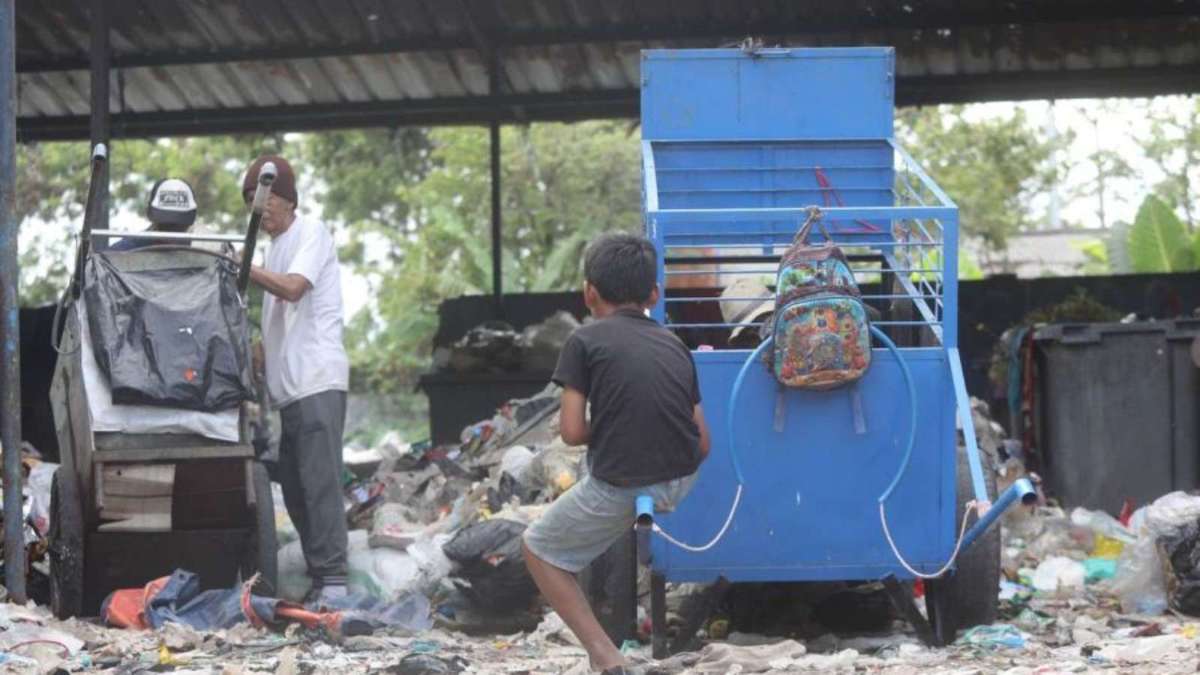
PORTALJABAR, BANDUNG CITY - The Bandung City Government (Pemkot) continues to strengthen its waste management strategy, not only through large-capacity waste processing, but also by preparing small- to medium-scale technology that can be placed closer to waste sources at the village and sub-district levels.
Bandung Mayor Muhammad Farhan said he would hold discussions with the Minister of Research, Technology, and Higher Education, the President Director of PT Pindad, and the Chancellor of the Bandung Institute of Technology (ITB) to study the use of new technology in waste processing.
"This afternoon I will be meeting with the Minister of Research, Technology, and Higher Education, the President Director of Pindad, and the Chancellor of ITB to discuss new small-to-medium capacity technologies that we will deploy in sub-districts and districts," said Farhan at the Horison Ultima Hotel in Bandung, Wednesday (12/8/2026).
According to him, medium to large capacity waste processing is currently supported by the presence of incinerator machines in Bandung City.
Farhan stated that Bandung City currently has around 31 incinerators. An additional 13 units are being added, bringing the total number of incinerators to around 31.
He said the incinerator had met the required standards, including the Indonesian National Standard (SNI) and an air pollution control system.
"The incinerator has passed both SNI and air pollution control standards. It has been implemented," he said.
Meanwhile, the Bandung City Government remains hopeful that the construction and operation of the Legok Nangka Waste Management Facility will proceed as planned. However, Farhan believes the city needs to develop alternative waste management options to strengthen the resilience of its waste management system.
One option being explored is proposing a new Waste to Energy (PSEL) point in the Jelekong area, Bandung Regency, to be included in Danantara's third batch.
Farhan said the idea was discussed with the Deputy Chairman of the MPR RI and also the head of Commission XII of the DPR RI, Eddy Soeparno.
"In accordance with the direction and discussions with the Deputy Speaker of the People's Consultative Assembly (MPR) and the head of Commission 12 of the House of Representatives (DPR), Mas Eddy Soeparno, it would be a good idea for Bandung City to also propose a new PSEL location in the Bandung City area, which will be included in the third Danantara batch," he said.
Farhan revealed that the land planned for the location is an asset belonging to the Bandung City Government with an area of approximately 9.7 hectares.
However, the main issue that needs to be resolved is access to the site. Currently, the available access is tied to land owned by another party, so the Bandung City Government plans to build a new access route.
"We own 9.7 hectares of Jelekong. But someone else owns the access road, so we have to build a new access road ourselves," said Farhan.
He believes that using the old access route has the potential to spark public opposition. Therefore, the government has chosen the option of building a dedicated route that won't disrupt public mobility.
"If we use the old route, we'll definitely be rejected. So we have to build a new route," he said.
According to Farhan, the location of the land has a strategic position and is in an area that is relatively easy to recognize because from the gate of the area you can see the Gelora Bandung Lautan Api Stadium (GBLA).
To ensure the plan can be implemented, the Bandung City Government will first conduct a feasibility study. Farhan targets completion of the study in approximately one month.
After the feasibility study is completed, the government will calculate the investment requirements and financing scheme for PSEL development.
"We'll discuss it first and conduct a feasibility study. The feasibility study will be completed within a month. After that, we'll calculate how much investment will be invested," he said.
The Bandung City Government is also open to collaborating with the private sector to finance the construction and operation of these facilities. However, Farhan stated that such investments must still consider the interests of the surrounding community, particularly regarding transportation access.
"We invite private partners to invest without disrupting public access," he said.
Farhan believes the need for alternative waste processing is becoming increasingly important because Bandung is the only city in West Java that does not have its own final waste processing facility (TPA).
Therefore, according to him, the construction of various waste processing facilities, whether small, medium or large scale, needs to be carried out simultaneously.
(Bandung City Communications and Information Service/rka)
 Share News Via
 facebook
 twitter
 whatsapp
 email
email