

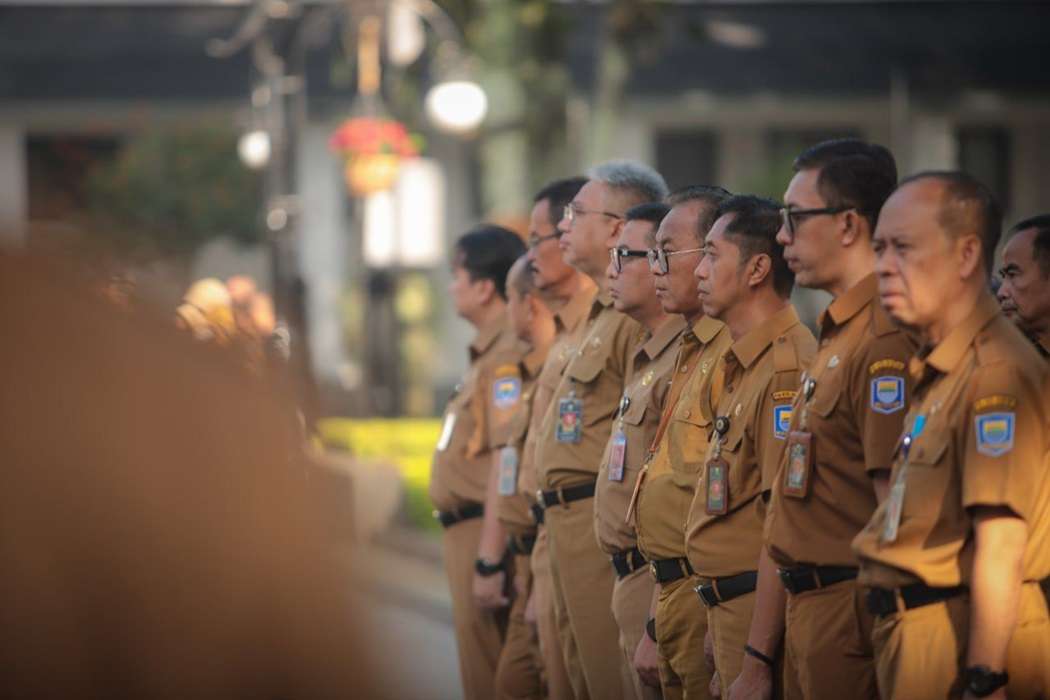
PORTALJABAR, BANDUNG CITY - The Bandung City Government (Pemkot) continues to encourage the transformation of the work culture of state civil servants (ASN) through the implementation of flexible work systems Work From Home (WFH) and Work From Office (WFO).
This policy was discussed in a talk show on Radio Sonata in collaboration with PR FM, together with the Head of the Bandung City BKPSDM, Evi Hendarin and the Head of the Procurement, Dismissal and Personnel Information Division of the Bandung City BKPSDM, Angga Fitrah Yulianto, Thursday (23/4/2026).
The Head of the Bandung City Human Resources Development Agency (BKPSDM), Evi Hendarin, explained that the WFH and WFO policies were motivated by the government's efforts to increase energy efficiency while encouraging the transformation of the ASN work culture to be more flexible and adaptive to current developments.
"Under certain circumstances, the government needs to adjust its work system to remain adaptive while conserving resources. However, most importantly, civil servant productivity remains maintained even though they are not always physically present in the office," he said.
According to Evi, the use of digital technology is key to supporting the implementation of this policy. Work is expected to continue to be carried out effectively from anywhere, as long as it remains within the applicable regulations.
"This is part of a strategic move to create a modern, flexible bureaucracy that is oriented toward results, not just attendance," he added.
Meanwhile, the Head of the Procurement, Dismissal, and Personnel Information Division of the Bandung City Human Resources Development Agency (BKPSDM), Angga Fitrah Yulianto, stated that ASN who are working from home are still required to comply with applicable regulations, such as wearing uniforms, performing electronic attendance three times a day (morning, afternoon, and evening), and remaining responsive during working hours.
"Discipline remains paramount. Civil servants are also not permitted to travel outside their domicile without official reasons while working from home," he explained.
The Bandung City Government has also implemented a technology-based monitoring system through an application integrated with network monitoring. This system allows ASN locations to be tracked based on registered coordinates.
"Presence can only be taken at designated locations, so it cannot be done haphazardly. This is to ensure accountability," said Angga.
Evi added that during the initial implementation of the policy, 1,354 civil servants were recorded as having their attendance recorded, with 137 detected outside the coordinate points. This finding was immediately followed up with confirmation from each regional government agency.
"If it cannot be accounted for, it will impact performance assessments and potentially result in sanctions," he said.
Nevertheless, Evi assured that public services are still running optimally. Several sectors that directly interact with the public, such as sub-districts, urban villages, and regional service agencies, are still carrying out their duties in person at the office.
"Public services will not be disrupted. In fact, this is being regulated to ensure they continue to operate optimally," he said.
Through this policy, the Bandung City Government hopes to create a more efficient, adaptive, and productive work system amidst the dynamic demands of a modern bureaucracy. (Bandung City Communications and Information Service/fka)
 Share News Via
 facebook
 twitter
 whatsapp
 email
email