

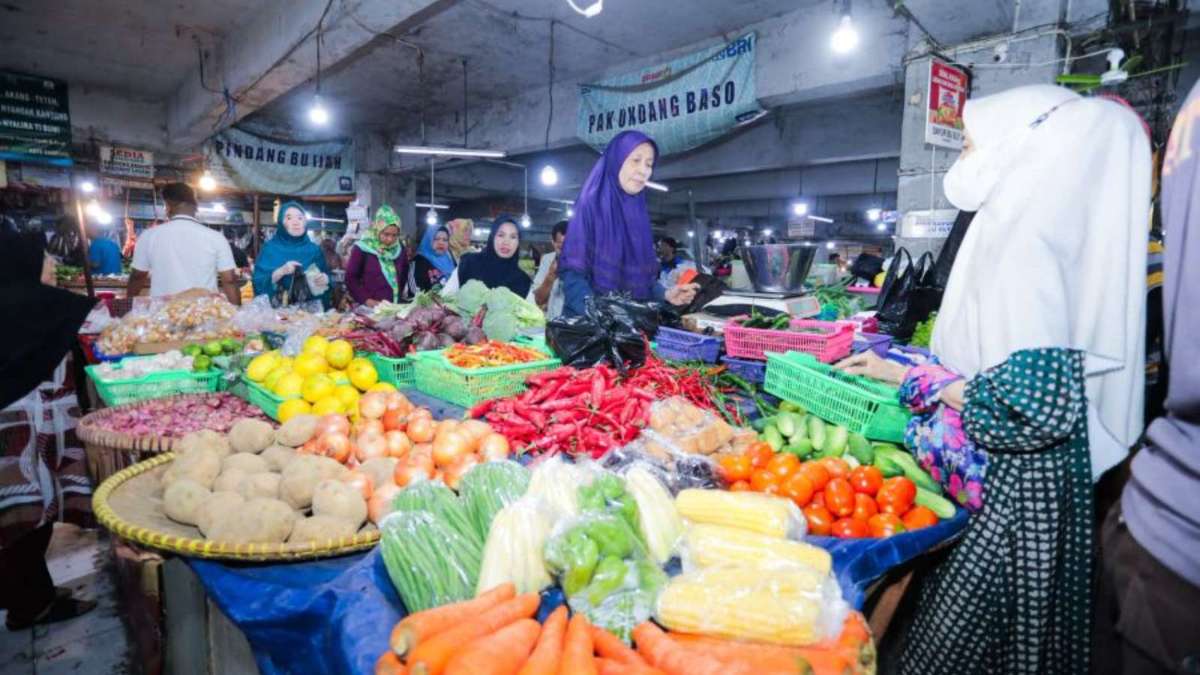
PORTALJABAR, BANDUNG CITY - The Bandung City Government (Pemkot) continues to monitor price movements of a number of food commodities that are considered sensitive to price increases, especially onions and chilies.
This condition has become a concern for the Bandung City Regional Inflation Control Team (TPID) to maintain price stability and public purchasing power.
Bandung Mayor Muhammad Farhan said that onions are one of the commodities that need attention due to the high demand from the people of Bandung City, especially for the culinary and tourism industries.
"Indeed, the most vulnerable prices are those of goods or commodities that we consider sensitive to price increases," said Farhan, Monday (10/8/2026).
According to him, the high demand for onions in Bandung is not comparable to production conditions in supplier areas, one of which is Brebes.
Onion productivity in the region is said to fluctuate, thus affecting supply and prices on the market.
"Bandung residents have very high demand for Brebes onions. Bandung residents have a wide appetite, as they typically purchase onions for tourism and the culinary industry. So, demand for Brebes onions is very high, while Brebes' productivity also fluctuates," he said.
In addition to shallots, the Bandung City Government is also monitoring the supply of a number of commodities originating from outside the region and imported, such as garlic and onions.
This condition is becoming increasingly concerning due to the potential for drought in a number of food production centers.
Farhan said that, based on the results of consultations with the Governor of West Java, the drought period is expected to last until October 2026.
"August to October isn't the planting season yet. The planting season starts in September. So hopefully, September and October won't be disruptive," he said.
To anticipate supply disruptions, the Bandung City Government is strengthening coordination with the Ministry of Agriculture, the Agriculture Service, and the Food Security Service.
The government ensures that fresh food supplies from various regions can continue to enter the city of Bandung.
According to Farhan, the supplies come from around 16 provinces and a number of imported commodities are distributed through the wholesale market, which is an important part of Bandung City's food supply chain.
"What we're doing now is ensuring that fresh food supplies from 16 provinces and imported ingredients can all enter Bandung through two or three main wholesale markets, which form the main supply chain network in Bandung," he explained.
On the other hand, market operations remain one of the Bandung City Government's instruments to maintain people's purchasing power.
The program is primarily directed at community groups deemed economically vulnerable based on mapping at the sub-district level.
"Market operations will continue, especially for those whose purchasing power is vulnerable, as indicated by the sub-district administration. These vulnerable groups will receive assistance to purchase these affordable goods," Farhan said.
However, Farhan reminded the public to understand that commodities sold in market operations have different characteristics and quality from premium products in modern markets.
"Please understand that cheap goods aren't as good as supermarket quality. For example, rice is sold at SPHP, but premium rice and specialty rice remain the same price," he said.
(Bandung City Communications and Information Service/rka)
 Share News Via
 facebook
 twitter
 whatsapp
 email
email