

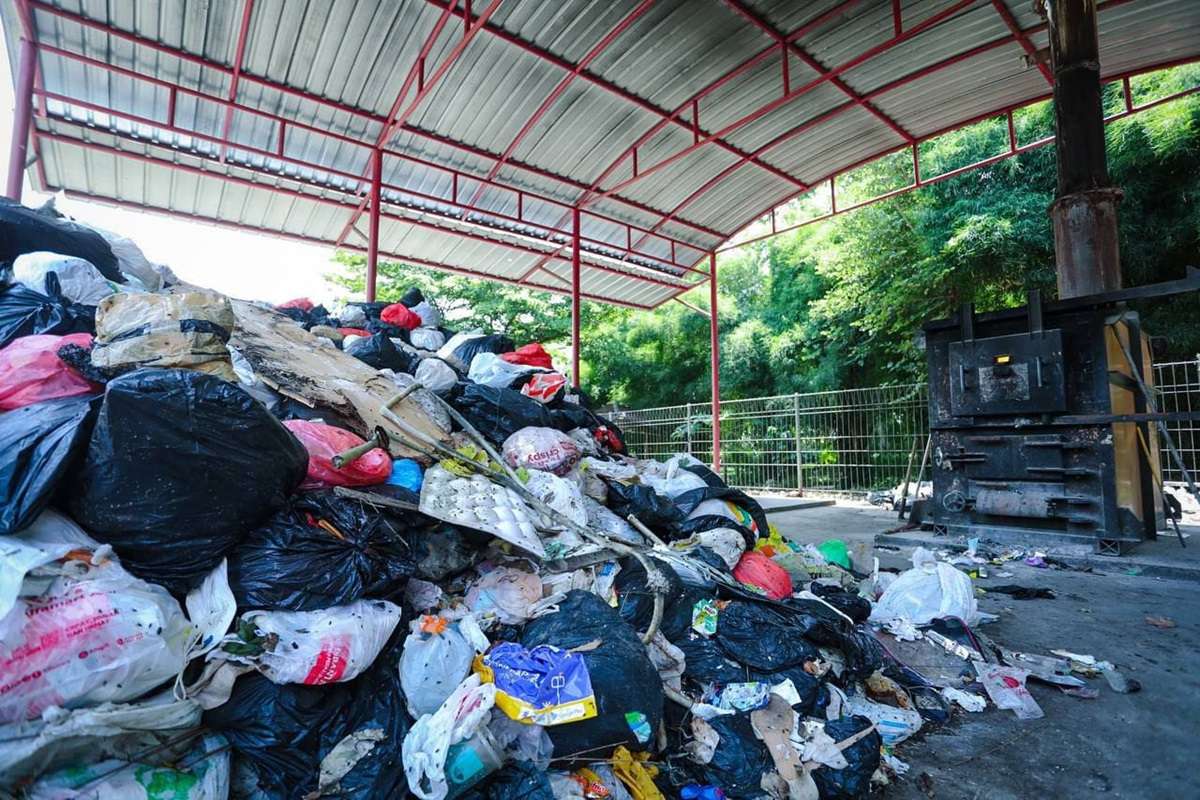
PORTALJABAR, BANDUNG CITY - The Regional Secretary (Sekda) of West Java Province, Herman Suryatman, said that his party had consolidated with universities in West Java to work together to handle waste management issues upstream.
Herman said that as many as 25,000 students will go into the field for three months starting in October 2026 to educate and assist the community in waste management.
Students will receive a conversion of activities into 10 credits and will be provided with modules and digital devices as implementation guides.
Regional Secretary Herman said that the large-scale program was a development of a trial in Arcamanik District, Bandung City, which involved around 500 students for three months.
Evaluation results of the program showed that student mentoring was able to reduce waste generation by around 20 percent while increasing waste sorting by two-fold.
This success will be replicated in approximately 52 sub-districts in the Greater Bandung area. The West Java Provincial Government has collaborated with sub-district heads and universities to prepare for implementation.
"The target is to reduce waste at source by 20 percent. If this target is achieved, of the approximately 5,000 tons of waste produced by Greater Bandung every day, approximately 1,000 tons can be reduced before reaching the Sarimukti Landfill," said Herman Suryatman, at the West Java Regional People's Representative Council (DPRD) Building, Tuesday (6/10/2026).
Meanwhile, the West Java Provincial Government is also encouraging the optimization of waste management facilities already available in regencies and cities throughout Greater Bandung. These include 3R waste disposal sites (TPS), sorting, RDF (Recyclable Waste Disposal), composting, maggot cultivation, and various other processing technologies, all tailored to the characteristics of the waste and the conditions of each region.
Herman assessed that many facilities are actually in place, but they are not functioning optimally. One problem is that incoming waste is not sorted, preventing certain processing technologies from working optimally.
He cited the example of maggot cultivation facilities, which require sorted organic waste. When the waste is mixed with plastic and other materials, the facility cannot be utilized optimally.
"No matter how great the technology, the key remains human capital. Behavioral issues aren't something you can easily fix, but they must be addressed," he said.
Therefore, the West Java Provincial Government's strategy utilizes two simultaneous approaches: technology engineering and social engineering. Technology is continuously developed, while behavioral change is driven massively through education and direct mentoring.
Herman said that all these steps are expected to provide space for the West Java Provincial Government to extend the operational period of the Sarimukti TPA until December 2029. Before finally processing waste into electrical energy or Waste to Energy at the Legok Nangka TPPAS officially becomes fully operational in 2030 as a long-term solution.
"The Governor hopes that Sarimukti can be operational by December 2029. We are working on the upstream, midstream, and downstream," he said.
According to him, the Greater Bandung waste problem can no longer be viewed solely as a government matter. Public participation is crucial, as most problems stem from the source of the waste itself.
Herman cited the continued discovery of piles of trash in several locations that appear clean at first glance, but are actually hidden. This situation demonstrates that the waste problem cannot be solved simply by transporting it from one location to another.
"We can't just keep on carrying things around without comprehensive action. It's time for the community and all stakeholders to participate," Herman stressed.
Therefore, he invited the residents of Greater Bandung to start reducing waste production, sorting waste from the source, and utilizing waste that still has utility value.
"Regional governments have taken action, universities have taken action, and Scouts have taken action. Let's get the community moving too," he said.
According to Herman, a 20 percent reduction would have a significant impact on the Greater Bandung area's waste management system. With stronger public participation, this reduction could even exceed the target.
"This is no longer just a matter of duties and functions. This is about our self-respect," said Herman.
By implementing upstream, midstream, and downstream strategies simultaneously, the West Java Provincial Government hopes to prevent the threat of a waste crisis in Greater Bandung. Herman said the decision cannot be postponed any longer; all parties must act before the waste problem escalates into an uncontrollable explosion.
 Share News Via
 facebook
 twitter
 whatsapp
 email
email