

PORTALJABAR, BANDUNG CITY - The West Java Provincial Government (Pemprov) through the West Java Education Office (Disdik) continues to strive to ensure that all school-age children have access to education.
One of the steps taken is to establish cooperation with private cooperative schools (SSK) to accommodate prospective students who are not accommodated in public schools in the 2026 New Student Admission System (SPMB).
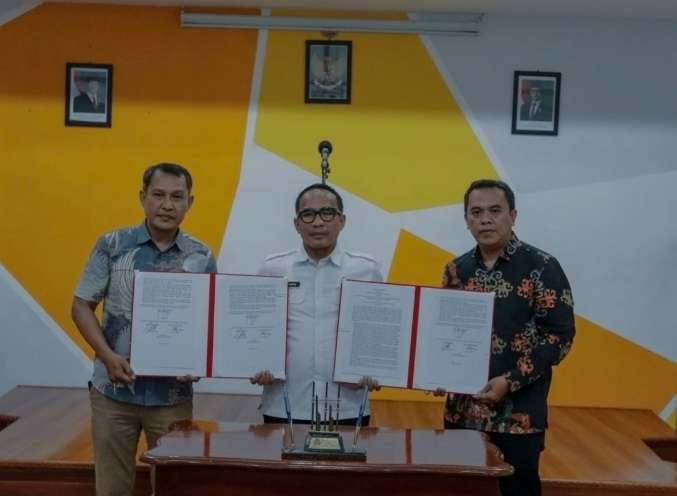
The collaboration was marked by the signing of a joint agreement between the Governor of West Java, represented by the Head of the West Java Education Office, Purwanto, and representatives of private high school and vocational school principals in West Java, which took place at SMKN 1 Bandung, Monday (15/6/2026).
The Head of Education explained that this policy is a form of government intervention after mapping prospective students through a series of SPMB processes.
"This is a form of intervention by the West Java Provincial Government following the mapping process. From that mapping, we learned that there are still children who cannot be accommodated. Therefore, the government wants to continue providing the best educational services to the community," he said.
According to him, the Governor has directed that all children in West Java continue to have access to education. Due to the limited capacity of public schools, the government has provided a solution through collaboration with private schools.
"The Governor has explained to us how to ensure all children in West Java have access to education. The government's limited capacity must be addressed through various interventions, one of which is collaboration with private schools," he said.
Based on mapping conducted by the West Java Education Office, approximately 78,000 prospective students are estimated to be unable to be accommodated in public schools. To ensure they can continue their education, the West Java Provincial Government is providing educational assistance to students attending partner private schools.
The Head of Education explained that the assistance prepared includes assistance in the form of an Education Contribution Fund (DSP) or initial fee of IDR 1.5 million per student, as well as monthly education fee assistance of IDR 100 thousand per month or IDR 1.2 million per year.
"Because they basically intended to attend public schools but couldn't find the right places, the government provided assistance as a form of support so they could continue their education," he said.
He added that the assistance is intended for prospective students who have completed the SPMB (Admission Test) for Senior High Schools (SMA), Vocational High Schools (SMK), and Special Needs Schools (SLB) in West Java. This includes applicants who did not pass the SPMB selection for Superior Human Schools (SMA) and those not mapped in the New Student Prospective Mapping (PCMB) process. The government is currently developing a technical mechanism for distributing the assistance to ensure its effective and targeted implementation.
Meanwhile, 751 private schools have registered to participate in the collaborative program. However, this number will still undergo a curation process before being designated as partner schools.
"We certainly want to ensure that participating schools have adequate facilities and infrastructure, sufficient teachers, and meet the required quality standards. Therefore, all schools that register will first go through a curation process," he explained.
The Head of the Education Office emphasized that all these policies are part of the West Java Provincial Government's commitment to ensuring that no child loses the opportunity to receive an education simply because of the limited capacity of public schools.
Through the mapping conducted as part of the SPMB (School of Vocational Education) series, the government can obtain a more accurate picture of educational needs, enabling targeted interventions to be implemented and provide benefits. The West Java Provincial Government Prepares Educational Assistance for Students Not Accepted in Public Schools. (Apun)
 Share News Via
 facebook
 twitter
 whatsapp
 email
email