

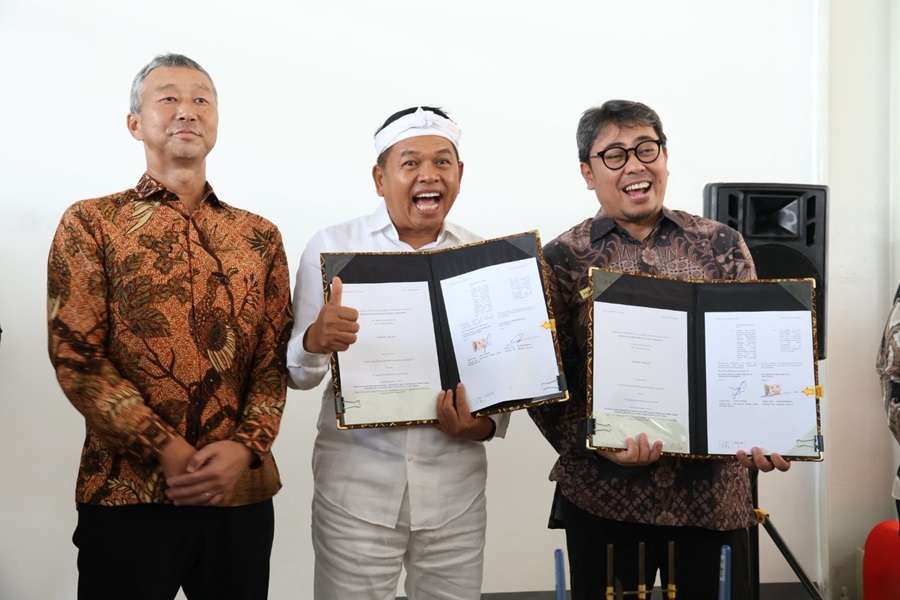
PORTALJABAR, INDRAMAYU REGENCY - The West Java Provincial Government together with PT Jabar Environmental Solutions (PT. JES) officially signed the Amendment and Restatement of the Cooperation Agreement for the Government-to-Business Entity Cooperation Project (KPBU) for the Legok Nangka Regional Final Waste Processing and Processing Site (TPPAS).
This strategic step marks a new chapter and strengthens the commitment of both parties to accelerate the realization of modern, environmentally friendly technology-based waste management infrastructure in West Java.
The signing ceremony was conducted by the Governor of West Java, as the Person in Charge of the Cooperation Project (PJPK), and Kenichi Ishikawa, Director of PT. JES, on Friday (June 5, 2026) in Indramayu Regency. The event also saw the signing of a Guarantee Agreement between PT Penjaminan Infrastruktur Indonesia (PT. PII) and PT JES, followed by the handover of a Regression Agreement from the West Java Provincial Government to PT PII.
This change and restatement of the PKS was made to accommodate a number of recent technical, financial, and regulatory adjustments to ensure the project runs more accountably, efficiently, and sustainably. The Legok Nangka Regional Waste Processing and Landfill (TPPAS) is projected to be able to process waste from the Greater Bandung metropolitan area (Bandung City, Bandung Regency, West Bandung Regency, Cimahi City), Garut Regency, and Sumedang Regency with a capacity of up to 2,131 tons per day using Waste-to-Energy (WtE) technology or Waste Processing into Electrical Energy (PSEL).
West Java Governor Dedi Mulyadi stated that the Legok Nangka TPPASR is expected to be a long-term solution to support regional waste management.
"The Legok Nangka Regional TPPAS will reduce dependence on final disposal facilities that are experiencing capacity limitations," said Dedi.
With the signing of this agreement, the next stage is the fulfillment of financing (financial close), which is targeted for completion by the end of 2026, followed by the acceleration of physical construction on the ground.
 Share News Via
 facebook
 twitter
 whatsapp
 email
email