

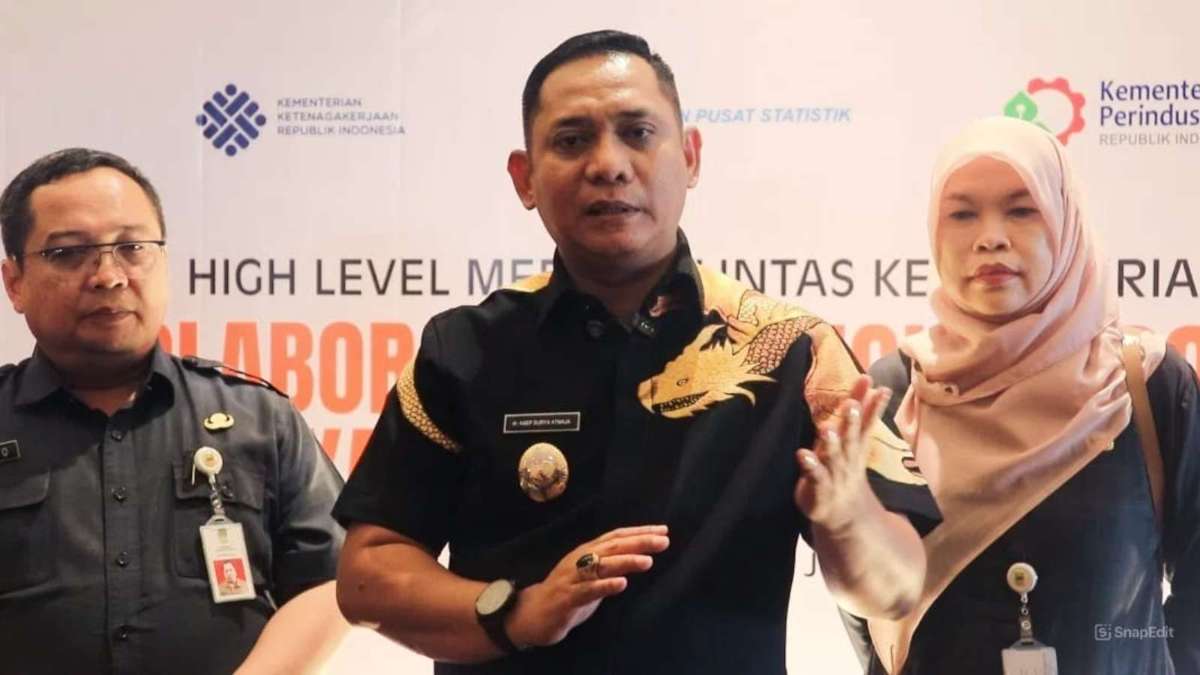
PORTALJABAR, BEKASI REGENCY - The Bekasi Regency Government continues to strengthen its strategic efforts to prepare competent human resources (HR) through the development of vocational education and training based on industry needs.
This effort is believed to be a solution to reduce unemployment rates while increasing the competitiveness of local workers amidst the rapid growth of industrial areas.
The commitment was conveyed by the Acting Regent of Bekasi, Asep Surya Atmaja, after attending the Cross-Ministry High Level Meeting (HLM) themed "Strategic Collaboration of the 2026 Economic Census, the Foundation of Future Industrial Competitiveness" held by the Central Statistics Agency (BPS) of West Java Province at the Nuanza Hotel & Convention, Jalan KH Makmun Nawawi, Km.40 No.17, Pasirsari Village, South Cikarang District, Tuesday (21/7/2026).
The event was also attended by the Minister of Manpower, Prof. Yassierli, and the Head of BPS RI, Amalia Adininggar Widyasanti.
"Bekasi Regency still has an unemployment rate of around eight percent. Therefore, we need to strengthen the Vocational Training Centers (BLK) and vocational education that truly aligns with industry needs," said Asep Surya Atmaja.
According to him, Bekasi Regency, as the largest industrial area in Southeast Asia, offers significant opportunities to absorb local labor. However, these opportunities must be balanced with the competency readiness of job seekers to meet the ever-growing needs of companies.
"If we provide training but the training doesn't align with the company's needs, the results will certainly not be optimal. Therefore, what must be done is to align industry needs with the training material," he said.
Asep explained that the Bekasi Regency Government will strengthen collaboration between the Manpower Office and industrial estate managers to periodically map labor needs. Based on this mapping, the government will develop vocational training programs that are more adaptive to developments in the business and industrial world.
"I will invite eleven industrial estates to sit down with us. We want to know in detail what kind of workforce companies need. After that, we will prepare them through vocational programs and job training," he stressed.
He believes this model will create stronger connections between education, training, and the world of work. This way, training graduates will no longer experience a competency gap when entering the job market.
"Our children must be prepared from the start. Don't let companies find themselves in need of workers whose competencies are mismatched. Vocational education must bridge the gap between industry needs and the readiness of the local workforce," he said.
Asep admitted that he had also discussed directly with the Minister of Manpower regarding strengthening vocational programs in Bekasi Regency.
Given that this region is one of the national industrial centers, central government support is considered crucial to expanding access to job training relevant to technological developments and the needs of modern manufacturing.
"We have proposed to the Minister that strengthening vocational training in Bekasi Regency be a priority. Bekasi is home to the largest number of companies in Indonesia, so it needs to be supported by human resources who are truly ready to work," he said.
In addition to improving workforce competency, synergy between local governments and industry is also expected to increase opportunities for local employment. According to Asep, the presence of thousands of companies in Bekasi Regency should have a tangible impact on improving the welfare of the surrounding community.
"We want to strengthen the collaboration between local governments and companies. We will provide what industry needs through education and training. This way, the people of Bekasi Regency will have greater job opportunities," he said.
(Bekasi Regency Communications and Information Service/rka)
 Share News Via
 facebook
 twitter
 whatsapp
 email
email