

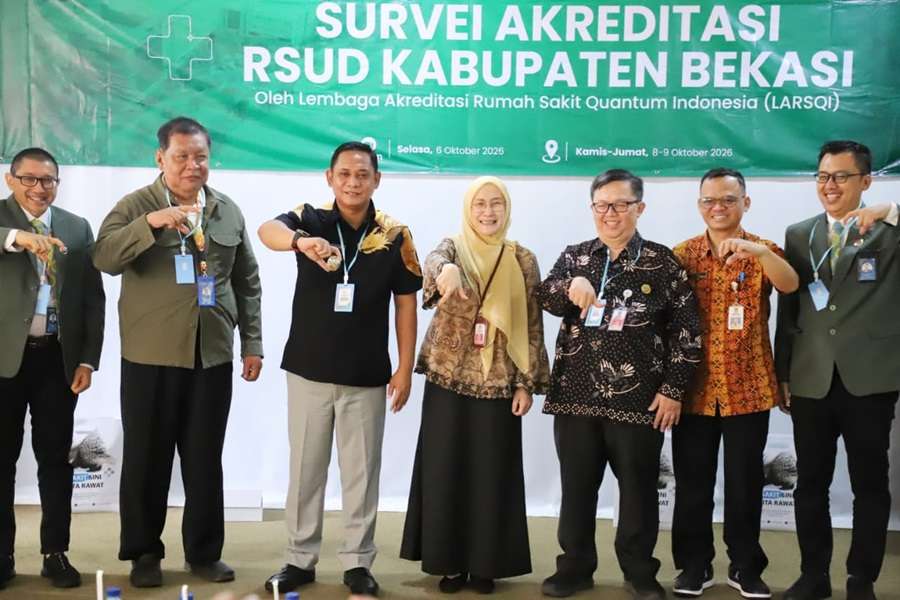
PORTALJABAR, BEKASI REGENCY - Acting Regent of Bekasi Asep Surya Atmaja emphasized that the accreditation survey of Bekasi Regency Hospital must encourage improvements in service quality and patient safety (8/10/2026).
This affirmation was conveyed when opening the accreditation survey by the Quantum Indonesia Hospital Accreditation Institute (LARSQI) at Bekasi Regency Hospital, Cibitung.
Asep emphasized that accreditation should not merely fulfill administrative requirements, but must ensure that service standards are implemented in daily hospital activities.
"For us, accreditation is not just about fulfilling an administrative obligation, but a crucial part of ensuring that healthcare services consistently meet quality standards and prioritize patient safety," Asep said.
According to Asep, the large population of Bekasi Regency means that regional hospitals must maintain professionalism and ensure services meet the needs of the community.
"The most important thing is maintaining quality and ensuring patient safety. Therefore, I hope all healthcare workers will continue to work professionally within their competencies," he said.
He hopes that the independent assessment can identify service deficiencies and serve as a basis for ongoing hospital improvements.
"We hope this process will be productive, open, and constructive. We also ask for guidance and direction so that the identification process can continue to drive improvements and enhance the quality of service," he said.
Director of Bekasi Regency Hospital, Sri Enny Mainiarti, explained that the survey covered service standards, performance, administration, and various Ministry of Health regulations.
"We must complete the assessment elements in accordance with the Ministry of Health's regulations. This accreditation process is ongoing and must be maintained," Sri Enny explained.
He emphasized that the implementation of quality standards must continue after the survey is completed to ensure that patient safety remains a priority in every service.
"When we go to school, we study, and then we have to take an exam. Now we're taking the exam. But the knowledge must be applied continuously. Quality is paramount, providing optimal service to ensure patient safety," he said.
According to Sri Enny, patient safety also depends on the readiness of medical equipment, infrastructure, electrical systems, water availability, and hospital operational systems.
"Patient safety isn't just about doctors working well or nurses being good. Equipment, facilities, electrical systems, water, and other things must all support the service," he stressed.
The survey also provides an opportunity for hospitals to evaluate public complaints, particularly regarding patient waiting times and staff friendliness.
"There have indeed been several patient complaints, such as long waiting times at the hospital and perceived unfriendly service. We will review these issues as they are part of the quality of service," he said.
Sri Enny explained that medical procedures and operations sometimes affect doctors' schedules, but these conditions still need to be evaluated to ensure timely service.
For emergency preparedness, Bekasi District Hospital has conducted a fire simulation to ensure staff understand patient safety and evacuation procedures.
"If a fire occurs, everyone must know what to do and how to evacuate. We already have a simulation, and it demonstrates our readiness to handle emergencies," he said.
Bekasi Regency Hospital also continues to develop the Hospital Management Information System (SIMRS) in stages to support the needs of health services and personnel.
"If you say it's progressed, it's pretty good. But it must continue to evolve. We'll continue to implement the SIMRS we currently use and continue to develop it gradually," he said.
Regarding the target of full accreditation, Sri Enny emphasized that improving the quality and readiness of facilities and infrastructure remains a priority, regardless of the assessment results.
"We all certainly hope for perfection. But the most important thing is that we improve ourselves first. Whatever the outcome, the process of learning and improvement is far more important than the outcome," he said.
Sri Enny said the Bekasi Regency Government supports improving hospital services by considering development needs and regional budget capacity.
"The leadership, including the Regent, has supported us. Of course, this support is tailored to the budget ceiling and the regional government's capabilities, as development and service needs also fall within other regional agencies," he explained.
Going forward, Bekasi Regency Hospital will continue to improve services and maintain infrastructure so that quality improvement becomes a work culture, not just preparation for accreditation.
"We hope that the work ethic of all our colleagues at Bekasi Regency Hospital will continue to improve. Improvements will not only be made to service performance, but also to infrastructure," Sri Enny concluded.
(Bekasi Regency Communications and Information Service/bhf)
 Share News Via
 facebook
 twitter
 whatsapp
 email
email