

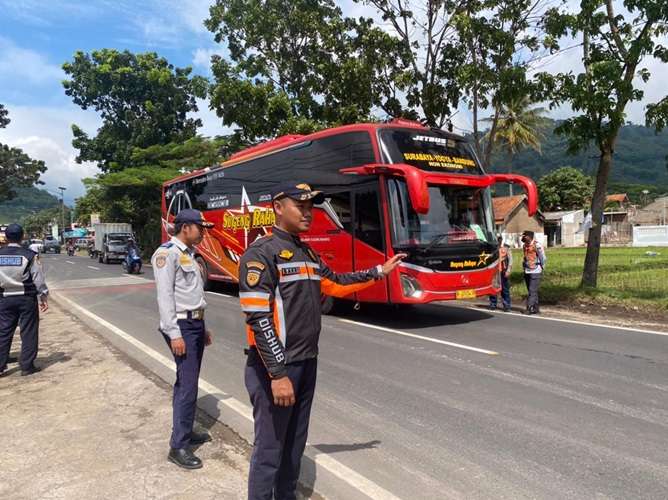
PORTALJABAR, BANDUNG CITY - The peak of the homecoming (mudik) traffic is estimated to occur three days before Eid al-Fitr 2026, or Wednesday (March 18, 2026). As many as 8.9 million West Java residents will return home during that time.
The Head of the West Java Transportation Agency, Dhani Gumelar, estimates that most travelers choose to depart after the pre-dawn meal, between 4:00 and 10:00 a.m. The number of travelers during that time is estimated to reach 21.68 million.
Travelers are advised to choose their departure times wisely to avoid getting stuck in traffic. Travelers will be less numerous between 12:00 AM and 4:00 AM and 11:00 AM and 11:00 PM.
The peak return flow is expected to occur on two separate days: D+2 of Eid al-Fitr, or Tuesday (March 24, 2026), and D+6 of Eid al-Fitr, or Saturday (March 28, 2026). An estimated 4.12 million people will return to their homes on D+2 of Eid al-Fitr, and 3.9 million on D+6 of Eid al-Fitr.
"The homecoming travelers are expected to return home after dawn, around 5:00 a.m. to 10:00 a.m.," Dhani said on Monday (March 9, 2026).
The total number of travelers returning to their homes during this period is predicted to reach 19.34 million. The fewest travelers are expected to return between 11:00 PM and 12:00 AM.
Homecoming route
Dhani said that 14.18 million travelers will travel the Trans-Java toll road (Japek-Cipali-Palikanci). Other routes expected to be busy include Bandung-Cileunyi-Nagreg-Limbangan-Malangbong-Tasikmalaya-Ciamis-Banjar, with a total of 2.9 million travelers.
The Cikampek-Cipularang-Padaleunyi toll road is also expected to be busy with a total of 1.96 million homecoming travelers.
"Most of the homecoming travelers will be traveling by car, with a total of 16.75 million people," said Dhani.
Garut Destination
As many as 25.6 million West Java residents are estimated to travel during Eid al-Fitr 2026. Garut Regency is the largest destination with 2.94 million visitors.
Dhani said that of the 25.6 million people who traveled, the majority, or 24.86 million (96.73 percent), traveled home. The remaining 0.5 million (1.9 percent) traveled for tourism, 0.29 million (0.118 percent) visited their hometowns, 0.01 million (0.023 percent) worked, and 0.05 million (0.18 percent) engaged in other activities.
 Share News Via
 facebook
 twitter
 whatsapp
 email
email