

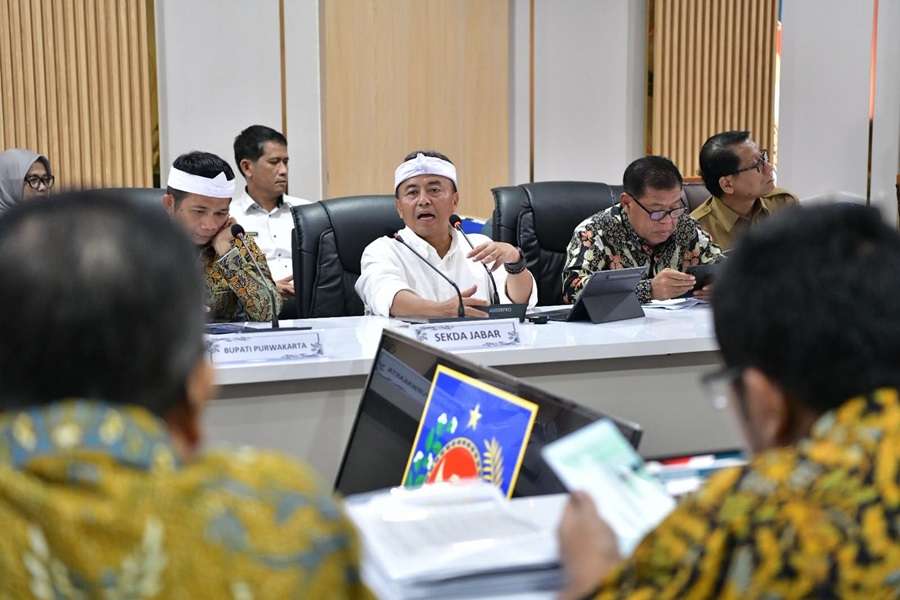
JAKARTA - The West Java Provincial Government is promoting the Rebana Metropolitan area as a new driver of economic growth in West Java, as well as a key component in strengthening the region's contribution to the target of "Indonesia Maju Menuju Indonesia Emas 2045."
This was conveyed by the Regional Secretary of West Java Province, Herman Suryatman, in the JCC Meeting regarding the cooperation of the Japan International Cooperation Agency (JICA) in the Rebana area, which took place in the Graha Sawala Room, Ali Wardhana Building, Coordinating Ministry for Economic Affairs, Jakarta, Tuesday (29/9/2026).
Herman said that the development of Rebana is strategically positioned because the area still has ample room for economic growth, unlike metropolitan areas that already face limited development space.
According to him, Rebana has a number of important assets, starting from industrial areas, transportation infrastructure, West Java International Airport (BIJB) Kertajati, ports, the agricultural sector, tourism, to investment potential that is still very large.
"If we want to make West Java a special place, moving towards a more developed Indonesia, one of the keys is how we develop Rebana. This area has great potential and still has ample room for development," said Herman.
Therefore, Herman believes Rebana must be overseen through integrated planning and execution. Therefore, the Rebana development master plan, developed in collaboration with JICA, must not remain a planning document but must be translated into concrete programs on the ground.
"A master plan shouldn't just look good on paper. We need to analyze it together, provide feedback, ensure it fits the conditions on the ground, and then execute it together," he said.
Herman emphasized that the seven regencies/cities within the Rebana area play a key role in determining the success of the region's development. He said the provincial and central governments should strengthen support, facilitate, and synchronize policies.
Therefore, he asked the regional government in the Rebana area to actively provide input on the development plan currently being prepared. He believes the document still has room for refinement until it becomes a shared concept that truly reflects the needs and potential of each region.
"This isn't just about the government's interests today, but also the fate of our children and grandchildren. If we take the wrong steps in the next five years, the impact will be long-lasting. If we take the right steps, we can build a strong foundation for the future," Herman said.
In addition to investment, Herman reminded that Rebana's development strategy must maintain four main components of economic growth, namely government spending, public consumption, investment, and exports.
He believes government spending in the Rebana area needs to be directed toward accelerating infrastructure development and creating a multiplier effect for the local economy. At the same time, public purchasing power must be maintained by controlling inflation and ensuring the availability of basic necessities.
"If inflation is controlled, people's purchasing power is maintained. If purchasing power is maintained, people's consumption can grow. This is important because consumption contributes significantly to the economy," he explained.
On the investment side, Herman noted that several industrial areas in Rebana have shown significant growth. He hopes this increased investment will continue to be monitored to create jobs and directly impact community well-being.
Poverty reduction
According to Herman, Rebana's economic growth must also go hand in hand with poverty and unemployment reductions. He cautioned that the region's growth as an industrial hub should not create a gap between economic growth and the well-being of the surrounding community.
"Rebana must be inclusive. Economic growth must be accompanied by a reduction in poverty and unemployment. We must ensure that economic growth occurs without the communities surrounding the industrial area experiencing any benefits," he said.
In addition to the economic aspect, Herman highlighted a number of homework assignments that need to be completed, including waste management, infrastructure quality, inter-regional connectivity, and optimization of West Java International Airport.
He stated that the existence of BIJB Kertajati is a crucial node in the Rebana ecosystem. In addition to its commercial aviation function, the airport area's development is also geared towards supporting industrial activities, including the development of the Maintenance, Repair, and Overhaul (MRO) sector.
"The airport and port are already in place. The infrastructure is starting to be built. It just remains to be seen how we integrate all these nodes to truly create a productive economic ecosystem," he said.
Herman also pushed for improvements in the quality of regional infrastructure, particularly access to industrial areas and new growth centers. Adequate infrastructure is considered a crucial prerequisite for providing certainty for investors and increasing public mobility.
In the context of cooperation with JICA, Herman hopes that Japan's experience and expertise can help West Java develop a regional development model that is not only oriented towards economic growth, but also sustainability and equitable distribution of development benefits.
He emphasized that Rebana's success ultimately depends on the ability of all stakeholders to work together. The central government, the West Java Provincial Government, seven regional governments, the business community, and international partners need to share a common vision and work within a unified development orchestration.
 Share News Via
 facebook
 twitter
 whatsapp
 email
email