

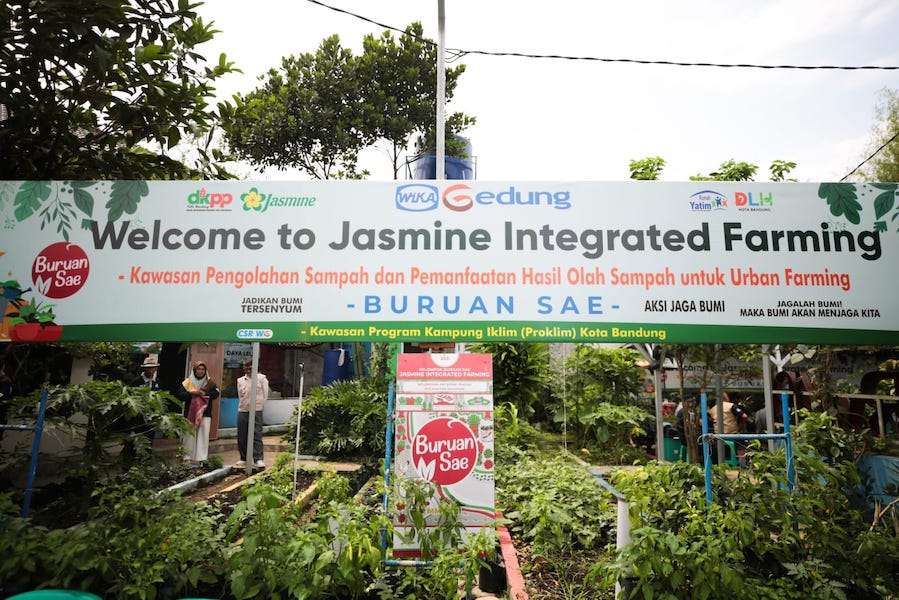
PORTALJABAR, BANDUNG CITY - RW 19 Antapani Tengah Village, Antapani District, Bandung City continues to show success in the independent waste management program that began in 2014. Residents actively sort and manage waste through Jasmine Integrated Farming, making the environment cleaner and winning an award as the champion of the Climate Village Program (Proklim) at the middle level.
One of the administrators of Jasmine Integrated Farmin Yanti explained that every week the waste bank receives around 350 kg of sorted waste.
"Some of our waste is donated to scavengers, some is managed in a waste bank. Some is also donated to people in need," he said, Monday (10/15/2024)
Waste generation from around 900 people 301 families, per day 450 kg of waste per day. Average organic 800-1 ton per week. Approaching fasting can increase to 1.5 tons.
Waste sorting in RW 19 is divided into several categories, namely organic, residue, and special waste such as B3.
Organic waste is processed into compost, maggot feed, and local microorganism liquid fertilizer (MOL). With this approach, no organic waste ends up in landfills. Residues such as diapers, tissues, and other hazardous waste are channeled to a special Dropbox.
In addition to organic waste, the waste bank also accepts used cooking oil which will be further utilized. On average, the residual waste produced in one week is equivalent to one triseda or one cubic.
According to the Head of RW 19 Antapani Tengah Village, Dodi, efforts to educate residents began with a door-to-door approach, while distributing buckets and providing trolleys in each RT.
"We provide continuous education to the community so that they understand the importance of waste sorting," he said.
In fact, waste collectors, including "cart drivers" are trained to ensure that the waste remains separate when being transported so that it does not get mixed up again.
At the sub-district level, Antapani Tengah Village Head Teguh Haris Pathon emphasized that the focus is on waste sorting with a target of each RT collecting around 130 kg of sorted waste per week. Currently, 60 percent of the 24 RW in the area have actively sorted waste.
The collected organic waste is processed using the open windrow or brick tetawang method. This program has attracted the attention of various parties, including visits from other regions and academic circles.
Compost harvesting is done every 40 days. This is one of the indicators of the success of sustainable waste management.
The waste management program in RW 19 Antapani Tengah not only has a positive impact on environmental cleanliness, but also reduces the amount of waste that must be disposed of in landfills, making it a real example of successful community-based waste management.
 Share News Via
 facebook
 twitter
 whatsapp
 email
email