

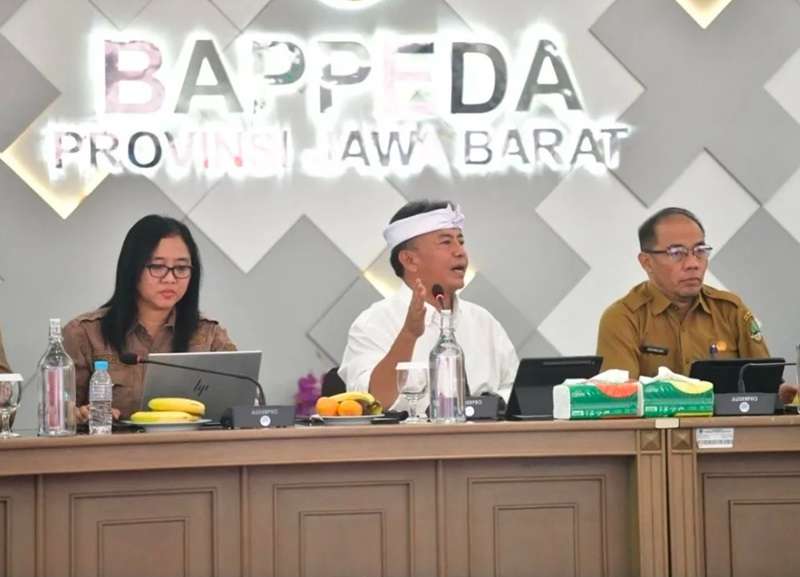
PORTALJABAR, BANDUNG CITY - The Regional Secretary of West Java Province, Herman Suryatman, asked the Heads of the Regional Development Planning Agency (Bappeda) of 27 regencies/cities throughout West Java to ensure that development policies and the eradication of sectoral problems are truly in line with the real needs of the community.
This message was conveyed by Herman while leading the Development Policy Synchronization Meeting with the Heads of Bappeda from 27 districts/cities throughout West Java at the West Java Provincial Bappeda Office, Bandung City, Monday (28/9/2026).
According to Herman, synchronization between provinces and regencies/cities is crucial because West Java's development achievements are ultimately the aggregate of achievements across all regions. West Java Province does not have a distinct territory or population, but rather is entirely located across 27 regencies/cities.
"The province's achievements are aggregate. The province doesn't have a single resident, not even an inch of land. Everything is divided among 27 districts/cities," Herman said.
Therefore, Herman emphasized the need for alignment from the RPJMD (Regional Medium-Term Development Plan), RKPD (Regional Work Plan), to the APBD (Regional Budget). He urged the Head of Bappeda to not stop at administrative planning functions but instead to ensure that regional development policies are accurately translated into budget priorities.
Herman also reminded local governments that they have approximately three and a half effective years to ensure that the regional head's development targets can be achieved by 2029. Evaluation is needed now to ensure that planning and budgeting do not proceed with a business-as-usual pattern.
"We're now evaluating the past year and a half. There are still about three and a half effective years to go. We must mitigate these challenges now to truly achieve the macroeconomic indicators we want to achieve by 2029," he said.
In this context, Herman asked the Heads of Bappeda in 27 districts/cities to utilize One Data West Java (SADA Jabar) as an instrument to strengthen data-based planning.
SADA Jabar integrates various sectoral data, including education, health, employment, poverty, social, and population data, and is linked to the National Social and Economic Single Data (DTSEN) and West Java development data. This system allows for more detailed mapping of community issues, including by name and address.
"The heads of Bappeda must start using data as a basis. We need to understand the issues in detail so that interventions can be appropriate," said Herman.
On that occasion, Regional Secretary Herman also highlighted several basic services that require attention, including road and bridge infrastructure, public street lighting, irrigation, waste management, and clean water provision. He stated that these priorities need to be considered based on the conditions of each region.
Waste Management
Herman Suryatman also highlighted the waste issue as one that requires cross-regional action. According to Herman, this issue cannot be viewed solely as a technical waste management issue. If not addressed from the planning and budgeting stage, it can develop into a broader public service issue.
"Don't let basic matters be handled too late. The Head of the Regional Development Planning Agency (Bappeda) must be the guardian of the regional budget (APBD), reminding the Regional Secretary and regional heads to at least pay attention to basic service standards," he said.
Herman emphasized that the Head of Bappeda must also have the courage to provide input to regional heads if budget allocations are deemed inadequate for development needs. He believes that courage to make corrections is necessary to ensure the Regional Budget truly benefits the community.
Therefore, Herman hopes that the consolidation he is carrying out will result in a common perspective between provinces and districts/cities, so that the evaluation recommendations will not remain as administrative documents, but will become the basis for improving policies and budgeting.
Meanwhile, the Head of the West Java Provincial Development Planning Agency (Bappeda), Dedi Mulyadi, said that synchronizing development policies and budgeting is becoming increasingly important amidst limited regional fiscal capacity.
According to Dedi, the fiscal situation, which remains dependent on central government transfers, must be balanced with the need to finance the visions and programs of each regional head. This situation demands a change in approach to development planning so that every available budget has maximum impact.
"Ultimately, it all comes down to budgeting. So, there are several policies we need to synergize with our colleagues in the districts and cities," said Dedi.
Dedi said the forum would provide a platform to discuss central, provincial, and district/city policies related to the implementation of development in 2026 and preparations for 2027.
He hopes that discussions with the Heads of Bappeda from 27 districts/cities can strengthen the connection between planning, control, evaluation, and budgeting, so that West Java's development policies move in one direction and become more measurable.
Strengthening the synchronization of planning and budgeting is in line with the West Java Bappeda agenda, which previously also placed the consolidation of planning and budgeting for 2026–2027 as an important part of regional development coordination.
(Rep pun/bhf)
 Share News Via
 facebook
 twitter
 whatsapp
 email
email