

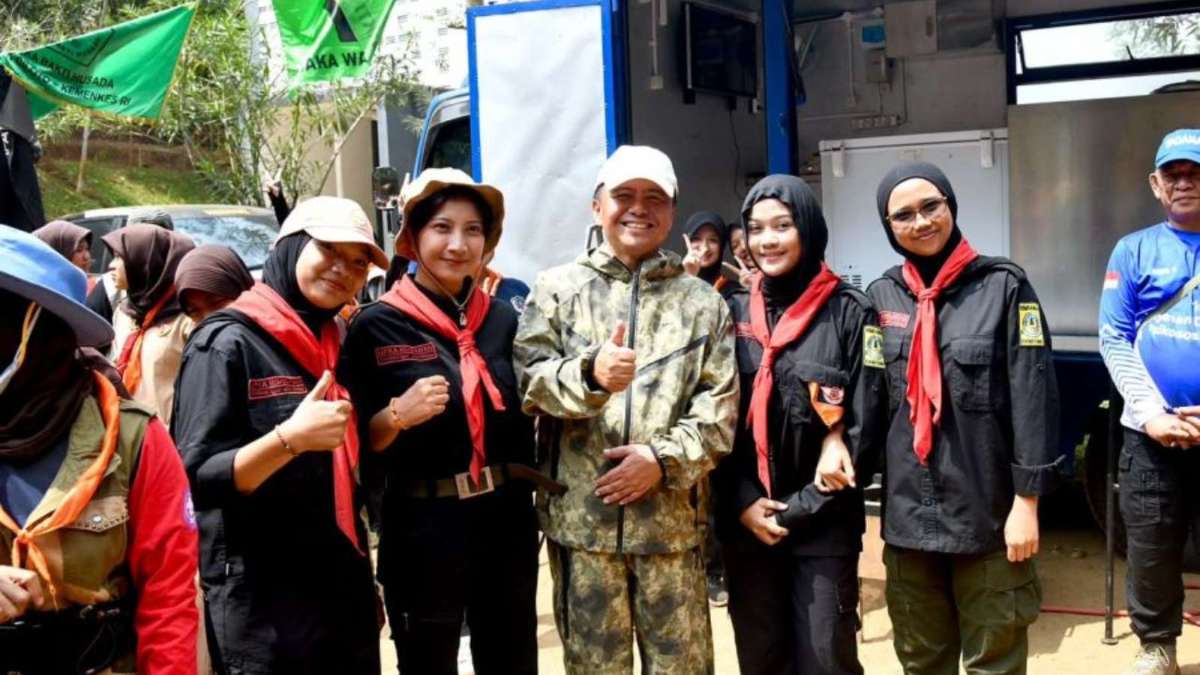
PORTALJABAR, BANDUNG REGENCY - West Java Provincial Secretary Herman Suryatman emphasized that disaster volunteers need more than just courage and a passion for helping. Volunteers must also possess knowledge, experience, skills, and the ability to read situations to ensure appropriate assistance and avoid adding to problems on the ground.
This message was delivered by Herman when he was the Ceremony Instructor and officially opened the 2026 Disaster Volunteer Jamboree and commemorated World Bamboo Day at Kampung Bamboo, Jalan Padasuka KM 04, Kampung Sukasari, Cimenyan, Bandung Regency, Saturday (12/9/2026).
The West Java Regional Secretary stated that West Java needs many volunteers with a humanitarian spirit. However, this volunteer spirit must be accompanied by adequate capacity, especially when dealing with dynamic and high-risk disaster situations.
"We need volunteers. But we need volunteers with knowledge and experience. Don't let the intention be to help, but in the field, it's actually the volunteers who need to be helped," said Herman.
According to Herman, the jamboree activity is an important momentum for volunteers to increase their capacity, starting from search and rescue , health, logistics, to other skills needed in disaster management.
He also reminded that experience doesn't always have to be gained through personal experience. Volunteers can learn from the experiences of others who have previously worked in various disaster situations.
"Don't let your intention to help actually make things difficult. Therefore, volunteers must be prepared. It's not just about courage, but most importantly, gaining knowledge and experience," he said.
Beyond technical skills, Herman Suryatman emphasized the importance of early detection and early reporting. He believes a spirit of volunteerism should sensitize someone to potential dangers and foster the initiative to take appropriate action.
"If you see a potentially dangerous situation, you must be able to detect it and report it so the situation can be handled immediately," said Herman.
Herman also encouraged volunteers to understand the increasingly complex characteristics of disaster situations through the VUCA concept— volatility, uncertainty, complexity, and ambiguity . These conditions, he said, require an appropriate response from each volunteer.
According to Herman, volatility or rapid change must be met with vision , namely having a clear vision of the purpose of volunteering. Meanwhile, uncertainty must be faced with understanding , namely understanding the situation comprehensively through accurate information.
To understand the situation, volunteers can use the 5W+1H principle, namely what, where, when, who, why , and how or what happened, where, when, who was affected, why it happened, and how to help.
Complexity must be addressed with clarity , the ability to clearly see the problem and prioritize actions. Ambiguity , or unclear situations, must be addressed with agility through effective communication and coordination to ensure all elements are moving in the same direction.
"So, volatility is answered with vision . Uncertainty is answered with understanding . Complexity is answered with clarity. And ambiguity is answered with agility ," said Herman.
Therefore, Herman encouraged volunteers to work based on data and a scientific approach. With these skills, volunteers are expected to be able to provide effective assistance while ensuring their own safety and the safety of the people they assist.
"Be a data-driven and science-based volunteer. God willing, your fellow volunteers will be part of the solution, not part of the problem," he said.
Meanwhile, the Chief Executive of the 2026 Disaster Volunteer Jamboree, Dede Koswara, said that the event, which will take place on September 11-13, 2026, will serve as a forum for fostering camaraderie, increasing capacity, sharing experiences, and strengthening synergy among disaster volunteers.
The Jamboree was attended by 453 participants, including high school and vocational school students, as well as disaster relief organizations and communities from various regions in West Java. Representatives from Palembang also participated. With chaperones and other supporting staff, the total number of participants and chaperones reached approximately 550.
Over three days, various activities were carried out, including registration and participant orientation, opening ceremonies, volunteering materials, training and practical sessions, field simulations, disaster preparedness activities, and education and conservation. The series of activities concluded with an evaluation and closing ceremony.
"Through this series of activities, we hope participants will not only gain new knowledge and skills, but also build networks and a spirit of togetherness in carrying out humanitarian tasks," said Dede.
Dede hopes that the jamboree will strengthen communication and synergy among volunteers, increase capacity in dealing with disaster situations, and raise awareness that disaster management is a shared responsibility.
"We hope this Jamboree can be the beginning of broader collaboration and build volunteers who are resilient, skilled, and solid, ready to help the community when disaster strikes," he said.
He also expressed his appreciation to the government, related agencies, volunteer organizations and communities, resource persons, facilitators, jury, sponsors, activity partners, committee, and all participants who have supported the implementation of the 2026 Disaster Volunteer Jamboree.
Dede emphasized that the activity is not expected to remain a ceremonial agenda, but rather a momentum to strengthen brotherhood, increase capacity, build networks, and simultaneously create strong and alert West Java volunteers.
"Let's work together to build a strong, alert West Java volunteer community and a community that is empowered to face disasters," he concluded.
WEST JAVA PUBLIC RELATIONS
Head of the Communication and Information Service of West Java Province
Adi Komar
 Share News Via
 facebook
 twitter
 whatsapp
 email
email