

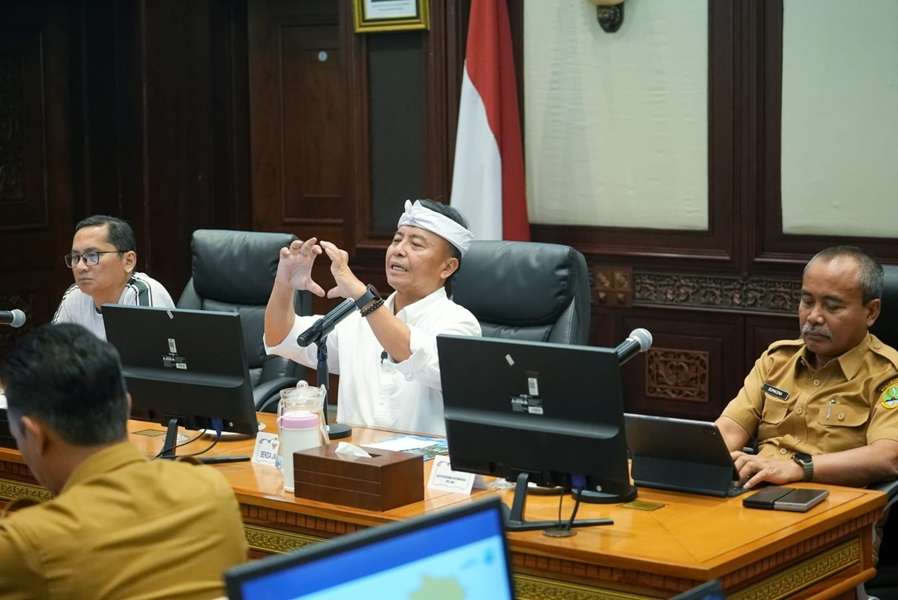
PORTALJABAR, BANDUNG CITY - The Regional Secretary of West Java Province, Herman Suryatman, encouraged all Assistants for Economic and Development (Ekbang) in regencies/cities throughout West Java to strengthen their roles as drivers of economic development in their respective regions.
Beyond simply carrying out administrative tasks, the Economic and Development Assistant is required to work more substantively, quickly, measurably, and data-driven.
This message was delivered by Herman while leading the Coordination Meeting of the Assistants for Economic and Development throughout West Java in the Papandayan Meeting Room, Gedung Sate, Bandung City, Monday (21/9/2026) afternoon.
According to Herman, West Java's development cannot be carried out partially or with a separate mindset between the provincial and district/city governments. West Java is an aggregate of 27 districts/cities, so the province's progress depends heavily on the performance of each region.
"West Java is an aggregate. If villages and sub-districts are special, they will produce special sub-districts. Special sub-districts produce special regencies and cities. Special regencies and cities will become special provinces," Herman said.
Therefore, he emphasized the importance of synergy between provincial, district/city, and sub-district governments, as well as villages/sub-districts. Furthermore, the Governor serves as both regional head and representative of the central government in the region.
"We can't think in silos or think of a great province without great regencies and cities. Everything is interconnected," he said.
Herman specifically emphasized the importance of the role of the Economic and Development Assistant, as they occupy a strategic position in assisting regional heads in formulating and coordinating economic development policies.
He mentioned a number of economic indicators that are of concern, ranging from public consumption, investment, trade to government spending.
"If the regional economy is poor, the implications are low investment, low exports and imports, and low public consumption. Therefore, the Economic and Development Assistant is one of the parties responsible," he said.
On that occasion, Herman also pushed for changes in bureaucratic work patterns. He argued that government should not stop at political processes and governance, but must also be able to enter the administrative process, ensuring that policies are translated into effective government services and actions.
He emphasized that a change in political leadership should not halt the work of government. The government system must continue to function, and public services must continue to operate.
"What we need is a systemic government. Governments change, but the show must go on. The government must remain effective," he said.
Herman then introduced the strengthening of data-driven governance as part of the West Java Provincial Government's ongoing transformation. One of the instruments being promoted is One Data West Java (SADA Jabar), which is expected to support district/city governments in understanding regional conditions and determining more appropriate interventions.
According to Herman, utilizing the West Java SADA platform is important so that development data does not remain merely statistics but can serve as a basis for decision-making at all levels of government.
"This data must be a tool for action. We shouldn't just know the numbers without knowing where the problem lies and who needs to be addressed," he said.
This approach is then strengthened through the use of name-by-address data. This approach allows for more specific mapping of issues such as poverty, children not attending school, pregnant women experiencing chronic energy deficiency, stunting, and other social problems down to the regional level.
"Speaking of poverty, we have data by name and address. We also have data on children out of school (ATS). We also have data on pregnant women with chronic energy deficiency. So, sub-district heads can simply open their dashboards and find out the numbers, who they are, and where they are," Herman explained.
According to him, SADA West Java can be a supporting tool for district/city governments, down to the sub-district and village/sub-district levels. With integrated data, regional heads and their staff can identify issues by region, sector, and target group that require intervention.
"West Java Province is like an orchestra. There's a conductor and a group leader. Everyone must play the same score, ensuring strong leadership while ensuring the system remains functional," Herman said.
Therefore, the West Java Provincial Government is simultaneously preparing governance tools in the form of government arrangements and policies that can be used down to the regional level. These instruments are expected to ensure that policies are not limited to leadership directives but translated into measurable actions down to the village and sub-district levels.
 Share News Via
 facebook
 twitter
 whatsapp
 email
email