

PORTALJABAR, BANDUNG CITY - West Java Regional Secretary Herman Suryatman has instructed the strengthening of cross-sectoral efforts to ensure that no school-age child loses access to education. The West Java Provincial Government will even form a team to hunt for out-of-school children down to the village and sub-district levels, involving sub-district heads, village heads, and village heads.
Herman emphasized that the issue of out-of-school children (ATS) cannot be solely the responsibility of the Education Office or the Ministry of Religious Affairs. Collaboration between provincial, district/city, sub-district, and village governments is needed to investigate the reasons why children are out of school and ensure their continued access to education.
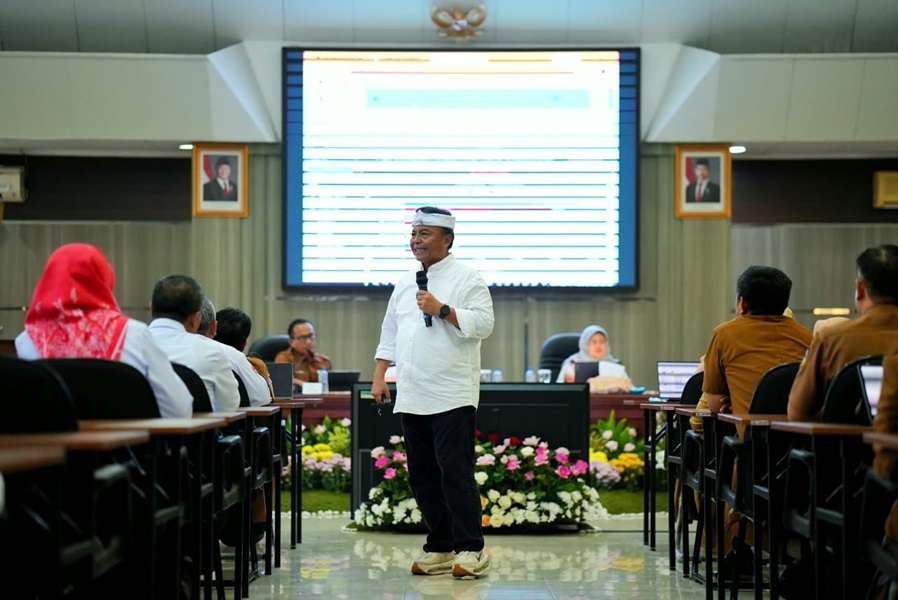
"Next week, we will invite all sub-district heads in West Java. Furthermore, the sub-district heads, along with cross-sectoral groups, will educate village heads and urban village heads throughout West Java. We will even form a team to hunt for out-of-school children in villages," Herman said at the Education Coordination Meeting at the Dewi Sartika Hall, West Java Provincial Education Office, Bandung City, Monday (12/10/2026).
According to Herman, the approach to children who do not attend school must begin with understanding the real conditions of the family, not simply concluding that the child or his parents do not have the desire to attend school.
He believes that economic issues, the demands of helping parents with work, and even disabilities can hinder children's access to education. Therefore, the government must provide solutions tailored to the needs of each family.
"Don't just think, 'Why aren't they in school?' We need to understand the circumstances. Some children have to help their parents farm or trade, some families need assistance, and some children have disabilities. The situations are varied," he said.
Herman believes that the majority of children's out-of-school issues can be addressed if the government offers flexible solutions tailored to family circumstances. One such approach is through Community Learning Centers (PKBM) and equivalent education packages, Package A, Package B, and Package C.
According to him, more flexible study times, including on weekends or outside of working hours, can be an alternative for children who have difficulty attending formal education.
"If offered creative and flexible solutions through community development programs (PKBM) or equivalency education, I think they'd be willing. I've visited several families whose children aren't attending school, and when I talked to them and offered solutions, they were willing," he said.
Therefore, Herman urged district/city education office heads to go beyond data collection and administrative reporting. They must go directly to families, understand the social conditions in the community, and ensure every child has a path to return to learning.
He also established an escalation mechanism if issues remain unresolved at the lower level. If district/city government efforts fail, the issue must be reported to the Head of the West Java Education Office for immediate action. If this remains unresolved, Herman stated he is ready to intervene.
"If the district/city head is unable to resolve the issue, report it to the Head of the West Java Education Office. If they still can't, report it to me. I will intervene directly. Which parents refuse to allow it, which children refuse to go to school? Show me the data, and I will intervene," he asserted.
Herman emphasized that successfully addressing the issue of out-of-school children requires the courage of officials to directly assess the community's situation. He stated that tiered reporting should not be used as an excuse to delay resolving issues that could be addressed through coordination and appropriate approaches.
"This is a constitutional duty. The heads of district/city departments must be directly involved and assess the families' and community's psychological well-being. As the Regional Secretary, I am also ready to be involved. If the governor is willing to go down to investigate and facilitate problem resolution, why shouldn't we at the executive level do the same?" he said.
He also asked all heads of district/city education offices in West Java to make handling children out of school a real responsibility, not just a target on paper.
Herman emphasized that local governments must demonstrate results through case investigations, family support, and child placement in appropriate educational pathways. If there are any obstacles, they must be communicated openly so that solutions can be found.
 Share News Via
 facebook
 twitter
 whatsapp
 email
email