

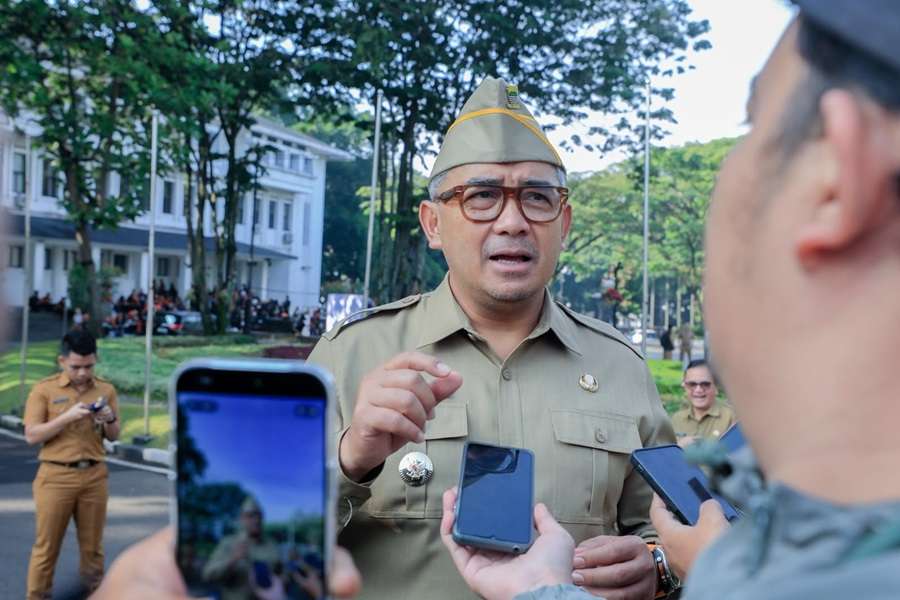
PORTALJABAR, BANDUNG CITY - Bandung Mayor Muhammad Farhan said the 2026 Economic Census will be the compass for Bandung City's development in the next decade.
Through accurate and comprehensive data, the government can formulate targeted policies to encourage economic growth, improve public welfare, and address various development challenges in the future.
Farhan made this statement at the launch of the 2026 Economic Census at Bandung City Hall Plaza on Monday (June 15, 2026). The event marked the beginning of preparations for the national economic census, which will be conducted by the Central Statistics Agency (BPS).
According to Farhan, the economic census, which is conducted every 10 years, has a strategic role because it forms the basis for formulating various macroeconomic development assumptions, both at the regional and national levels.
"Macroeconomic development assumptions must be based on the results of the census, which is conducted every 10 years, while we collect annual data to monitor various developments," he said.
He believes that successful development is inseparable from the availability of quality data. Therefore, all government policies must be formulated based on facts and real conditions on the ground.
Farhan stated that Indonesia, as a great nation, must continue to move forward by utilizing data as the primary foundation for decision-making. An evidence-based development approach, or evidence-based policy, is a non-negotiable necessity.
"Policies and development based on data or evidence-based must be carried out through good and systematic data collection," he said.
He explained that the 2026 Economic Census will capture a comprehensive snapshot of the condition and development of the business world in Indonesia. This data will serve as a crucial reference for the government in formulating more effective economic development strategies that are responsive to changing times.
Furthermore, Farhan continued, Bandung is currently facing quite complex economic dynamics. As a center of trade, services, education, and tourism in Indonesia, Bandung is required to adapt to the rapid changes taking place.
On the other hand, Bandung's economic performance is showing a positive trend. Farhan stated that Bandung's current economic growth is in line with national economic growth and has increased compared to the previous year.
"Now we're at around 5.75 to 5.76 percent. This is a significant increase compared to the previous year, when it was still below 5 percent," he said.
Even in the first quarter of 2026, Bandung City's economic growth was recorded at around 5.75 percent. According to him, this achievement demonstrates that various development and economic strengthening policies implemented by the government and stakeholders are beginning to show positive results.
"This proves that economic development and growth in Bandung City are proceeding in a unified, integrated manner, and are producing optimal results," he said.
However, Farhan emphasized that these achievements must be maintained and improved. One potential momentum with the potential to significantly impact Bandung's economy is the planned reactivation of Husein Sastranegara International Airport.
He welcomed the plan, saying it could open up new opportunities for the tourism, trade, investment, and services sectors. However, he noted that the resulting economic benefits would not come automatically without careful planning.
"We are awaiting the reactivation of Husein Sastranegara Airport, which is expected to be a driver of economic growth," he said.
Farhan explained that the current state of the aviation industry is different from before the pandemic. Rising aviation fuel prices, expensive airline tickets, and changing travel patterns are factors that will impact future airport development.
Therefore, the government must prepare a data-based development strategy so that every economic opportunity that arises can be optimally utilized.
"This momentum isn't a windfall. It must be capitalized on through sound planning based on accurate data and sound analysis," he said.
To ensure the success of the 2026 Economic Census, Farhan instructed all regional apparatus, sub-districts, villages, and territorial units such as neighborhood associations (RT) and community associations (RW) to actively disseminate information and support the census implementation needs.
He also invited entrepreneurs, micro, small and medium business actors, and the entire community to participate by providing correct and complete data to census officers.
"I instruct all regional, sub-district, and village officials, and urge all neighborhood association (RW) and neighborhood association (RT) heads, entrepreneurs, and other business actors to coordinate, conduct outreach, disseminate information, and facilitate the implementation of the 2026 Economic Census," he said.
On the same occasion, Farhan expressed his appreciation to the Bandung City Statistics Agency (BPS), which has been an important partner of the government in providing accurate and reliable statistical data.
He hopes that BPS will continue to maintain independence, professionalism, and integrity in implementing the census so that the resulting data can truly become a foundation for the development of Bandung City for the next 10 years.
"We believe that good development must be supported by quality data and evidence-based policies. Let's work together to make the 2026 Economic Census a success," he said. (Bandung City Communications and Information Office)
 Share News Via
 facebook
 twitter
 whatsapp
 email
email